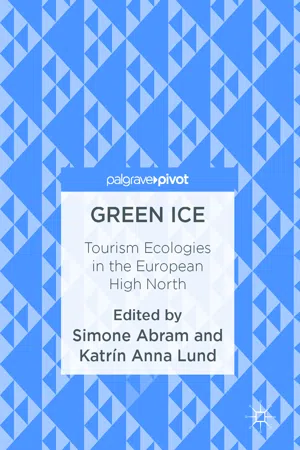
eBook - ePub
Green Ice
Tourism Ecologies in the European High North
- English
- ePUB (mobile friendly)
- Available on iOS & Android
eBook - ePub
Green Ice
Tourism Ecologies in the European High North
About this book
This book presents lively case studies of tourism developments in the European High North from diverse perspectives. It compares views of the changing political ecology of a fragile region shaped by climatic and cultural factors. In exploring the mutual relations between new developments in Arctic travel narratives and tourism practices. Green Ice: Tourism Ecologies in the European High North pays particular attention to the changing discourses that produce, and are in turn produced by, encounters between contemporary Arctic peoples and territories. Questions of gender and nationality are considered alongside a comparison of texts and practices in different languages, examining the politics of language and its significant role in tourism. This title pays attention to the changing symbolic value of Arctic discourses in environmental movements, in order to consider the close connections between global forms of environmentalist discourse and action and local cultural responses. Anengaging and timely work, this book will be of great interest to scholars of Geography, Anthropology, and Arctic Tourism.
Information
© The Author(s) 2016
Simone Abram and Katrín Anna Lund (eds.)Green Ice10.1057/978-1-137-58736-7_11. Green Ice? Tourism Ecologies in the High North
Simone Abram1 and Katrín Anna Lund2
(1)
Durham University, Durham, United Kingdom
(2)
University of Iceland, Reykjavik, Iceland
Abstract
Tourism has been expanding rapidly in the European Arctic alongside growing international interest in the Arctic as a site of extreme, palpable climate change. This chapter explores the idea of tourism ecologies, tracing the development of tourism in the European High North in its colonial contexts, and highlighting the tourism narratives that help to sustain Arctic ecotourism. We ask what entices people to travel from afar to experience something called ‘the Arctic’, what they might be expecting, and how it is promoted and performed in practice. What idea of Nature is it that sustains this tourism, and how are the people of the European Arctic imagined, from inside and out? The chapter outlines the ecologies of this tourism, looking beyond the notion of a natural Arctic, and considering the many people, places and things that come together to make Arctic tourism possible. In the current forms of tourism development in the European High North, we see echoes of earlier colonial images and practices, but we also see attempts to learn from past mistakes that may help to redefine tourism development and reinvent tourism for an ecological future. The chapter thus situates the current growth in Arctic ecotourism in relation to postcolonial European narratives, introducing the chapters that follow.
Keywords
European High NorthArctic ecotourismPostcolonial ArcticTourism ecologiesSápmiGreenlandIcelandSimone Abram
is a Reader at the Department of Anthropology at Durham University, UK. Research reported in this volume was conducted while she was Reader at Leeds Beckett University, UK. Her books include Media, Engagement and Anthropological Practice (2015, with Sarah Pink), Elusive Promises: Planning in the Contemporary world (2013, with Gisa Weszkalnys), Culture and Planning (2011), Anthropological Perspectives on Local Development (1998, with Jacqueline Waldren) and Tourists and Tourism (1997 with Jacqueline Waldren and Donald MacLeod).
Katrín Anna Lund
is an anthropologist and professor in the Department of Geography and Tourism at the University of Iceland. Her research is on landscape, narratives and modes of travelling in southern Spain, Scotland and Iceland. Her recent work focuses on destination making and winter tourism in Iceland.
Tourism in the Arctic regions is expanding rapidly in both scale and scope. Where once intrepid travellers set out on well-equipped expeditionary tours, today’s tourists can glide through Arctic waters on luxury cruise ships or fly from destination to destination, living the Arctic tourism product they were sold in anticipation of their actual journey. Tourism has been seen as a primary target for economic development in many peripheral regions, and all of the European Arctic nations have prioritised tourism in recent years. But tourism has consequences, some perhaps surprising, which have to be considered. In this chapter, we introduce ideas about tourism ecologies in the European High North, outline the key concepts and set an agenda for new tourism research, laying the ground for the chapters that follow.
Our title ‘Green Ice’ gently pokes fun at the idea of Arctic ecotourism. As many commentators have observed, for people outside the polar regions the word ‘Arctic’ often conjures visions of sparkling snow and ice, startling blue skies and an overall impression related to the concepts ‘clean’, ‘untouched’ and, of course, ‘cold’. Arctic tourism itself retains much of the spirit of the expedition for many tourists, with all its associated visions of wilderness and the exotic sublime (Oslund 2005; Oslund 2011; Sæþórsdóttir et al. 2011). The promotion of tourism in European Arctic regions leans particularly heavily on such imagery, adding in icebergs, polar bears and other Arctic wildlife, as well as the stock images of tourism promotion—luxury-tinged hotels and occasional indigenous colour. Of course, that is not the whole story, and one aim of this book is to show what else Arctic tourism is in the European region, how it is changing and what some of the consequences are for people who live and work in the relevant regions. Contrary to the kind of imagined frozen Arctic of the tourism brochure world, many people do live and work in the European High North, in Arctic and sub-Arctic zones, which extend relatively far South into Scandinavia, depending on which of the various definitions of ‘Arctic’ are being used. For this book, we have referred to the European High North, an area that extends from around the Arctic Circle northwards, also incorporating Iceland, but we are not including the Russian North in our discussion. This is mainly for pragmatic reasons, since the book reports primarily on recent research on ecotourism in Norway, Iceland and Greenland, but we also reflect on related regions in the broader context of polar tourism, including a comparison with Antarctic tourism (see the Afterword to this volume).
Our particular focus is already a broad area that encompasses land and sea that is Nordic, Scandinavian, Sámi and Inuit—but not necessarily in that order. The order matters, not least because these are places that need to be considered in relation to various phases and forms of colonialism. The sister volume to this one, subtitled ‘Unscrambling the Arctic’, includes a more detailed discussion of the claims and merits of the idea of the ‘postcolonial’ (Huggan and Jensen 2016) that complements the discussions here, but the political contest around defining, claiming and exploiting Arctic resources is central to all the following discussions. The broader context is thus the rising clamour about the fate of the Arctic in a time of global climate change, with increased pressure for resource extraction, bubbling tension over sovereignty claims and a rapid expansion in industrial activity in all sectors, not least mineral and fuel extraction, and tourism activities.
The political ‘heat’ building around Arctic issues is spreading well beyond the countries whose coasts border the Arctic oceans (see Roussel and Fossum 2010). Since the Arctic Council was founded in 1996 in the wake of the end of the cold war, its work as a high-level forum has gradually given substance to the idea of the Arctic as a region. Yet the tension over who belongs to the Council, and who should have rights or claims on Arctic resources, continues to bubble. The role of indigenous organisations acknowledges the tensions related to what Martello calls ‘Arctic citizenship’ (Martello 2004), but is hardly straightforward. These organisations are acknowledged as ‘permanent participants’, but their status is not equal to the ‘member states’ who make up the council. The Arctic littoral states are continually testing their rights over the extended continental shelf through the auspices of the United Nations Convention on the Law of the Sea (UNCLOS),1 and there is pressure at every Arctic Council ministerial meeting to negotiate the status of other interested parties as observers. China and Korea were allowed to be ad hoc observers in 2009 but their applications to be permanent observers were declined. By 2013 a different approach was reached, with a new ‘manual’ clarifying observer status, including the requirement to support the Council’s objective and respect its authority. At this point, 11 countries were given permanent observer status, including France, Germany, the Netherlands, Poland, Spain, the UK, China, Italy, Japan, Korea, Singapore and India. The claims of China and India to have interests in the Arctic may be as much about neighbourly rivalry as resource interest (Chaturvedi 2013), but the diverse list of countries indicates the broadening awareness of the potential of the Arctic as a global political space as well as a source of valuable resources. Ironically, of course, it is the very changes in climate that threaten to do so much damage in the Arctic area that make it attractive to states and industries around the world; through the promise of increasing access to navigation and resources as the ice sheet retreats. This same paradox shapes the growing Arctic tourism industries, as greater sea access and heightened awareness of environmental fragility feed a growth in cruise tourism across the Arctic, particularly in the European High North, across into western Greenland (see Bjørst and Ren, 2015) and northern Canada and now into Russian waters too.
The expansion in tourism activities is our focus in this volume. All around the world, tourism has been on the rise since the end of the Second World War. As traditional subsistence livelihoods have become increasingly fragile, and manufacturing industries have become increasingly footloose, communities, corporations, nations and associations have looked to tourism as an alternative opportunity. Tourism appears to promise economic redistribution, new livelihoods or ways to maintain traditional livelihoods and artisanal production, with the added promise of personal fulfilment, social contact, and opportunities to experience new people and places, as well as familiar ones. Tourism, in fact, is so broad a category that it is commonly described as an ‘industry’, thereby incorporating everything from sales trips to visits to weekend cottages or even days out shopping. In the ‘industry’ sense, definitions of tourism usually refer to travel, accommodation, consumption and visiting, and all the networks and facilities that enable those things to happen (see Abram 2010). But tourism has also been described as a way of experiencing the world, closely linked to colonial history, science, politics and religion (Urry 2001; Mitchell 1991; Graburn 1977). Once we acknowledge that tourism revolves around the generation and satisfaction of particular desires that are grounded in particular conditions of politics, economics, society and nationalism (Franklin 2004), the notion of tourism rears up as a rather peculiar object of study. It prompts us to ask why people want to travel from afar to experience something called ‘the Arctic’, and what they make of it when they get there, or after they return. And what do these tourist desires have in common with those of the people who live in the European High North, and how do these various desires and their effects interact? Despite quite extensive research on the global Arctic, attention to tourism in the European High North is still emerging, and forms the core of this volume.
The Voyage North
Tourism to the European Arctic regions is not new, and its history remains present today, underlying much of the style and content of contemporary tourism. Hall and Johnston, who have done so much to establish Polar Tourism as a field of study, remarked back in 1995 that the world’s polar regions were thriving tourism frontiers. While they identify Antarctic tourism dating back to the 1960s, Arctic tourism has a much longer history (Hall and Johnston 1995). Viken (1995) refers to the first organised commercial tours to Svalbard (Spitsbergen) in 1871, and by the 1890s there were regular tourist routes from Norway, in the early days of organised travel. But organised tourism always follows on from prior journeys, either by traders, explorers, colonisers, missionaries or others, and the European High North is no exception. Steen Jacobsen (1997), for instance, traces the current status of North Cape in northern Norway (Finnmark) back to the British Willoughby Expedition that sought the north-east passage to China in 1553.2 Maps made by Richard Chancellor on his return from the voyage marked the North Cape out as a landmark, and his maps provided a vision of the periphery of the European known world of the time. By 1664, Francesco Negri was extolling the experience of reaching the end of the world at North Cape, enabling him to look forward to returning home satisfied (Ibid.) and just over a 100 years later, books were being published with images of the North Cape headland. By 1875, after a string of famous and royal visitors, Thomas Cook was offering tours to North Cape, with regular steamships following from 1877 and the coastal steamer (Hurtigruten) plying the coast from 1893 and carrying tourists even then.
The history of Europeans travelling north is dominated by discourses of exploration and discovery, and by external accounts of heroic adventures (Ryall et al. 2010). These accounts remain current, repeatedly reinvented through contemporary travel writing, travel company brochures and advertising campaigns (Oslund 2005; Sæþórsdóttir et al. 2011; Lund 2013). Only in the last year (2014/2015) has the Greenlandic tourism agency redefined its advertising strategy away from the ‘white hero explorer’ narrative towards a more inclusive, less colonial-style outdoor adventure theme (see chapter 4). For Ryall et al. (2010), post-romantic era texts (i.e. since the mid-nineteenth century) repeatedly return to fixed motifs, with the Arctic typically imagined either as an icy hell or an earthly paradise, the latter vision now seen as threatened by human influence rather than the extreme climate. These images inform elements of the historical perception of the Arctic which circulate in tourism contexts, w...
Table of contents
- Cover
- Frontmatter
- 1. Green Ice? Tourism Ecologies in the High North
- 2. Responsible Cohabitation in Arctic Waters: The Promise of a Spectacle Tourist Whale
- 3. Chasing the Lights: Darkness, Tourism and the Northern Lights
- 4. Greenland, My Greenland—Accessing Greenlandic History, Identity and Nation-building through its Nation-branding Strategy, a Tourist Website and 247 Comments
- 5. Afterword
- Backmatter
Trusted by 375,005 students
Access to over 1.5 million titles for a fair monthly price.
Study more efficiently using our study tools.
Frequently asked questions
Yes, you can cancel anytime from the Subscription tab in your account settings on the Perlego website. Your subscription will stay active until the end of your current billing period. Learn how to cancel your subscription
No, books cannot be downloaded as external files, such as PDFs, for use outside of Perlego. However, you can download books within the Perlego app for offline reading on mobile or tablet. Learn how to download books offline
Perlego offers two plans: Essential and Complete
- Essential is ideal for learners and professionals who enjoy exploring a wide range of subjects. Access the Essential Library with 800,000+ trusted titles and best-sellers across business, personal growth, and the humanities. Includes unlimited reading time and Standard Read Aloud voice.
- Complete: Perfect for advanced learners and researchers needing full, unrestricted access. Unlock 1.5M+ books across hundreds of subjects, including academic and specialized titles. The Complete Plan also includes advanced features like Premium Read Aloud and Research Assistant.
We are an online textbook subscription service, where you can get access to an entire online library for less than the price of a single book per month. With over 1.5 million books across 990+ topics, we’ve got you covered! Learn about our mission
Look out for the read-aloud symbol on your next book to see if you can listen to it. The read-aloud tool reads text aloud for you, highlighting the text as it is being read. You can pause it, speed it up and slow it down. Learn more about Read Aloud
Yes! You can use the Perlego app on both iOS and Android devices to read anytime, anywhere — even offline. Perfect for commutes or when you’re on the go.
Please note we cannot support devices running on iOS 13 and Android 7 or earlier. Learn more about using the app
Please note we cannot support devices running on iOS 13 and Android 7 or earlier. Learn more about using the app
Yes, you can access Green Ice by Simone Abram, Katrín Anna Lund, Simone Abram,Katrín Anna Lund in PDF and/or ePUB format, as well as other popular books in Social Sciences & Hospitality, Travel & Tourism Industry. We have over 1.5 million books available in our catalogue for you to explore.