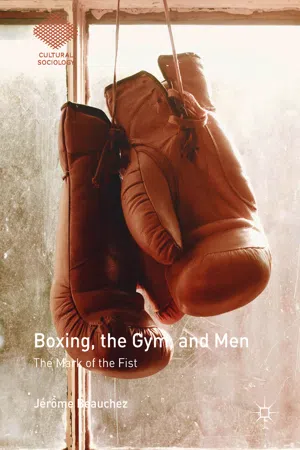
This book explores the lived experiences of boxers in a French banlieue, largely populated by people from working-class and immigrant backgrounds. Jérôme Beauchez, who joined in the men's daily workouts for many years, analyzes the act of boxing as a high-stakes confrontation that extends well beyond the walls of the gym. Exploring the physical and existential realities of combat, the author provides a multifaceted "thick description" of this world and shows that the violence faced by the gym's members is not so much to be found in the ring as in the adversity of everyday racism and social exclusion. Boxing can therefore be understood as an act of resistance that is about more than simply fighting an opponent and that reflects all the existential struggles facing these men who are both stigmatized and socially dominated by race and class.
- English
- ePUB (mobile friendly)
- Available on iOS & Android
eBook - ePub
About this book
Information
In Private: Where the Blows Resound
© The Author(s) 2018
Jérôme BeauchezBoxing, the Gym, and MenCultural Sociologyhttps://doi.org/10.1007/978-3-319-56029-8_11. The Stranger: Portrait of the Boxer as a Young Man
Jérôme Beauchez1
(1)
Centre Max Weber, Université de Lyon, Saint-Etienne, France
Estville’s northern suburbs. The main street is the symbolic boundary of a maze of buildings that it slices through from one end to the other. On one side, as the crumbling concrete continues to deteriorate, the engines of accelerating scooters compete for sonic space with the din of young people who never leave, as if the neighborhood’s existence depended on them. On the other side, the buildings are a bit nicer. Their lawns are kept up and their walls less coated with graffiti. Here, workers still live—on the “right” side of the street, where most people still have jobs. When he arrived from La Réunion at age ten, Chuck first lived across the street, before he and his family moved here, to the better side—to this liminal space where, even as the projects are kept at a distance, they are never far away.
The Boxers’ Microcosm
The boxer opened the door, welcoming me with a broad smile, moments after I rang his feeble buzzer. It is Saturday, May 12, 2001. He is expecting me for an interview. Recording it will help me to retrace the steps that brought him to the ring, from the time he started as an amateur a dozen years ago to the moment he became a professional and competed for his first national title. Because his chances are good, Chuck does not skimp on effort. In addition to spending all day at the factory, every morning, he runs the kilometers he needs to build up his endurance and strengthen his legwork , which he practices every evening at the gym.
A “Neighborhood” Accent
As I set up the recording equipment, his usual good-naturedness seems to fade. Something is worrying him, I sense. He keeps it inside for a while, and then finally bursts out:
Chuck:
We talked about it at the gym and all, but listen, who’s going to hear this? I mean, what you’re going to record and all?
Me:
“What I’m recording? Like I said, just me! I’m recording it because I can’t remember it all and if I write it down while you talk, then it’s not really a conversation anymore … So the tape, it’s a way of remembering what you said. That’s all! A guarantee, you could say, to make sure I don’t distort your words and then write bullshit. But that’s it. Trust me. It won’t be played for anyone else!”
Chuck:
“No, look, I trust you. The thing is … You see, if some people hear my voice, they’re going to say to themselves: “Where’d this guy come from? Listen to how he talks!” I know they will. Because, I mean, let’s be honest. I do have the neighborhood accent. And I dropped out of school in eighth grade, so, you know, I’m not very educated and all. Sometimes, I find it hard to find the right words … And I’m not always sure they’re right! [Laughs.] But look, seriously, when they hear me, I don’t want people to think boxers are dumb, or scum, or whatever … Because you know as well as I do that’s not how it is, is it? I mean, it’s bad enough that they say the Gants d’Or is full of foreigners: rebeus [Arabs], renois [blacks] and guys from the neighborhood. There’s no need to keep piling it on!”
Far from being a dominated subject who has so deeply internalized the “neighborhood’s” dispositions—its linguistic habits and distinctive form of self-presentation—that they unwittingly betray him, Chuck understands what speaking means. In any case, he knows enough to anticipate the stigmatizing labels that might be attached to his banlieusard inflections. When he is outside his own milieu, his speech is just one social stigmatism that “sticks”—to the way one talks, appears, and simply exists—to those who grew up on the “bad” side of the street, where immigrant origins and harsh living conditions overlap. As Chuck points out, the Gants d’Or cohort is made up of rejects from the concrete towers. Though they realize that these prejudices could tarnish their image as fighters, it is nonetheless on this basis that, each day, the boxers try to give value to who they are.
A “Foreign” Body?
Within the boxers’ diasporic microcosm, a wide range of “foreign” spaces take form and become intertwined. Their fists stretch out like the shoots of an uprooted America, Africa, or Middle East that was never really given a chance to take root in France. After all, “they” all say that the gym consists of nothing but immigrants. By dwelling on this fact, are “they” reducing the Gants d’Or boxers to a stigmatized Other? Do these uncanny foreigners want to beat up respectable society? Chuck and his friends know what it means to have this kind of reputation all too well. It is carved like a bas relief onto the buildings of the impoverished neighborhoods where they were raised; it is coarsely painted on walls that began to crumble when they were abandoned by the laboring classes which, slowly but surely, became dangerous classes. 1 Along these walls, the boxers’ spray-painted portraits, with their dazzling colors, seem like an act of vengeance against the drab concrete.
Seen up close, in the flesh , it becomes apparent that these fighters’ faces are those of young men who are immigration’s heirs. Their stories too are written here: along these facades, along all these buildings, which, as if afflicted by some kind of architectural stutter, we insist on calling the banlieues, a term that leads to endless misunderstanding. Since becoming the focus of innumerable accounts of the “republican impasse,” 2 everything would seem to suggest that they have become sites of exclusion. The threshold effects of these spaces now seem to consist in constant to and fro between misery here and the disillusioned loss of a “there.” And as the challenges of proximity become intertwined with the negative signs of remoteness, this particular way of being neither here nor there inflicts on those who embody it the identity-related anxiety that Georg Simmel described as characteristic of “the stranger.” 3 An affliction arising from separation, this term connects the experience of exile, stigmatization, and devaluation that Chuck and his friends experience on a daily basis.
At the Gym: Among One’s Own?
In One’s People’s Name
The esprit de corps experienced by the Gants d’Or boxers functions as a kind of body armor: it creates sense of belonging that dispels the strangeness that each, in his own way, feels in his flesh —the flesh that, by working out at the gym, they try to make stronger and harder. Every aspect of training constantly brings flesh into contact with leather. This living matter on which the blows are beaten out gives the Gants d’Or its reality, while the activity that seems to rebound from one body to another constitutes its history. It is the story of all those who have carried the gym’s name into the ring, whether or not they left a visible trace on its walls. Its décor, it must be said, rather stubbornly ignores their existence. Unlike most boxing gyms, which, like Chinese banners, proudly display posters chronicling the adventures of local fighters, none of the boxers trained by Luis, the Gants d’Or trainer, appear in the photographs surrounding its ring. Yellowing with age, these posters, dating from the 1980s, present, rather, the past glories of another boxing cohort, whose name is written all over: the Pugilistic Circle of Estville.
What makes this earlier cohort different is that, unlike the Gants d’Or, which brings together people from all kinds of elsewheres, it was, in fact, from here. During the nearly 30 years it existed (1970–1988), the Circle brought together the sons of the working class the old fashioned way: its members were workers and craftsmen who were “native-born Frenchmen,” according to René D., its lifelong president. This former boxer and sergeant—an “army boss,” as he likes to call himself—was recruited to run the gym in 1972. He did not leave until he and his trainer, Fernand R., concluded that their boxers’ faces had become unrecognizable. With the likes of Luis and the men of the Gants d’Or, the offspring of the indigènes (indigenous peoples) who had invaded the country, the newcomers were taking over the Circle and boxing, in general, by storm. In these circumstances, what was left for the sergeant? And what had become of Marcel Cerdan, whose face had the reassuring look of a boxer who felt very much at home?
The Indigène and the Sergeant
Monday, February 19, 2001. I was preparing to listen to what René D. had to say, when I was summoned to his apartment downtown. The entry hall was full of sporting trophies, cups, and fight pictures. In the middle hung a portrait of Charles de Gaulle. When René D. saw that my gaze had lingered on it, he acknowledged it with the brisk admiration of military conviction: “le Général!” In his eyes, this fighter seemed to explain many things, most of which went beyond boxing. Presumably, the portrait had been aging on his door for several decades. It was simultaneously severe and serene, overseeing the passageway and its rights—the very rights he strove to defend at the Pugilistic Circle of Estville. De Gaulle, as if he were representing, in miniature, the very France whose integrity he sought to preserve, seemed to cling to the wall as though it were a border protecting the country’s fine young men. René D. was not afraid to say it: “There was a real paternal spirit at the Circle … We had kids and their parents; there was a family structure” (excerpt from the recorded interview). Among these butchers, bakers, and other workers, René D. had become an “actor of his own ideal,” 4 willingly assuming the role of symbolic father charged with instilling an esprit de corps.
With the trace of a satisfied smile still lingering on his lips as his recollections of good times came to an end, the face of the Circle’s former president suddenly darkened. His kindly voice became scornful and gruff:
Family is through! I’m no more racist than the next guy! Especially because I was a soldier for twenty-three years […] so I knew lots of people who were foreigners […]. And anyway, there’s no place for that in sports! There’s place for it when those people don’t make an effort, don’t recognize the existing rules, period. […] No one knows these people! What posters would you put up? […] 90% of boxing in France now is North African, nothing can be done about it. 90%! Then there’s 7% from the island countries, and the rest are Spaniards, Turks… There aren’t many native-born Frenchmen, huh? That’s what we felt, that’s what we… That last two-three years, we barely held on, huh? (ibid.)
From One Training Room to Another
Norbert Elias spoke of the “complementarity of group charisma (one’s own) and group disgrace (that of others),” adding that it is “one of the most significant aspects of the type of established-outsider relationship .” 5 It encompasses, according to Elias, the exacerbation of differences relating to origin and skin color. The latter are nothing more than a visible but secondary way of fixing the primary malaise experienced by the dominant group with the rise of the dominated. 6
The Circle’s Center and Periphery
Regardless of the ideology it publicly embraces—equal opportunity or an avowed refusal of discrimination of all kinds—sports has no inherent qualities allowing it to extricate itself from the established-outsider dynamic. Whatever the enthusiasts of the view that sports can lead to social integration might say, 7 the sense of belonging, at the gym as elsewhere, typically leads people to cling jealously to their definitions. They protect this feeling by erecting symbolic boundaries that differentiate “us” from “them”—that is, all the Others who come from elsewhere and “share nothing” with us (as René D. puts it), thus threatening a territory founded on a certain common sense (and sense of the common).
Caught in a genuine struggle over the definition of legitimate boxing practices—the old guard versus the newcomers—the Circle thus grappled, in its own way, with the effects of the migratory movements that have reshaped France’s working classes. Contributing to the racialization of France’s “new social question,” 8 its leaders have underscored the strangeness of this transformation. It was personified by Luis and his boxers. As modernity was precipitating the Circle’s collapse, the “natives” of the Gants d’Or were storming its gates. With virtually no one left to represent Estville’s old boxing guard, the town hall imposed a minor revolution: the gym had to be shared with Luis’s group, a rapidly expanding new cohort of boxers. This was the last straw: the Circle was disbanded by its founders. Ever since, the Gants d’Or would seem to be the masters of the house. Yet its members remain cautious, as if they were reluctant to consider the old guard’s space their own.
Two Faces of the Working-Class World
Like people who are just passing through, Luis’ boxers live amid the traces of a past that is not their own. Nothing ha...
Table of contents
- Cover
- Frontmatter
- 1. In Private: Where the Blows Resound
- 2. Facing the Other: Trials of the Self
- Backmatter
Trusted by 375,005 students
Access to over 1.5 million titles for a fair monthly price.
Study more efficiently using our study tools.
Frequently asked questions
Yes, you can cancel anytime from the Subscription tab in your account settings on the Perlego website. Your subscription will stay active until the end of your current billing period. Learn how to cancel your subscription
No, books cannot be downloaded as external files, such as PDFs, for use outside of Perlego. However, you can download books within the Perlego app for offline reading on mobile or tablet. Learn how to download books offline
Perlego offers two plans: Essential and Complete
- Essential is ideal for learners and professionals who enjoy exploring a wide range of subjects. Access the Essential Library with 800,000+ trusted titles and best-sellers across business, personal growth, and the humanities. Includes unlimited reading time and Standard Read Aloud voice.
- Complete: Perfect for advanced learners and researchers needing full, unrestricted access. Unlock 1.5M+ books across hundreds of subjects, including academic and specialized titles. The Complete Plan also includes advanced features like Premium Read Aloud and Research Assistant.
We are an online textbook subscription service, where you can get access to an entire online library for less than the price of a single book per month. With over 1.5 million books across 990+ topics, we’ve got you covered! Learn about our mission
Look out for the read-aloud symbol on your next book to see if you can listen to it. The read-aloud tool reads text aloud for you, highlighting the text as it is being read. You can pause it, speed it up and slow it down. Learn more about Read Aloud
Yes! You can use the Perlego app on both iOS and Android devices to read anytime, anywhere — even offline. Perfect for commutes or when you’re on the go.
Please note we cannot support devices running on iOS 13 and Android 7 or earlier. Learn more about using the app
Please note we cannot support devices running on iOS 13 and Android 7 or earlier. Learn more about using the app
Yes, you can access Boxing, the Gym, and Men by Jérôme Beauchez in PDF and/or ePUB format, as well as other popular books in Social Sciences & Anthropology. We have over 1.5 million books available in our catalogue for you to explore.