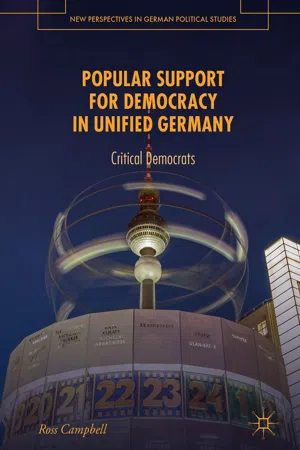
This book examines attitudes towards democracy in the Federal Republic of Germany. By drawing on extensive survey evidence, it charts Germans' changing views of the political system prior to and following unification. The study examines four aspects of the political system: how it functions overall, attitudes towards the Basic Law, trust in representative institutions, and views of the European Union. Rather than accepting or rejecting democracy, the research shows how Germans merge shades of criticism and support. In addition, it pinpoints the factors that condition support, showing how it is influenced by durable and changeable stimuli. Overall, the findings challenge suggestions of a crisis of democracy but they also demonstrate that support is particularly low towards aspects of the European Union. This book appeals to readers interested in public opinion and democracy in Germany, along with those interested in the changing relationship between citizens and the state.
- English
- ePUB (mobile friendly)
- Available on iOS & Android
eBook - ePub
About this book
Information
© The Author(s) 2019
Ross CampbellPopular Support for Democracy in Unified GermanyNew Perspectives in German Political Studieshttps://doi.org/10.1007/978-3-030-03792-5_11. Introduction
Ross Campbell1
(1)
School of Media, Culture and Society, University of the West of Scotland, Paisley, UK
Thomas Mann, winner of the Nobel Prize for literature in 1929, was famously sceptical about the prospects of establishing democracy in Germany. Mann traced Germany’s ‘democratic problem’ to the public’s aversion for politics and their admiration for the Obrigkeitsstaat—an authoritarian state detached from society without popular sovereignty.1 Although it was an undeniably bleak assessment, Mann’s pessimism was amply vindicated by the tragic breakdown of the Weimar Republic, the mass enthusiasm for National Socialism and the enormity and irrationality of the Third Reich. But in the century since his views were published, a critical paradox has emerged: few would question that German democracy has evolved into a model of stability; and yet research has repeatedly shown that it lacks the popular support upon which its stability depends.2 As support for aspects of democracy has drained away and been replaced with scepticism, acquiescence and indifference, it has challenged triumphalist claims that liberal-democracy is the final form of human government and strengthened the case for reform.3 Critical questions thus arise and justify fresh analysis. To what extent is there an emerging challenge to the traditional bases of political authority? And what conditions are most conducive to the development and maintenance of popular support? These are the central questions that this study aims to address.
This is a propitious time to answer them. There is consensus that political attitudes are one of the principal challenges confronting contemporary democracies, but scholars differ on which trends are the most important and what they mean.4 Interpretation is problematic. Academics emphasise the importance of ‘idealist’ support, which stresses citizens’ normative adherence to the values and goals underpinning democratic political systems—values and goals that may not yet be fully realised.5 This form of support is high, widespread and durable. Equally, national attachments are deep and tenacious, confirming that the emotional foundations of the political community are strong.6 Forms of non-democratic government, meanwhile, have been unequivocally rejected, demonstrating that whilst people may question aspects of democracy, the attraction of forms of authoritarianism is negligible. And as sizeable majorities affirm that democracy is the least worst form of political system, they confirm that it is a form of government to which there is no serious alternative.7 Viewed from this perspective, then, signs of discontent should not be overly embellished; they may be addressed through the normal channels of managing political conflict.
Another argument, however, points to numerous indications of disaffection, the depth and durability of which are giving cause for concern. At this level, scholars focus on ‘realist’ measures, emphasising the actual workings of democracy; i.e., the concrete institutions and real-life practice. The evidence is straight-forward. Satisfaction with democracy has eroded as Germans recognise—and are increasingly critical of—gaps between ideals and reality.8 In tandem, disaffection with aspects of representation suggests that linkages between citizens and representatives are waning and losing their affective base.9 Opprobrium towards elites, meanwhile, is pervasive and contrasts markedly with idealistic perceptions of them as custodians of a broader public service.10 Trust in democratic institutions, meanwhile, is low and shows no signs of recovering.11 And as the institutional picture centres on parliaments, it reveals that they are viewed more as theatres of illusions than as responsible democratic fora. In addition, a lack of deference towards political parties, civil servants and the media is ubiquitous and entrenched.12 And the symptoms are not isolated to the nation-state. Disaffection is equally manifest towards the EU—especially its institutions, elites and processes of citizen engagement.13 Overall, then, German public opinion, whilst characterised by inner reserves of support, has changed in a more critical direction.
Mapping these trends has been straight-forward but interpreting them as a whole has been more challenging. Abstracting from the dense thicket of linguistic convolutions, three viewpoints dominate.14 The first suggests that despite its difficulties, no alternative system commands significant public approval and support for a return to the pre-1989 arrangements is negligible.15 As Germans demonstrate durable, if qualified, attachments to democracy, it strains credulity to suggest that the polity is languishing in the midst of crisis.16 Disaffected democrats are not necessarily hopeful revolutionaries. A second interpretation suggests that disaffection is confined to institutions and elites and signifies a healthy critical zeitgeist.17 If the ideals of democracy clash with the deficiencies of its reality, disaffection is to be anticipated, particularly when centred on the competitive parts of the political process.18 Yet since Germans distinguish among and ascribe contrasting levels of support to key political objects, disaffection with the everyday reality exists in balanced tension with an adherence to democracy. And a third interpretation emphasises the persistence of the trends. As disaffection has endured despite alterations of government, elections have proven ineffective at alleviating it, which has compounded the problems by triggering deeper levels of criticism.19 Resolving which of these interpretations more closely corresponds to reality is no minor issue. They present one of the most formidable challenges to which governments must respond; and yet a meaningful response depends first upon a clear understanding of the challenge.
What, then, is the trajectory of support over time? Two scenarios dominate the literature. According to one line of argument, there has been ‘systematic erosion’, meaning that support has declined across a number of objects of the political system and that it has affected the vast majority of the population, albeit unevenly. The challenge for contemporary governments is thus formidable: the time-frame and nature of the change suggest that long-term factors have consigned the halcyon era of political deference to the past. As support may not easily be reclaimed, governments need to adjust to a low support environment and redesign aspects of democracy to provide more effective channels of citizen input. An alternative argument suggests that support exhibits ‘trendless fluctuation’, meaning that it ebbs and flows without definitive pattern. If the decline is temporary and less dependent on long-term factors, support should restore itself, making the need for democratic reform less urgent. Developments in German politics, however, provide reasons to anticipate a different scenario from either of those outlined. As Germany absorbed sixteen million people from the former German Democratic Republic (GDR) in 1989/1990, it set in motion far-reaching processes of social and political change which profoundly influenced how Germans viewed the institutions and agents of the state. Support in both parts of Germany was initially strong as easterners embraced their first democratic arrangements since the Weimar Republic. But, as the economic strain of rehabilitating the east became increasingly apparent, support drained away leaving scepticism. To what extent is this still the case? This part of the research not only underlines that the trajectory of support has practical implications for public policy, but it intersects with debates about the adaptability of post-communist citizens to democratic arrangements.20
An important part of the terms of reference for this study is thus set by the circumstances of the peaceful revolution of 1989 (Wende) and the legacy of German unification.21 Unification raised searching questions, the most important of which was would the Berlin Republic thrive or revert into a democracy without democrats? If its success depended, in part, upon reshaping eastern political culture to sustain democracy, developing support on the rubble of the GDR was a formidable exercise: the sobering history of forty years of socialist-authoritarianism provided precarious foundations for democratic government. Some anticipated that the acquisition of democratic values would be achieved incrementally, driven by the actuarial replacement of those socialised in the pre-1989 era.22 But there was a more optimistic scenario.23 As east Germans’ personal fortunes provided positive experiences of the market economy, so it would nurture support for the democratic framework in which it was located.24 And the initial evidence supported this. When aspects of liberal democracy were surveyed, easterners endorsed democratic values at surprising levels.25 Freedom of expression, the right to demonstrate and the right of parties to govern if elected received widespread support. And the acceptance of political conflict—and commitments to manage it within the democratic formula—were, if anything, slightly higher in the east. The evidence, then, confirmed that easterners began their experience of the new Germany with a set of values conducive to sustaining democracy. Equally optimistically, the levels of support were indistinguishable from the west.26 United Germany began with a united consensus.
But for some this was unconvincing. Support for democratic values during a transition is no guarantee that democracy will be accepted in the long-term. Initially, it may be supported because it is not the previous regime, but as people evaluate it on its own terms they may revise their views and take a more critical perspective. In addition, as easterners lacked familiarity with the intricate workings of western democracy, there was the possibility that their answers were superficial responses from Fragebogendemokraten (questionnaire democrats).27 Support may have been a mile wide, but was it an inch deep? At best, it was preliminary, possibly even no more than an indictment of the GDR, and conclusive judgements about its resilience had to be suspended.28 Equally, much of the early evidence rested upon an Anglo-Saxon model of democracy and analysed a limited battery of survey questions based upon it. Classic Lockean philosophy, supplemented by theorising by Robert Dahl, placed primacy upon the liberal elements of democracy, especially popular sovereignty, participation, the role of the opposition and the protection of minority rights.29 Whilst immensely important aspects, a number of theorists conceived of an equality dimension, designed to ensure that democracy did not revert into a system sustained by an elitist few. And when this was included in the surveys, it attracted greater support in the east compared with the west.30 The reduction of income differences, the rejection of poverty and the role of the private sector and the market economy constituted areas on which east and west Germans diverged in their...
Table of contents
- Cover
- Front Matter
- 1. Introduction
- 2. Theories of Popular Support for Democracy
- 3. Designing the Research: From Concept to Measures and Methods
- 4. Mapping Popular Support for Democracy in Germany
- 5. Evaluative Support and the Functioning of Democracy in Germany
- 6. Affective Support and Constitutional Patriotism
- 7. Trust in Democratic Institutions: Evidence and Explanations Beyond Unification
- 8. Trust in the EU and Governing Without Consensus
- 9. Popular Support and German Democracy; Resilience and Restoration
- Back Matter
Trusted by 375,005 students
Access to over 1.5 million titles for a fair monthly price.
Study more efficiently using our study tools.
Frequently asked questions
Yes, you can cancel anytime from the Subscription tab in your account settings on the Perlego website. Your subscription will stay active until the end of your current billing period. Learn how to cancel your subscription
No, books cannot be downloaded as external files, such as PDFs, for use outside of Perlego. However, you can download books within the Perlego app for offline reading on mobile or tablet. Learn how to download books offline
Perlego offers two plans: Essential and Complete
- Essential is ideal for learners and professionals who enjoy exploring a wide range of subjects. Access the Essential Library with 800,000+ trusted titles and best-sellers across business, personal growth, and the humanities. Includes unlimited reading time and Standard Read Aloud voice.
- Complete: Perfect for advanced learners and researchers needing full, unrestricted access. Unlock 1.5M+ books across hundreds of subjects, including academic and specialized titles. The Complete Plan also includes advanced features like Premium Read Aloud and Research Assistant.
We are an online textbook subscription service, where you can get access to an entire online library for less than the price of a single book per month. With over 1.5 million books across 990+ topics, we’ve got you covered! Learn about our mission
Look out for the read-aloud symbol on your next book to see if you can listen to it. The read-aloud tool reads text aloud for you, highlighting the text as it is being read. You can pause it, speed it up and slow it down. Learn more about Read Aloud
Yes! You can use the Perlego app on both iOS and Android devices to read anytime, anywhere — even offline. Perfect for commutes or when you’re on the go.
Please note we cannot support devices running on iOS 13 and Android 7 or earlier. Learn more about using the app
Please note we cannot support devices running on iOS 13 and Android 7 or earlier. Learn more about using the app
Yes, you can access Popular Support for Democracy in Unified Germany by Ross Campbell in PDF and/or ePUB format, as well as other popular books in Politics & International Relations & European Politics. We have over 1.5 million books available in our catalogue for you to explore.