Yochai AtariaBody Disownership in Complex Posttraumatic Stress Disorderhttps://doi.org/10.1057/978-1-349-95366-0_1
Begin Abstract
1. Introduction
Yochai Ataria1
(1)
Tel-Hai College, Upper Galilee, Israel
Yochai Ataria
End Abstract
1.1 When the Body Is the Enemy—Améry’s Basic Intuition
Jean Améry survived the concentration camps of Auschwitz and Buchenwald and was later liberated at Bergen Belsen. In 1978, he took his own life. According to his own testimony , his suicide cannot be detached from his experiences at the concentration and death camps. Indeed, these experiences led him to claim that only under torture does one experience the body for the first time as totally one’s own: “Whoever is overcome by pain through torture experiences his body as never before” and thus, “only in torture does the transformation of the person into flesh become complete” (Améry, 1980, p. 33).
More precisely, in extreme circumstances victims experience the body as being too much their own. They have a sense of over-presence , or in cognitive terms, their sense of body-ownership is too strong. In effect, not only do victims completely identify with their body, but also they are reduced solely to the body: “the tortured person is only a body, and nothing else beside that” (p. 33).
The main consequence of this reduction is that the individual identifies the body as the source of intolerable suffering and pain : “Body = Pain = Death” (p. 34). The main contention of this book is that this equation can trigger the development of a destructive cognitive mechanism which seeks to destroy the victim’s body as the source of suffering: “When the whole body is filled with pain, we try to get rid of the whole body” (Schilder, 1935, p. 104). Throughout the book, the term “body-disownership” is used to describe this cognitive mechanism. This book’s aim is to describe body-disownership on the cognitive and phenomenological levels and to demonstrate that this mechanism is responsible for the development of complex posttraumatic symptoms.
1.2 Disownership
Scholarly literature discusses disownership of body parts (de Vignemont, 2007, 2010, 2011, 2017), for example the case of somatoparaphrenia , defined as a “delusion of disownership of left-sided body parts” (Vallar & Ronchi, 2009, p. 533). Those who develop such a delusion strongly believe that a particular body part does not belong to them but rather to someone else. Another such condition, known as body integrity identity disorder (BIID) , is defined as a persistent and ongoing desire to undergo amputation , which often presents as an attempt to adjust one’s actual body to one’s desired body (First, 2005).
A phenomenological investigation of cases of somatoparaphrenia and BIID reveals inconsistencies at the body-schema level as well as between body-schema and body-image . Gallagher (2005) argues that “body-image and body-schema refer to two different but closely related systems.” While body-image can be defined as a “system of perceptions, attitudes, and beliefs pertaining to one’s own body,” body-schema is “a system of sensory-motor capacities that function without awareness or the necessity of perceptual monitoring” (p. 24). In effect, “bodily experience involves a complex integration of (a) automatic , bottom-up sensory and organisational processes (body-schema) with (b) higher order, top-down bodily and perceptual representations (body-image)” (Giummarra, Gibson, Georgiou-Karistianis, & John, 2008, p. 146). When the intentional structure is directed toward the body-as-an-object of perception , we are directed to the body-image and not the body-schema. To rephrase this notion, when we contemplate our body from a third-person perspective (3PP) , we are contemplating our body-image.
Gallagher (2005) advocates the notion of a double dissociation between body-image and body-schema. This disparity can also be described in terms of the discrepancy between the lived-body (Leib) or body-as-subject (body-schema) and the physical body (Körper) or body-as-object (body-image) .
Leib
Körper
First-person perspective (1PP)
Third-person perspective (3PP)
Body-as-subject
Body-as-object
Body-schema
Body-image
The left and right columns represent different kinds of perspectives of the human body. Both sides are essential to the twofold structure of the human body. Furthermore, although it may seem that these two aspects are completely separate , in practice this kind of segregation is somewhat artificial. This book uses terms such as Leib , 1PP, body-as-subject and body-schema somewhat synonymously although each one of has its own unique features. In particular, whereas Leib is a classic term in the phenomenological world , body-schema is more cognitive. The same applies for the right column of this table: Körper, 3PP, body-as-object, and body-image: Körper is a classic term in the phenomenological world, while body-image is more cognitive
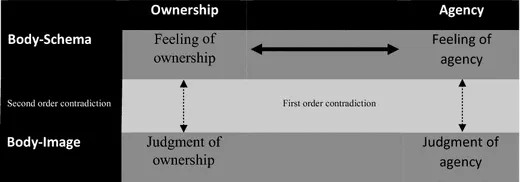
Having clarified these concepts, let us return to the cognitive incongruities responsible for the development of limb-disownership . On the cognitive level, a twofold incongruity appears to be necessary for limb-disownership to develop. The first-order contradiction is between sense of body-ownership (SBO), that is “the sense that I am the one who is undergoing an experience,” and sense of agency (SA), that is, “the sense that I am the one who is causing or generating an action” (Gallagher, 2000, p. 15). These two independent yet closely related mechanisms routinely work together. Yet if SBO and SA collide, the result is contradiction at the body-schema level. In the case of somatoparaphrenia , the individual loses SA but not SBO, while in the case of BIID the individual loses SBO but not SA.
Sense of agency (SA)
Sense of body-ownership (SBO)
Somatoparaphrenia
−
+
Body integrity identity disorder (BIID)
+
−
Yet, this first-order contradiction between SBO and SA at the body-schema level is insufficient for limb-disownership to develop. Rather, a second-order contradiction is also necessary. To understand this second-order contradiction, we must first differentiate between feeling and judgment—between knowing this is my body and feeling it. This incongruity can be defined in terms of the discrepancy between one’s feeling ofbody-ownership at the body-schema level and one’s judgment of body-ownership at the body-image level. A similar gap exists between the feeling of agency (body-schema) and the judgment of agency (body-image). Feelings of agency and ownership are non-conceptual and implicit, emerging at the body-schema level. In contrast, judgments of agency and ownership require an interpretive judgment based on one’s conceptual framing of the situation and one’s beliefs.
We can therefore explain the second-order contradiction in terms of an inconsistency between one’s feeling of agency or ownership (body-schema) and one’s judgment of agency or ownership (body-image). As this mismatch between body-schema and body-image becomes more intolerable, the consequences become increasingly acute. In effect, the second-order contradiction can only emerge if there exists a first-order contradiction at the body-schema level. Nevertheless, the first-order contradiction alone is not sufficient for limb-disownership to occur.
This double dissociation between body-schema and body-image is the key to understanding the book’s central argument. If two different mechanisms were indeed at work, it would be possible for one to sustain damage while the other remains intact. Yet the fact that these mechanisms are detached from one another does not mean they do not engage in dialogue. Indeed, they work together on a regular basis; their synchronization enables us to act naturally, automatically, and unconsciously in-the-world . Hence, if a problem arises in one of these mechanisms, their synchronization will be gravely harmed, with varied and grievous consequences.
This book seeks to show that a possible consequence of a problem in one of these body maps is the loss of the synchronization between body-s...
Table of contents
Cover
Front Matter
1. Introduction
2. The Twofold Structure of Human Beings
3. Ownership
4. When Ownership and Agency Collide: The Phenomenology of Limb-Disownership
5. The Complex Relations Between SA and SBO During Trauma and the Development of Body-Disownership
6. Self-Injuring Behavior
7. The Destructive Nature of Complex PTSD
Back Matter
Trusted by 375,005 students
Access to over 1.5 million titles for a fair monthly price.
Study more efficiently using our study tools.
Frequently asked questions
Yes, you can cancel anytime from the Subscription tab in your account settings on the Perlego website. Your subscription will stay active until the end of your current billing period. Learn how to cancel your subscription
No, books cannot be downloaded as external files, such as PDFs, for use outside of Perlego. However, you can download books within the Perlego app for offline reading on mobile or tablet. Learn how to download books offline
Perlego offers two plans: Essential and Complete
Essential is ideal for learners and professionals who enjoy exploring a wide range of subjects. Access the Essential Library with 800,000+ trusted titles and best-sellers across business, personal growth, and the humanities. Includes unlimited reading time and Standard Read Aloud voice.
Complete: Perfect for advanced learners and researchers needing full, unrestricted access. Unlock 1.5M+ books across hundreds of subjects, including academic and specialized titles. The Complete Plan also includes advanced features like Premium Read Aloud and Research Assistant.
Both plans are available with monthly, semester, or annual billing cycles.
We are an online textbook subscription service, where you can get access to an entire online library for less than the price of a single book per month. With over 1.5 million books across 990+ topics, we’ve got you covered! Learn about our mission
Look out for the read-aloud symbol on your next book to see if you can listen to it. The read-aloud tool reads text aloud for you, highlighting the text as it is being read. You can pause it, speed it up and slow it down. Learn more about Read Aloud
Yes! You can use the Perlego app on both iOS and Android devices to read anytime, anywhere — even offline. Perfect for commutes or when you’re on the go. Please note we cannot support devices running on iOS 13 and Android 7 or earlier. Learn more about using the app
Yes, you can access Body Disownership in Complex Posttraumatic Stress Disorder by Yochai Ataria in PDF and/or ePUB format, as well as other popular books in Philosophy & Public Health, Administration & Care. We have over 1.5 million books available in our catalogue for you to explore.