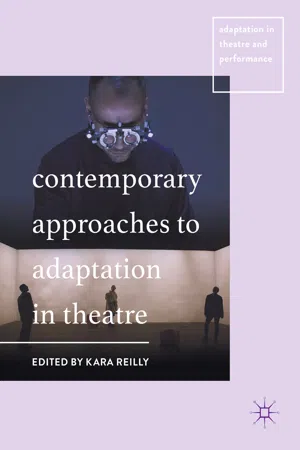
This book examines contemporary approaches to adaptation in theatre through seventeen international case studies. It explores company and directorial approaches to adaptation through analysis of the work of Kneehigh, Mabou Mines, Robert Le Page and Katie Mitchell. It then moves on to look at the transformation of the novel onto the stage in the work of Mitchell, and in The Red Badge of Courage, The Kite Runner, Anne Frank, and Fanny Hill. Next, it examines contemporary radical adaptations of Trojan Women and The Iliad. Finally, it looks at five different approaches to postmodern metatheatrical adaptation in early modern texts of Hamlet, The Changeling, and Faustus, as well as the work of the Neo-Futurists, and the mash-up Medea/Macbeth/Cinderella. Overall, this comprehensive study offers insights into key productions, ideas about approaches to adaptation, and current debates on fidelity, postmodernism and remediation.
- English
- ePUB (mobile friendly)
- Available on iOS & Android
eBook - ePub
Contemporary Approaches to Adaptation in Theatre
About this book
Information
Subtopic
Performing ArtsCompany and Directorial Approaches to Adaptation, Introduced by Scott Proudfit
Company approaches to adaptation in the theatre may seem antithetical to directorial approaches, at first glance. The former suggests a creative process based on decentralized authority and diverse responses to a source text or narrative, while the latter suggests a single authority in the creative process with a guiding ‘take’ on the source. This particular supposition about the group creative process stems from the common belief that a natural distinction exists between company-generated and director-generated work in the theatre, a belief that perhaps unintentionally has been reinforced by histories of devised theatre and collective creation that adopt as their starting point 1960s’ avant-garde performance in Europe and the Americas. The communitarian ideals of a small number of Western theatre collectives during this decade seem particularly symbiotic with the hypothesized ‘postdramatic turn’ in the modern theatre. The influx of improvisation and chance as guides in the creative processes of a number of visible 1960s’ theatre collectives suggest that the embrace of physical theatre coincided with the rejection of the primacy of the text, an anti-authoritarian impulse that led to the director rapidly becoming as unnecessary and unwelcome in the rehearsal room as the playwright. Following this narrative, in the contemporary theatre, the company and the director have become opposing forces: the former disseminating authority, the latter consolidating it.
However, as the chapters in this part demonstrate, theatre history that acknowledges the roots of contemporary company-generated devising and adaptation in an earlier ‘wave’ of collaborative impulses—at the beginning of the twentieth century—demands that group-centred and directorial approaches are rarely antithetical. It was, after all, the rise of the modern director in the late nineteenth century that demanded a new kind of collaboration with designers, writers, and performers in order to achieve the total artwork. The legacy of this collaborative impulse in the early twentieth century was not only a new reverence for the authority of the director-auteur but also simultaneously a transfer of authority in the generative process from directors and playwrights to performers who took a new responsibility for their creative work—performers who acted as creators of their own individual mise en scene.
This more-accurate lineage of collaborative work in the modern theatre can be perceived in Melissa Poll’s chapter, ‘Making Music Visible: Robert Lepage Adapts Aspects of Siegfried Without Shifting a Word’, which looks at Lepage’s production of Richard Wagner’s Der Ring des Nibelungen at the Metropolitan Opera. Poll connects Lepage’s interactive scenography, in which performers’ vocal intonations are immediately reflected in the flow of 3D images projected from the mobile planks that form the various settings of Wagner’s opera cycle, to the productions of Adolphe Appia. For his 1920s’ revivals of Wagner’s works, director-designer Appia is credited with more fully realizing the composer’s dramaturgy than even Wagner was able to at Bayreuth. Appia, like Lepage, is a director whose strong scenographic concepts were recognized in his time, while his empowerment of actors (in Appia’s case, an empowerment he considered necessary so that actors might mediate between Wagner’s music and the physical space) has been often overlooked. As Poll writes,
Appia viewed performing bodies as the material expression of the music and scenography as an extension of the actor, he sought to enhance the meaning-making interactions between the actor and the stage space through sets and lighting.
From Wagner to Appia to Lepage, Poll traces the development of a type of adaptation of Wagner’s operas that relies on ‘bodies in motion’ to rewrite and thereby adapt the composer’s canonical works.
Related to Lepage’s interactive scenography, the ‘live cinema’ productions helmed by director Katie Mitchell, as described in Adam Ledger’s chapter ‘“The thrill of doing it live”: Devising and Performing Katie Mitchell’s International “Live Cinema” Productions’ may seem to depend on a director’s singular vision, when actually they are generated through Mitchell’s extensive collaboration with ‘technicians, camera operators, sound artists, musicians, and actors’. Only multilayered group collaboration could achieve the type of minutely choreographed and technologically assisted productions that Mitchell has become known for, in which audiences divide their attention between a carefully constructed ‘film’ of the live narrative performance and the stage presentation itself. As a starting point, these collaborative adaptations often utilize as their source texts a single novel or short story.
Since ‘live cinema’ relies heavily on the cinematic close-up, thereby focusing on the psychology of a single character, it is appropriate that Mitchell’s work with actors descends ‘in large part from Stanislavski’, combining the creation of ‘precisely detailed’ biographies of characters created in rehearsals with improvisations that explores these proposed character histories. Mitchell’s collaboration, though, is as much with the camera operators and technicians capturing these performances as it is with the actors performing. The result, as Ledger points out, is adaptation as ‘collective labour, in which matters of authorship and production are devolved through pockets of expertise’, Such collaboration is better understood by tracing it back to the forebears Mitchell herself acknowledges, early-twentieth-century directors such as Stanislavski who first pursued the collaborative impulse in the modern theatre, than to collective-creation practitioners of the mid-twentieth century.
Mitchell’s reliance on her actors to ‘work in groups to produce performance proposals’ connects her ‘live cinema’ adaptations, which previously have been misread as solely products of Mitchell’s individual vision and style, to Kneehigh Theatre’s popularist retellings of folklore under the direction of Emma Rice—as detailed in Heather Lilley’s chapter ‘Kneehigh’s Retellings’. The similarities in process between Mitchell and Rice are striking, reinforcing the fact that an assumed necessary division between director-centred and company-centred work is problematic at best.
As with Mitchell’s ‘live cinema’, there is no doubt that Kneehigh’s work is ‘director-led’, whether it is Rice or Mike Shepherd leading. As a leader, Rice describes her role as fundamentally concerned with delegation and enablement. Whether collaborating with her writers, her actors, or her designers, Rice’s job primarily is ‘setting them tasks’. Mitchell’s description of her own work as a director echoes Rice’s closely. As with Rice, Mitchell insists that the generating of ideas in her process has to come from the group not from the director. In past productions, she explains, ‘I proposed very little—I set tasks’.
At the same time, unlike the productions of Mitchell and Lepage described in these chapters, the Kneehigh Theatre adaptations that Lilley highlights do not begin with a single, identifiable source. Rather, the company takes as it source texts ‘cultural memories that have pluralistic resonances for individuals and within interpretive communities’. As Rice puts it, ‘I don’t believe anybody owns a story’. Nevertheless, as Lilley reveals, Rice is clearly at the centre of Kneehigh’s ‘tightly structured and yet playful exploration of performance material’.
The question, then, is not whether contemporary company-devised adaptation in the theatre has leaders but rather the degree to which these leaders share the generating of these adaptations with their fellow artists. On the far end of the spectrum, in terms of decentralized authority in the creative process, is Ruth Maleczech, whose directing at Mabou Mines is profiled in Jessica Silsby Brater’s chapter ‘Collective Creation and “Historical Imagination”: Mabou Mines’ Devised Adaptations of History’. More than her fellow co-artistic directors JoAnne Akalaitis or Lee Breuer, Maleczech describes her philosophy of directing as handing off authority: ‘Neither one of them involves their collaborators at the level that I do’, she notes in Brater’s chapter. ‘The collaborators have completely free rein’.
Connecting the ‘historical pastiche’ of Mabou Mines’ 1980 production Dead End Kids with the ‘partisan iconography’ behind the creative process of its 1999 production, Belen: A Book of Hours, Brater describes an ethos of adaptation that has moved even further than Kneehigh’s from the single-source adaptations of canonical texts by Mitchell and Lepage. At Mabou Mines, the source material in adaptation is disrupted, challenged, and amended. As Brater describes it, Belen, which tells the story of a Mexico City sanctuary-for-women turned prison ‘function[s] as an excavation of sorts, unearthing fragments of personal histories and daily living and then inventing characters and stories that tell us who these women were and how they spent their days’.
Ultimately, as these four chapters suggest, it may be that the creative work at Mabou Mines and Kneehigh Theatre clearly looks more decentralized because their sources are multiple, diverse, and therefore encourage a process in which the inevitable leaders in the adaptation process collaborate with their fellow artists in particular ways. In the end, the type of source (or sources) and the treatment of these sources in adaptation may be the most important factors when explaining the extent to which a director or a company becomes the more visible ‘brand’ behind a series of productions.
© The Author(s) 2018
Kara Reilly (ed.)Contemporary Approaches to Adaptation in TheatreAdaptation in Theatre and Performancehttps://doi.org/10.1057/978-1-137-59783-0_11. Kneehigh’s Retellings
Kneehigh Theatre have been telling stories since 1980, and from the very beginning a large proportion of those stories have been adaptations , or what joint artistic director Emma Rice would prefer to call ‘retellings’.
I don’t know why I use the word adaptation, I much prefer retelling, I feel that’s what we do; we retell stories. And so using the word ‘adaptation’ is already making it more reverent than I feel. In truth, I don’t really feel irreverent, I just think it is my turn. I am already looking forward to someone else telling it next and three cheers for whoever does!… They are retellings and I don’t believe anybody owns a story. (Rice, author interview, 2014)
In a comprehensive history of Cornish theatre, Alan Kent has charted the development of the company ...
Table of contents
- Cover
- Frontmatter
- 1. Company and Directorial Approaches to Adaptation, Introduced by Scott Proudfit
- 2. Re-mediating the Book to the Stage, Introduced by Frances Babbage
- 3. Reinscribing the Other in Contemporary Adaptations of Greek Tragedy, Introduced by Eleftheria Ioannidou
- 4. Postmodern Meta-Theatrical Adaptation, Introduced by Kimberly Jannarone
- Backmatter
Trusted by 375,005 students
Access to over 1.5 million titles for a fair monthly price.
Study more efficiently using our study tools.
Frequently asked questions
Yes, you can cancel anytime from the Subscription tab in your account settings on the Perlego website. Your subscription will stay active until the end of your current billing period. Learn how to cancel your subscription
No, books cannot be downloaded as external files, such as PDFs, for use outside of Perlego. However, you can download books within the Perlego app for offline reading on mobile or tablet. Learn how to download books offline
Perlego offers two plans: Essential and Complete
- Essential is ideal for learners and professionals who enjoy exploring a wide range of subjects. Access the Essential Library with 800,000+ trusted titles and best-sellers across business, personal growth, and the humanities. Includes unlimited reading time and Standard Read Aloud voice.
- Complete: Perfect for advanced learners and researchers needing full, unrestricted access. Unlock 1.5M+ books across hundreds of subjects, including academic and specialized titles. The Complete Plan also includes advanced features like Premium Read Aloud and Research Assistant.
We are an online textbook subscription service, where you can get access to an entire online library for less than the price of a single book per month. With over 1.5 million books across 990+ topics, we’ve got you covered! Learn about our mission
Look out for the read-aloud symbol on your next book to see if you can listen to it. The read-aloud tool reads text aloud for you, highlighting the text as it is being read. You can pause it, speed it up and slow it down. Learn more about Read Aloud
Yes! You can use the Perlego app on both iOS and Android devices to read anytime, anywhere — even offline. Perfect for commutes or when you’re on the go.
Please note we cannot support devices running on iOS 13 and Android 7 or earlier. Learn more about using the app
Please note we cannot support devices running on iOS 13 and Android 7 or earlier. Learn more about using the app
Yes, you can access Contemporary Approaches to Adaptation in Theatre by Kara Reilly in PDF and/or ePUB format, as well as other popular books in Media & Performing Arts & Performing Arts. We have over 1.5 million books available in our catalogue for you to explore.