Beci Carver, Tania Demetriou, Richard Sherwin and Rowan Williams have read and commented on a draft of this chapter at absurdly short notice. I am glad to remain unrepayably indebted to them for their acute engagement. Warm thanks are also due to Roberta Klimt for her intellectually engaged copy-editing. Where available, our contributors have cited from authoritative and scholarly modern English editions of early modern texts. Where such editions are lacking, they provide references to the original edition.
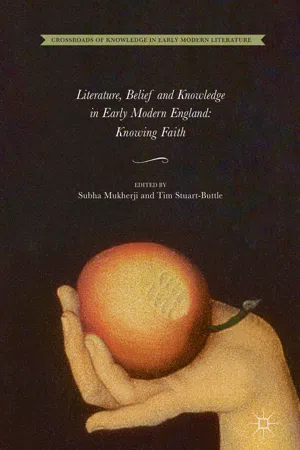
End AbstractLook at the apple, caught at the moment when Eve offers it to Adam: the
punctum in this painting by Lucas Cranach the Elder, luring the onlooker in, as it invites Adam.
1 In John Milton’s
Paradise Lost, the prehistory of this incisive moment is captured in a vividly synaesthetic description of Eve’s temptation where the
grammar bends to the fluid indeterminacy of desire:
Meanwhile the hour of noon drew on, and waked
An eager appetite, raised by the smell
So savory of that fruit, which with desire,
Inclinable now grown to touch or taste,
Solicited her longing eye…2
Is it the apple—the fruit that Satan says ‘will give [her] life/To knowledge’ (
PL. IX. 686–87)—or the desire (or perhaps the appetite of the desiring subject) that inclines to touch and taste, the two sensations explicitly forbidden by God in this context? A comparably curious syntactical slipperiness comes to mind, one that similarly arrests our attention and jolts our reading—from the Prologue to Christopher Marlowe’s
Dr. Faustus:
Till swoll’n with cunning of a self-conceit,
His waxen wings did mount above his reach
And melting heavens conspir’d his overthrow:
For falling to a devilish exercise,
And glutted now with learning’s golden gifts,
He surfeits upon cursed necromancy… (ll. 20–25)3
Marlowe’s passage, like Milton’s
, entwines knowledge with desire, and ambiguates agency. As A.D. Nuttall points out, volition seems to slide here from the Icarian scholar to his impersonal, inanimate wings.
4 Meanwhile, ‘for’ is perched uncertainly: did the heavens conspire for him to fall? or was he overthrown because he fell? In Cranach, the spillage extends. As the ‘alluring fruit’ solicits our longing eye, we see with Adam (
PL. IX. 588). But what exactly do we see, other than the haptic image which refracts into multiple sensations? The detail that jumps out—the ‘accident which pricks’ the viewer, as Roland Barthes might say—is the set of bite marks digging into the substance of fruit and rendering it flesh.
5 But it also forms an inscription, translating both fruit and flesh into text. The marks of the teeth write in both the bruise of knowledge, and its sensuous element; its risks as well as its temptations, its fragility and its dynamism. ‘It is what you imagine knowledge to be’, to quote Elizabeth Bishop, though these vexations and lures are specifically resonant to a period caught up in the cross-currents of Renaissance humanism and the
Reformation , when the exhilaration of possible knowledge was counterpointed against its moral limits and dangers.
6 Beyond their immediate
metaphoric valency, the dents of Eve’s teeth also inscribe narrative anticipation; they turn the forbidden fruit into the ‘table’ which Adam is about to co-scribble on; instrument and material of a co-knowing that is about to undo and re-invent them both. At the same time, this wound or point of rupture pulls us in on the edge of their desire, as we read; and perhaps even triangulates their will with ours. It becomes the poignant figuration which, though distinct from ‘
real presence’ , is far from real absence: a mimetic object that straddles representation and
embodiment , effecting a transference in the consciousness through interpretative action without ontologically turning one substance into another—like Hooker’s
‘true change’, as explicated in this volume by Torrance Kirby. In its distinct act of
mimesis , then, the apple brings together the place of literature and the transformative space of the Eucharist as understood in the Reformed tradition.
7 Locating knowledge in participation over cognition,
embodiment over creed, feeling over dogma, it marks the interception of desire in the conception of knowledge. In doing so, it conjoins certain crucial realities of religious belief and literary art. On the one hand, it comes weirdly close to the imaginative experience of
faith as Ethan Shagan describes it in his revisionist essay in this volume, positing the
Reformation as a time of the ‘belief-act’; and on the other, to the Erasmian notion of knowing
Scripture as an affective re-enactment, as shown in our opening essay by Brian Cummings.
That the aberrant detail is also a textual object is suggestive: it offers not only an analogy for the literary experience of knowledge, but a feel of it; its visual vividness, like that of Christ’s body or the scene-painting of the Gospels so admired by Erasmus , is integral to its expressive potency.8 At the same time, it taps into the centrality of reading, writing and literary thinking in the life of faith ; the acts of imagination implicated in scriptural exegesis —‘the guift of interpretation’, as Lancelot Andrewes said, is ‘bestowed’ by God.9 Indeed, it can be something of a two-way traffic, as Cummings points out in the context of Erasmus , whose most intricate thinking about literary style, truth and knowledge is worked out through the framework of divine literature. Besides, God is not only reader and writer, but the ultimate image-maker in the Sidneyan sense. When George Herbert writes, ‘When thou dost anneal in glass thy story’, a sense of narrative inscription as a form of glazing blends with the more technical senses of ‘annealing’ as burning in colours upon glass (or metal or earthenware) and of altering a surface or substance through heat.10 This semantic fusion of available contemporary senses brings together the actions of reading, writing and drawing—with added associations of transformation—in the image of church windows as the material script and artistic image of divine history, and of the preacher, in turn, as a figure for such legible casements to be read by the congregation.11 No wonder, then, that the hermeneutically enticing detail of the painted apple, full of jouissance, seems such an eloquent entry-point for a book about how imaginative literature probes, troubles and illuminates the relation between knowledge and belief through aesthetic medium in early modern England. T.S. Eliot’s cynical comment about Lancelot Andrewes’s habit of squeezing a world out of a word may raise its head: ‘squeezing and squeezing the word until it yields a full juice of meaning which we should never have supposed any word to possess’.12 The point Eliot misses, of course, is that in the discursive world of early modern faith , word, work, and flesh often dwelt together: ‘unto the word, that we heare, let there be joined the Element of the Worke … and so shall you have the great Mysterie of the Sacrament … [which is] said to be the manifesting of the word in the flesh’.13 For Andrewes himself, the Word only takes effect when it begets the labour of interpretation, translating into Work in a community of embodied readers.14
The acts of figuration at the heart of early modern theology, then, both enabled, and were generated by, a mode of imagining that we would now call literary. But legitimacy was only one aspect of the questions of knowledge that got entangled with religious experience and precept. At a juncture when post-Reformation religious debates, with their emphasis on
sola fides, brought epistemological
issues centre-stage, what is distinct about literary engagements with the relation between knowledge and
faith ? John Donne’s words, in his Christmas 1621 Sermon (3.369), are suggestive of an entwining as well as a gap between the two that called for negotiation:
Knowledge cannot save us, but we cannot be saved without knowledge; faith is not on this side Knowledge but beyond it: we must necessarily come to Knowledge first, though we must not stay at it.15
Imaginative writing—which roughly corresponds to our sense of ‘literature’—taps into the space between
faith and knowledge, putting pressure on both terms. Its relative freedom from specialised disciplinary investments allows a literary lens to bring into focus the relatively elusive strands of thinking about belief, knowledge and salvation, probing the particulars of affect implicit in the generalities of doctrine....