This book shows how the Bhagavad G?t? (part of the great Indian epic — the Mah?bh?rata) can be approached as a powerful tool for change management and as a catalyst for organizational transformation. It presents time-tested leadership strategies drawn from the Bhagavad G?t? that are relevant for today's leaders. This book focuses on how to harmonize the needs of the individual with the needs of society, and by extension, how to harmonize the needs of employees and the organization. It employs an inside-out leadership development approach based on Self-knowledge and Self-mastery, the two highly important areas for practicing effective Self-leadership. The G?t? is a non-sectarian spiritual text with a universal message for living a life of meaning, purpose, and contribution and for leading from our authentic self. It shows how to manage oneself, as a necessary prelude to leading others. Students and organizational leaders will learn to integrate leadership function more effectively into all aspects at the individual, team, and institutional level.
eBook - ePub
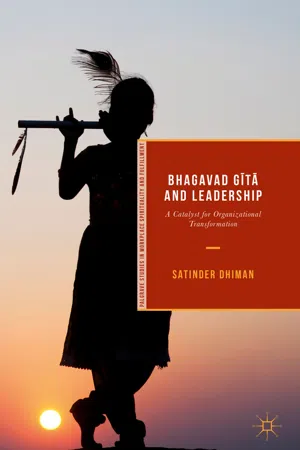
Bhagavad Gītā and Leadership
A Catalyst for Organizational Transformation
- English
- ePUB (mobile friendly)
- Available on iOS & Android
eBook - ePub
About this book
Trusted by 375,005 students
Access to over 1.5 million titles for a fair monthly price.
Study more efficiently using our study tools.
Information
© The Author(s) 2019
Satinder DhimanBhagavad Gītā and LeadershipPalgrave Studies in Workplace Spirituality and Fulfillmenthttps://doi.org/10.1007/978-3-319-67573-2_11. Prolegomena: The Bhagavad Gītā: A Timeless Manual for Self-Mastery and Leadership
Satinder Dhiman1
(1)
School of Business, Woodbury University, Burbank, CA, USA
Satinder Dhiman
Keywords
Bhagavad Gı̄tāSelf-masterySelf-awarenessBhagavad Gı̄tā and leadershipSelf-realizationIntroduction
सर्वोपनिषदो गावो दोग्धा गोपालनन्दनः ।पार्थो वत्सः सुधीर्भोक्ता दुग्धं गीतामृतं महत् ॥४॥
sarvopaniṣado gāvo dogdhā gopālanandanaḥ /
pārtho vatsaḥ sudhīrbhoktā dugdhaṃ gītāmṛtaṃ mahat //4//
All the Upaniṣads are cows, Śrıˉ Kṛṣṇa the son of the cowherd chief is the milkman, Arjuna the son of Pritha is the calf, and the intelligent people are the drinkers of the milk, the great nectar of the Bhagavad Gītā.
This book demonstrates how the Bhagavad Gītā1 (embedded within the great Indian epic, the Mahābhārata) can be approached as a powerful tool for change management and as a catalyst for organizational transformation. It presents time-tested leadership strategies drawn from the Bhagavad Gītā that are highly relevant for today’s leaders. It focuses on how to harmonize the needs of the individual with the needs of society and, by extension, how to harmonize the needs of the employees and the organization. Drawing upon the wisdom of the Gītā, Gandhi once said that “the best way to find yourself is to lose yourself in the service of others.” The Gītā teaches that selfless service is the highest principle of life and leadership.
This book employs an inside-out leadership development approach based on Self-knowledge2 and Self-mastery—two highly important areas for practicing effective self-leadership. The entire Indian spiritual tradition is a “series of footnotes” to the Bhagavad Gītā. It is the scripture of scriptures and contains the essence of all spiritual disciplines and philosophies.
The Bhagavad Gītā expounds a threefold path to Self-realization: (1) the path of selfless action (karma yoga); (2) the path of devotion (bhakti yoga); and (3) the path of knowledge (jñāna yoga). Meaning literally “Lord’s Song,” the Bhagavad Gītā unfolds as a dialog between Śrī Kṛṣṇa, the divine incarnation, and his warrior-disciple, Arjuna, on the eve of a historic battle of cosmic proportions.
Different commentators have read different meanings in interpreting the Bhagavad Gītā based on their own tradition (sampardāya) and philosophical leanings. Some say that it teaches karma yoga (path of selfless action), others observe that it teaches bhakti yoga (the path of devotion), and still others state that it teaches jñāna yoga (the path of Self-knowledge). Some commentators believe that the 18 chapters of the Bhagavad Gītā cover three broad categories of themes: (1) the first six chapters, called karma-ṣaṭkam , deal with the concept of selfless actions as a path to liberation; (2) the next six chapters, called bhakti-ṣaṭkam , deal with the topic of love of the personal God as a path to liberation; and (3) the final six chapters, called jñāna-ṣaṭkam , deal with the path of Self-knowledge as a means to spiritual liberation.
Relevance of the Gītā for Contemporary Leadership
The wisdom of the Bhagavad Gītā is as relevant in the boardrooms of the twenty-first century as it was on the battlefields of ancient times. Although traditionally interpreted as a religious-spiritual text, the Gītā encompasses great practical life lessons for modern leaders. Within the compass of 18 dynamic chapters, it presents the whole spectacle of human drama full of challenges met, victories won, and freedom attained. It teaches us how to emerge from a state of utter apathy, gloom, sorrow, and dejection to a state of perfect engagement, understanding, clarity, wisdom, renewed strength, and triumph. Meaning literally “Lord’s Song,” the Gītā unfolds as a dialog between Śrī Kṛṣṇa, regarded by the Hindus as the Lord in human form, and his warrior-disciple, Arjuna, on the eve of a historic battle of cosmic proportions.
The Gītā contains timeless leadership lessons for the contemporary organizations. Modern leadership concepts such as vision, motivation and empowerment, self-awareness, self-mastery, excellence in work, importance of ethical means in achieving righteous ends, meaning and fulfillment at work, service before self, and wellbeing of all beings, are all lucidly discussed in the Bhagavad Gītā. Likewise, many contemporary leadership constructs such as authentic leadership, servant leadership, transformational leadership, and values-based leadership, were already hinted, in the Bhagavad Gītā thousands of years ago.
Author’s Preparation for This Book Project
This book represents a culmination of and a sequel, as it were, to three of my recent books: Seven Habits of Highly Fulfilled People: Journey from Success to Significance (Personhood Press, USA, 2012), Gandhi and Leadership: New Horizons in Exemplary Leadership (Palgrave Macmillan, 2015), and Holistic Leadership: A New Paradigm for 21st Century Leaders (Palgrave Macmillan, 2017). During the course of my research for these books, it dawned on me that the Gītā contains compelling leadership lessons of much greater depth and scope, meriting a systematic book-length exposition in its own right.
During 2012–2015, I also renewed and solidified my lifelong interest in the Bhagavad Gītā by systematically and concertedly studying its traditional and modern commentaries with a Sanskrit scholar-teacher from India, Br. Pranipata Chaitanya.3 During this period, as a part of my spiritual practice, sādhanā, I also attempted a translation of one of its versions into English.4 In addition, I was given the rare opportunity of working with my Sanskrit teacher, Br. Pranipata Chaitanya, in revising, editing, contributing a scholarly introduction, and publishing the Sanskrit-English translation of one of the most important philosophical treatises of Vedānta called Vivekacūḍāmaṇi: The Crest Jewel of Wisdom . 5
This author has published three peer-reviewed journal articles on the leadership lessons of the Bhagavad Gītā;6 has served as a lead editor of a recently edited volume entitled Bhagavad Gītā and Management: Timeless Lessons for Today’s Managers (Springer, USA, 2018); has conducted several management development programs around the world using the Gītā as a foundational text; has co-organized, moderated, and presented at international conferences dedicated to the Bhagavad Gītā, such as the 2017 Global Bhagavad Gītā Convention organized by the Center for Inner Development Resources , North America , held at UC Irvine during September 9–10, 2017 and the 9th and 10th World Confluence of Humanity, Power & Spirituality held in Delhi and Kolkata, India, during December 16–17, 2016 and December 22–23, 2017, respectively; and has presented on this topic at various national and international academic conferences, including a presentation titled The Bhagavad Gītā: Old Text, New Leadership Context at the 2016 Academy of Management Annual Conference in the All Academy-Theme Symposium: Looking into the Bhagavad Gītā for Managing Organizations to Become Meaningful.
The ongoing preparations for this project also entailed several visits to various key spiritual centers in India such as Kundaldhām (Gujarat), Sri Ramana Ashram (Tiruvannamalai, Tamil Nadu), Sri Aurobindo Ashram (Pondicherry), Sri Ramakrishna Math, (Mylapore, Chennai, Tamil Nadu), Kailash Ashram (Rishikesh, Uttarkashi, Uttarakhand), Gītā Bhavan Ashram (Swargashram, Rishikesh, Uttarakhand), and Narayana Gurukulam (Edappally-Varkala, Kerala), and personally meeting, discussing, and learning with many eminent Vedānta teachers, seers, and saints, such as Swami Brahmatmanand Saraswati, Swami Dayananda Saraswati, Swami Paramarthananda, Swami Gyanajivandasji, Br. Shri Pranipāta Chaitanya, and Muni Narayana Prasad.
These explorations, discussions, and translations have helped me to understand and appreciate the larger context of spirituality in general and the universality of the message of the Gītā in particular. During the course of my search and research, I also discovered that, currently, there are hardly any titles that systematically and synergistically attempt to apply the message of the Gītā to leadership, primarily from the standpoint of Advaita Vedānta.7 This further spurred my interest in developing this book project.
Approaching the Teachings of the Gītā
The Bhagavad Gītā is an endearing dialog (saṁvād) between two friends—the warrior prince, Arjuna, and the Lord in human form, Śrī Kṛṣṇa. So, if we want to really understand the true import of the Gītā, we have to befriend Śrī Kṛṣṇa. There is no room for contention, vivād, among friends.
The Bhagavad Gītā is probably the only scripture in human history where the reader is not asked to accept anything on faith. Every question is examined insightfully, and diverse perspectives are presented for reflection. It offers food for thought without interfering with the intellectual appetite of the reader. At every step, the freedom of choice of the listeners/readers is respected. “Do as you wish” (not as I say), Arjuna is told at the end (BG 18.63). Teachers only open the door; we have to enter by ourselves.
Throughout, Arjuna asks good questions (paripraśnena) and Śrī Kṛṣṇa answers them lovingly and objectively, without becoming upset or deprecating. The student has humility and has respect for the teacher, and the teacher has caring concern for the wellbeing of the student. This makes the Gītā a great treatise on the art and science of effective communication. The real beauty of the Gītā lies in its ability to harmonize the spiritual and the temporal, in the art and science of attaining the highest good (param-śreyas) while remaining fully engaged in everyday practical matters. This blend of the spiritual and the practical is the key to the Gītā’s universal appeal over the centuries.
The Gītā uses a very special teaching methodology. It presents the highest teachings—the “big picture”—first. Arjuna’s was confused about his duty and wanted to know “the right thing to do” (śreyas). Śrī Kṛṣṇa starts the teaching with the highest good (param-śreyas)—the nature of the Self. Arjuna was mostly worried about the outer kingdom; Śrī Kṛṣṇa points him to the inner Kingdom—the abiding inner treasure of the fullness of our being (puraṇattvam).
The message of the Gītā is for everyone who is interested in attaining spiritual freedom. T...
Table of contents
- Cover
- Front Matter
- 1. Prolegomena: The Bhagavad Gītā: A Timeless Manual for Self-Mastery and Leadership
- 2. Introduction: Text and the Leadership Context of the Gītā
- 3. The Real Message of the Gītā: Decoding the Text
- 4. Advaita Vedānta: The Science of Reality
- 5. Karma Yoga: The Path of Enlightened Action
- 6. Being-Centered Leadership: Leader as an Enlightened Sage
- 7. Bhakti Yoga: Love and Faith in Leadership
- 8. Mind: A Leader’s Greatest Friend and Foe
- 9. Doing the Right Thing: Leaders’ Moral and Spiritual Anchorage
- 10. Be the Change: The Making of a Servant Leader
- 11. Epilogue: Timeless Teachings of the Gītā—Maxims for Life and Leadership
- Back Matter
Frequently asked questions
Yes, you can cancel anytime from the Subscription tab in your account settings on the Perlego website. Your subscription will stay active until the end of your current billing period. Learn how to cancel your subscription
No, books cannot be downloaded as external files, such as PDFs, for use outside of Perlego. However, you can download books within the Perlego app for offline reading on mobile or tablet. Learn how to download books offline
Perlego offers two plans: Essential and Complete
- Essential is ideal for learners and professionals who enjoy exploring a wide range of subjects. Access the Essential Library with 800,000+ trusted titles and best-sellers across business, personal growth, and the humanities. Includes unlimited reading time and Standard Read Aloud voice.
- Complete: Perfect for advanced learners and researchers needing full, unrestricted access. Unlock 1.5M+ books across hundreds of subjects, including academic and specialized titles. The Complete Plan also includes advanced features like Premium Read Aloud and Research Assistant.
We are an online textbook subscription service, where you can get access to an entire online library for less than the price of a single book per month. With over 1.5 million books across 990+ topics, we’ve got you covered! Learn about our mission
Look out for the read-aloud symbol on your next book to see if you can listen to it. The read-aloud tool reads text aloud for you, highlighting the text as it is being read. You can pause it, speed it up and slow it down. Learn more about Read Aloud
Yes! You can use the Perlego app on both iOS and Android devices to read anytime, anywhere — even offline. Perfect for commutes or when you’re on the go.
Please note we cannot support devices running on iOS 13 and Android 7 or earlier. Learn more about using the app
Please note we cannot support devices running on iOS 13 and Android 7 or earlier. Learn more about using the app
Yes, you can access Bhagavad Gītā and Leadership by Satinder Dhiman in PDF and/or ePUB format, as well as other popular books in Business & Business Ethics. We have over 1.5 million books available in our catalogue for you to explore.