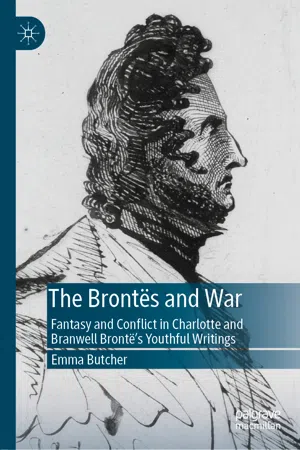
This book explores the representations of militarisim and masculinity in Charlotte and Branwell Brontë's youthful writings. It offers insight into how the siblings understood and reimagined conflict (both local and overseas) and its emotional legacies whilst growing up in early-nineteenth-century Britain. Their writings shed new light on a period little discussed by social and military historians, providing not only a new approach to Brontë Studies, but also acting as a familial case study for how the media captivated and enticed the public imagination.
eBook - ePub
The Brontës and War
Fantasy and Conflict in Charlotte and Branwell Brontë’s Youthful Writings
- English
- ePUB (mobile friendly)
- Available on iOS & Android
eBook - ePub
The Brontës and War
Fantasy and Conflict in Charlotte and Branwell Brontë’s Youthful Writings
About this book
Information
© The Author(s) 2019
E. ButcherThe Brontës and Warhttps://doi.org/10.1007/978-3-319-95636-7_11. Introduction: Youth Writing War
Emma Butcher1
(1)
University of Leicester, Leicester, UK
Emma Butcher
Charge on the enemy
Victory leads
Capture their battery
Footmen or Cavalr’y
He shall be conqueror
Fastest who speeds
Think not of danger now
Enter the breach
Dream not of cannon-ball
Mount by the shattered wall
Soon shall their banner-staff
Bend to your reach
War is an ecstasy
Risk is wild
What though their battlements
Stand like a rock
Charlotte’s youthful poem, ‘Charge on the Enemy ’ (1837), is not situated within her other Angrian writings, acting as a stand-alone example of her interest in war. Throughout, the verse’s exhilarating, progressive form captures the essence of war, demonstrating multidimensional knowledge of militarism ranging from battlefield terminology to feelings of near-death experience. It is heroic and patriotic, yet also dark: ‘risk is wild’. It is playful and euphoric, yet considered and poignant. It is a deeply multifaceted response to the experience of war.
Like this poem suggests, young people are integral witnesses to history, yet, over time, their voices have been marginalised in the grand scheme of authoritative adult narratives. Even in the nineteenth century, when childhood became a social category in its own right, young people were caught in a passive consumer culture where their identity was shaped by the literature written for them, rather than by them. By returning to the past and analysing events through the lens of youthful penmanship, it is clear that youth’s imaginative agency captures previously (un)interrogated moments of history. In the instance of war, it is the uninhibited, inquisitive nature of youth that paints a vivid canvas of some of the most important military events in history. This is the case in regard to the focus of this book, which examines Charlotte and Branwell Brontë’s youthful writing partnership in the years following the Napoleonic Wars .
The Brontës contribute to a legacy of young people writing war in the nineteenth century. Samuel Coleridge’s son, Hartley Coleridge, reworked the Napoleonic Wars into his imaginary war-gaming kingdom, Ejuxria. His map, drawn between 1804 and 1810, is the only surviving material of this kingdom from his hand, yet surviving family correspondence confirms the kingdom’s content. His brother Derwent, writing of the kingdom after Hartley ’s death, stated that, after declaring that he had letters from Ejuxria, he [Hartley] would launch into his kingdom’s news, which regularly revolved around wars fought between sovereign powers.2
Hartley Coleridge is just one example. Other notable authors such as George Eliot, Robert Louis Stevenson and Iris Vaughan wrote war narratives as children.3 The Juvenilia Press has published numerous volumes of child authors, highlighting the sophisticated, interesting and playful forgotten content of important writers. The war stories and accompanying drawings written by these young prodigies tend to rework and play with past military periods; their tales usually revive or reimagine historical wars. Although these writings do not demonstrate the same sophisticated level of sustained content as the Brontë juvenilia, or perhaps Hartley Coleridge, they do, however, highlight the importance of war in the creative development of well-known authors, demonstrating early understandings of conflict , death, heroism and military masculinity .
Charlotte and Branwell Brontës’ collaborative writings take the form of a war-fuelled fantasy world, first titled Glass Town (1829–1834) and then evolving into Angria (1834–1839). Over the course of approximately ten years, Charlotte, aged 13–23, and Branwell, aged 12–22, constructed an elaborate encyclopaedia of characters, places, and events, which are a complex conflation of real-life influence and imaginative play .4 A majority of the literature does not fall under the usual category of ‘child author’, as, technically, these are ‘coming of age’ or ‘teen’ writings. Yet, with the Brontës, there has become a clear divide between the siblings’ adult published works and the labyrinth of youthful writings they produced in the safety of their tight family unit. Childhood, despite its categorical placing in legal and social circles, is a fluid, abstract concept that is relative to the process of ‘growing up’. Both Charlotte and Branwell’s saga is often in line with youthful nature, it is experimental, imitative , and playful .
Despite its youthful execution, their saga demonstrates an ever-evolving recognition of one of the most adult topics that a young writer could tackle: war. As this book will go on to demonstrate, this was an exciting time in war writing, with British soldiers and journalists putting pen to paper and trying to make sense of a particularly conflict-riddled period, ranging from large-scale wars and their legacies—namely the Napoleonic Wars —to other colonial conflicts around the globe, such as the First Anglo-Ashanti War. The Brontë children were part of this nationwide conversation, using writing as an outlet to process and evaluate the varying post-war opinions they were exposed to through the material they read. The following chapters demonstrate that both siblings read widely and had a strong knowledge of formal and opinion-based war histories gained from canonical texts, biographies, newspapers and periodicals circulating in the ‘adult world’. Using these texts as their source material, both brother and sister created a fantasy theatre of war, spending over a decade crafting their worlds of Glass Town and Angria. Within, they built a playful , alternative military history. The sagas draw on conflicts ranging from the ancient to the recent past and go further to consider and imagine wartime feeling and sensation. In sum, their writings offer an important socio-historical reading of war’s impact on the social and artistic climate of Britain in the post-Waterloo years. Ultimately, this book shows that, if listened to, youthful voices are a rich spectrum of sources for understanding military mentality; the young mind occupies a twilight zone that responds and is sympathetic to the most serious real-world situations, yet is also emotionally intuitive enough to tap into wartime states of feeling and create uninhibited, imaginative war commentary.
Celebrating the Brontë Juvenilia
The Brontës’ early writings remain a complex and uncertain, yet fascinating, area of scholarship. The majority of manuscripts were written deliberately in miniature hand, almost illegible to the naked eye. The siblings’ saga was a private microcosm constructed by a shared imagination, which was mutated and adapted through various forms. It began with three different play sagas—Our Fellows’ Play, Young Men’s Play and Islanders’ Play—the latter two morphing into the Glass Town saga in 1829. Finally, this fully formed saga evolved into Angria in 1834. This trajectory goes some way to explain why confusion exists between who wrote what and when parts were written. It is still unknown how many undiscovered fragments of juvenilia exist and how much content has been destroyed, either by the Brontës themselves or posthumously. The main focal worlds of this book, Glass Town and Angria, appear to be fairly complete, yet even in recent years, more manuscripts are being discovered. In 2017, a Glass Town manuscript—retrospectively titled A Visit to Haworth—written by Charlotte was discovered when a book previously belonging to the Brontë family was sold by a private collector in America. In 2019, a little book by Charlotte turned up at an auction house in Paris. Although finding new Brontë material is rare, the extensive nature of the Brontë universe leaves extra stories and layers of detail open to discovery and interpretation.
Emily and Anne were involved in the Plays and Glass Town writings (1825–1832). The early Brontë sibling unit—Charlotte, Branwell, Emily and Anne —acted as a form of collaborative, playful ‘think tank’. It is well known that the Reverend Patrick Brontë gave Branwell a set of toy soldiers in 1826, and each of the four siblings picked one, named him and used him for their creative collaborative stories. Emily and Anne ’s soldiers—Parry and Ross—make appearances in the early stories but have less involvement as the saga goes on.5 Despite Emily and Anne ’s evident presence within these early stories, no manuscript is written in their hand. Emily and Anne ’s non-vocal, marginal role in the Glass Town saga is potentially why, in 1832, the two younger siblings made a decisive move away from Glass Town and distanced themselves from the Angrian writings. They formed their own saga, Gondal, which was separate yet in-keeping with their shared writing tradition. Emily and Anne ’s move away from Glass Town consolidated Charlotte and Branwell’s writing partnership and confirmed them as the primary owners of their ever-evolving Glass Town and Angrian events and characters.
The Glass Town and Angrian manuscripts are notoriously difficult to navigate. Within these private spaces, Charlotte and Branwell had the freedom to discuss explicit, problematic content in an uncensored literary environment, without any intention for it to be shared with a public audience. The result of this is, however, a problem for future critics. Unlike published material, the saga is an organic, ever-changing conversation between the sibling unit and therefore signposting and clarity in regard to direction and any last-minute character changes is often omitted.
Christine Alexander and Juliet McMaster’s The Child Writer offers detailed explanations as to the patterns and practices of the child writer during the long nineteenth century. As well as erraticism, the child’s desire to imitate material they have read is often a reason why children’s voices are seen to lack authenticity. Alexander and McMaster advocate that this regressive interpretation misunderstands the juvenilias’ intrinsic value. Alexander quotes Robert Browning:
He saw imitation as vital to the development of genius: ‘Genius almost invariably begins to develop itself by imitation ...
Table of contents
- Cover
- Front Matter
- 1. Introduction: Youth Writing War
- 2. The Brontës’ Military Reading
- 3. Wellington and Napoleon
- 4. The Napoleonic Wars
- 5. Colonial Warfare
- 6. Civil War and Conflict
- 7. Conclusion: After Angria
- Back Matter
Trusted by 375,005 students
Access to over 1.5 million titles for a fair monthly price.
Study more efficiently using our study tools.
Frequently asked questions
Yes, you can cancel anytime from the Subscription tab in your account settings on the Perlego website. Your subscription will stay active until the end of your current billing period. Learn how to cancel your subscription
No, books cannot be downloaded as external files, such as PDFs, for use outside of Perlego. However, you can download books within the Perlego app for offline reading on mobile or tablet. Learn how to download books offline
Perlego offers two plans: Essential and Complete
- Essential is ideal for learners and professionals who enjoy exploring a wide range of subjects. Access the Essential Library with 800,000+ trusted titles and best-sellers across business, personal growth, and the humanities. Includes unlimited reading time and Standard Read Aloud voice.
- Complete: Perfect for advanced learners and researchers needing full, unrestricted access. Unlock 1.5M+ books across hundreds of subjects, including academic and specialized titles. The Complete Plan also includes advanced features like Premium Read Aloud and Research Assistant.
We are an online textbook subscription service, where you can get access to an entire online library for less than the price of a single book per month. With over 1.5 million books across 990+ topics, we’ve got you covered! Learn about our mission
Look out for the read-aloud symbol on your next book to see if you can listen to it. The read-aloud tool reads text aloud for you, highlighting the text as it is being read. You can pause it, speed it up and slow it down. Learn more about Read Aloud
Yes! You can use the Perlego app on both iOS and Android devices to read anytime, anywhere — even offline. Perfect for commutes or when you’re on the go.
Please note we cannot support devices running on iOS 13 and Android 7 or earlier. Learn more about using the app
Please note we cannot support devices running on iOS 13 and Android 7 or earlier. Learn more about using the app
Yes, you can access The Brontës and War by Emma Butcher in PDF and/or ePUB format, as well as other popular books in Literature & Military & Maritime History. We have over 1.5 million books available in our catalogue for you to explore.