Nowadays remembered mostly through Adam Smith's references to the short-lived Ayr Bank in the Wealth of Nations, the 1772-3 financial crisis was an important historical episode in its own right, taking place during a pivotal period in the development of financial capitalism and coinciding with the start of the traditional industrialisation narrative. It was also one of the earliest purely financial crises occurring in peacetime, and its progress showed an impressive geographical reach, involving England, Scotland, the Netherlands and the North American colonies.
This book uses a variety of previously unpublished archival sources to question the bubble narrative usually associated with this crisis, and to identify the mechanisms of financial contagion that allowed the failure of a small private bank in London to cause rapid and severe distress throughout the 18th century financial system. It re-examines the short and turbulent career of the Ayr Bank, and concludes that itsfailure was the result of cavalier liability management akin to that of Northern Rock in 2007, rather than the poor asset quality alleged in existing literature. It furthermore argues that the Bank of England's prompt efforts to contain the crisis are evidence of a Lender of Last Resort in action, some thirty years before the classical formulation of the concept by Henry Thornton.
Paul KosmetatosThe 1772–73 British Credit CrisisPalgrave Studies in the History of Financehttps://doi.org/10.1007/978-3-319-70908-6_1
Begin Abstract
1. ‘A Year of Confusion, Dismay, and Distress’: The 1772–73 Financial Crisis and Its Potential Significance
Paul Kosmetatos1
(1)
University of Edinburgh, Edinburgh, UK
End Abstract
On 29 June 1772, the following mock bulletin appeared in the London Morning Chronicle:
Ship News Extraordinary
Port of London
On Tuesday the 16th instant, the wind being full North, arose one of the most violent and fatal storms that has been known here since the South Sea blast in the year 1720… Had it not been for the shelter the Castle of Public Credit afforded, the ruin might have been universal. The Bubble, Captain F[ordyc]e, deep laden with Scotch Bills, lying in anchor with the Soap-tub, Captain [Neal]e, and the Two Partners, Captain J[ame]s and Captain D[ow]n,… broke from her moorings at Thread-needle point, and driving out to sea went to pieces on Bull and Bear rock; then immediately the Soap-tub, and the Two Partners breaking from their anchors, drove on the breakers, call’d Stop Payment Rocks, and all went to the bottom; the Bubble ran afoul of the Adelphi, Captain Adam, on her voyage to the Savoy, and sunk her; the Sleepy Dick, Captain Gl[y]n, in company with the Lame Duck, Captain H[alifa]x, founder’d near Election Gulph; the New River India-man, Captain C[olebrook]e, rode out the storm very well, but running aground, on a place call’d Empty Purse Sand, was very near sharing the same fate… but for the timely assistance of the Premier man of war, Captain N[ort]h from Fort St. James, with a number of vessels under the command of Captain Yellow-boy from the Mother Bank… The Surety ship is put into dock to refit [and] a great number of other vessels… Tenders, Scotch traders, &c. are missing, suppos’d to be either lost or driven out to Sea.1
This need not necessarily be the best example of eighteenth-century British wit, but it does serve to present in a nutshell the dramatis personae of the outbreak of the 1772–73 credit crisis. Three weeks earlier, on 9 June, Alexander Fordyce , an Aberdonian ex-hosier whose financial talent had raised him to the leadership of the London banking partnership of Neale, James, Fordyce, and Down (henceforth: NJFD), an aristocratic marriage,2 and an unsuccessful bid for membership in Parliament,3 had absconded to the Continent after being caught wrong-footed in his speculations in East India stock.4 Fordyce, whose trading bet was a ‘bear play’ or a ‘short’, that is, an attempt to profit from a fall in prices, had evidently expected that the ongoing troubles of the East India Company (henceforth: EIC) would come to a head in the summer of 1772. In apparently espousing this view, he was being neither particularly naïve nor misinformed. Fordyce had been an experienced Exchange Alley operator since at least 1763, building his fortune and reputation for financial acumen on exactly the same sort of trading (and indeed the same stock) that now broke him.5 Neither was he unique in having bearish views on the EIC. Ever since the Company had secured the potentially lucrative diwani of tax-farming privileges over the Indian provinces of Bengal, Bihar, and Orissa in 1765, expectations had been raised in Europe of a dividend windfall for its proprietors. Its stock had been accordingly transformed into an object of volatile trading for speculators like Fordyce or insiders like its chairman in 1772 and Member of Parliament for Arundel, Sir George Colebrooke . Contemporaries debated whether the contentious term ‘bubble’ should be used to describe what was taking place,6 and indeed EIC share prices had followed a recognisable bubble trajectory as recently as 1766–69. Speculation in the stock continued even after prices reverted to what had been their long-term level, with syndicates based in Amsterdam remaining prominent.7 The proceedings of the ‘Little Parliament’ of the Company’s General Court of Proprietors attracted major press interest, as did the reported excesses of its servants in India.8 All this while, the Ministry sought a way to influence the Company’s affairs and extract monetary benefit for the Treasury. In June 1772, Exchange Alley was filled with rumours of military reverses in India and cash flow problems at home, while Colebrooke was known to be engaged in an elaborate, but doomed, attempt to corner the world market in the strategic commodities of alum, lead, and hemp.9
Educated or not, Fordyce’s guesses nonetheless proved premature and his trading positions unsustainable. For three months after his flight he lingered in France, during which time the British press led a hue and cry that displayed gusto and imagination in equal parts, sometimes reporting the fugitive to be simultaneously in places as far distant from one another as Aachen and Rome.10 He finally agreed to return to Britain in order to surrender to his creditors and did so at Guildhall in early September 1772 in a series of public hearings that were widely reported in the press.11 Despite the furore surrounding him, he apparently avoided the more severe consequences usually reserved for less well-connected bankrupts in the eighteenth century12 and lived in not especially constrained retirement until his death in London in 1789.13 In fact, he seems to have recovered his fortunes well enough to hazard running for the same parliamentary seat a second time in 1780, though again with the same unsuccessful outcome.14
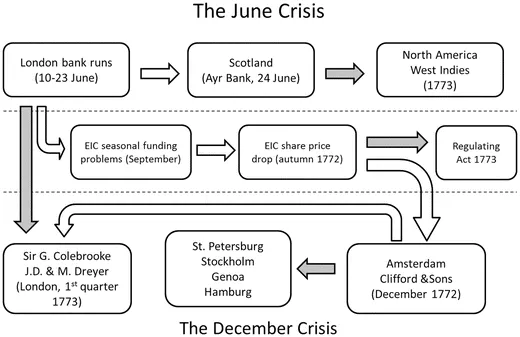
Fordyce’s personal drama was the first act of a multifaceted financial crisis that raged for about a year and which in fact consisted of two distinct phases (Fig. 1.1). The initial market distress in London peaked on 22 June with a series of bank runs,15 which reportedly led to a wave of:
general consternation [in] the metropolis… A universal bankruptcy was expected, and the stoppage of every banker looked for. The whole city was in uproar, and many of the first families in tears. Every countenance appeared clouded, occasioned either by real distress, or by what they feared for their friends.16
Fig. 1.1
Timeline of the 1772–73 crisis. The arrows signify a time sequence and do not necessarily imply a causal relationship. White arrows signify a short-term sequence; shaded arrows reflect a more delayed one
Included among the numerous payment stops that day were those (though but temporary ones in their case) of the partnership associated with the four Scottish architect brothers Adam, who were erecting the Adelphi Buildings in the Strand, and of the private bank of Sir Richard Glyn and Thomas Hallifax , the latter then running for election as Lord Mayor.17 Like the Scot Fordyce, the Londoners Glyn & Hallifax had been connected with the growing Scottish economy through the elaborate chains of bills of exchange that served both as short-term money-market funding and as paper money surrogates. The impact of the crisis in Scotland itself was even more spectacular, as David Hume described in a letter to Adam Smith:
We are here in a very melancholy Situation: Continual Bankruptcies, universal Loss of Credit, and endless Suspicions. There are but two standing Houses in this Place, Mansfield’s and the Couttses… The Case is little better in London. It is thought, that Sir George Colebrooke must soon stop; and even the Bank of England is not entirely free from Suspicion… The Carron Company is reeling, which is one of the greatest Calamities of the whole; as they gave Employment to near 10,000 People.18
Similar dire evaluations were made in the London press. The crisis, combined with the prevailing high prices for corn, was expected to reduce ‘hundreds to a state of beggary’,19 if not ‘absolute and unavoidable famine’.20 In Scotland, there were fears that the combination of rising unemployment with the longstanding problem of ‘the excessive price of provisions, [would reduce] hundreds to a state of beggary’21 and lead to mass emigration of skilled artisans.22 There were indeed food disturbances in early 1773 in Leicestershire,23 and Tayside,24 the centre of the Scots’ linen industry. Food riots in Dundee were serious enough to require intervention by troops.25 Though these events were not necessarily connected with the financial crisis in a directly causal manner, they did add to the atmosphere of alarm prevailing in the London press at the turn of 1773.26
Despite Hume’s fears, the Carron Company’s troubles proved only temporary as the firm recovered to continue well into the twentieth century, in the meantime giving Britain the famous carronades of its warships, its red pillar post-boxes, and its red telephone boxes.27 The biggest victim of the crisis in Scotland was instead the ambitious and experimental Ayr Bank (Douglas, Heron & Co.) , which had been founded in 1769 with much fanfare and the express purpose to make up the deficit in investment capital that the developing Sco...
Table of contents
Cover
Front Matter
1. ‘A Year of Confusion, Dismay, and Distress’: The 1772–73 Financial Crisis and Its Potential Significance
2. A Minsky Bubble? Economic Growth and the Financial Sector in 1763–72
3. ‘Roguery’, ‘Stupidity’, and Permissive Regulation: Asset Speculation and Speculative Projects in 1763–72
4. Propagation and Containment: Financial Contagion and the Lender of Last Resort in 1772–73
5. Impact and Resolution
6. Conclusion
Back Matter
Trusted by 375,005 students
Access to over 1.5 million titles for a fair monthly price.
Study more efficiently using our study tools.
Frequently asked questions
Yes, you can cancel anytime from the Subscription tab in your account settings on the Perlego website. Your subscription will stay active until the end of your current billing period. Learn how to cancel your subscription
No, books cannot be downloaded as external files, such as PDFs, for use outside of Perlego. However, you can download books within the Perlego app for offline reading on mobile or tablet. Learn how to download books offline
Perlego offers two plans: Essential and Complete
Essential is ideal for learners and professionals who enjoy exploring a wide range of subjects. Access the Essential Library with 800,000+ trusted titles and best-sellers across business, personal growth, and the humanities. Includes unlimited reading time and Standard Read Aloud voice.
Complete: Perfect for advanced learners and researchers needing full, unrestricted access. Unlock 1.5M+ books across hundreds of subjects, including academic and specialized titles. The Complete Plan also includes advanced features like Premium Read Aloud and Research Assistant.
Both plans are available with monthly, semester, or annual billing cycles.
We are an online textbook subscription service, where you can get access to an entire online library for less than the price of a single book per month. With over 1.5 million books across 990+ topics, we’ve got you covered! Learn about our mission
Look out for the read-aloud symbol on your next book to see if you can listen to it. The read-aloud tool reads text aloud for you, highlighting the text as it is being read. You can pause it, speed it up and slow it down. Learn more about Read Aloud
Yes! You can use the Perlego app on both iOS and Android devices to read anytime, anywhere — even offline. Perfect for commutes or when you’re on the go. Please note we cannot support devices running on iOS 13 and Android 7 or earlier. Learn more about using the app
Yes, you can access The 1772–73 British Credit Crisis by Paul Kosmetatos in PDF and/or ePUB format, as well as other popular books in Economics & Economic History. We have over 1.5 million books available in our catalogue for you to explore.