The Eurasian Economic Union (EAEU), which includes Russia, Kazakhstan, Belarus, Kyrgyzstan, and Armenia, is a new but substantial regional organization. Significant achievements include a common external customs tariff, a customs union and a common labour market: a well-developed institutional environment has emerged to support and advance these processes, ranging from the Eurasian Economic Commission and the EAEU Court to the Eurasian Development Bank and the Eurasian Fund for Stabilization and Development. This major integration achievement also has several drawbacks and 'stumbling stones'—some due to Russia's dominant position, some due to the authoritarian nature of political regimes, and some due to dependence on oil and gas exports.
This book presents a detailed qualitative and quantitative assessment of the Eurasian Economic Union, including the history of Eurasian integration, the macroeconomy of EAEU member states, an assessment of trade and investment links, a descriptive analysis of the EAEU Treaty, an analysis of Eurasian institutions, the sociology of integration, the EAEU's emerging foreign economic policy, relations with the EU and China, the EAEU's position on One Belt One Road policies, and its mid-term policy agenda. This primer text will be of interest and value for students, academics and practitioners working in economic policy and business communities and interested in the history and development of the Eurasian Economic Union.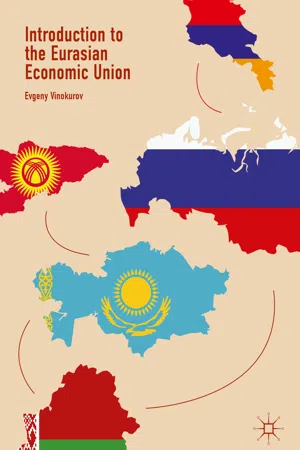
- English
- ePUB (mobile friendly)
- Available on iOS & Android
eBook - ePub
Introduction to the Eurasian Economic Union
About this book
Information
© The Author(s) 2018
Evgeny VinokurovIntroduction to the Eurasian Economic Unionhttps://doi.org/10.1007/978-3-319-92825-8_11. The History of Eurasian Integration: 1991–2016
Evgeny Vinokurov1
(1)
Eurasian Development Bank, St Petersburg, Russia
Evgeny Vinokurov
1.1 “Civilized Divorce” and False Starts of the 1990s and 2000s
Comprehensive and far -reaching international projects often have difficulty getting off the ground. The establishment of the Eurasian Economic Union (EAEU) is a serious achievement for its members after the collapse of the USSR and the disruption of production chains formed over centuries even in the days of the Russian Empire. At the beginning of the 1990s, Soviet republics prioritized minimizing losses above all else. The bodies and industry councils of the Commonwealth of Independent States (CIS) pursued this critically important objective. The uninterrupted operation of the railways and power grids depended on its successful achievement. At that time, politicians and experts simultaneously tried to create a working plan for economic integration under the new conditions of independence and the transition to a market economy.
The starting point for discussing questions of post-Soviet regional integration was the need to come to an agreement regarding the future fate of the USSR in 1991. Amid the precipitous collapse, the state idea of creating a “weak” confederation—the Union of Sovereign States—did not find support among the Soviet republics. In December 1991, three heads of state, representing Russia, Ukraine, and Belarus, signed an agreement to terminate the existence of the Soviet Union and to simultaneously set up the CIS. Soon afterwards, Central Asian states joined the CIS.
From the very beginning, the CIS did not harbour any ambitions to become a federated state one day. The organization’s membership formed quickly: 12 of 15 Soviet republics (all except the Baltic States) joined the CIS by 1993. However, the list of agreements that had to be signed by all CIS member states was modest at that time and did not even include the CIS Charter. Legislatively, the CIS d istinguishes between a Commonwealth “member” and “associate” depending on whether the state has ratified the CIS Charter. Member states had the right to refuse virtually every agreement, which they in fact did systematically; many countries signed certain agreements with specific provisions and limitations. However, in 1992–1993, post-Soviet integration was explicitly linked to the CIS; most of the agreements signed in this period related directly to this organization. However, this was also the most contradictory period in the integration process. In these years, more than integration, the countries of the former USSR worried about finding a peaceful resolution to potential differences and conflicts associated with disintegration through a process frequently referred to in the literature as a “civilized divorce”.
The idea of a Eurasian Union (EAU) first appeared at a high level in a speech by Nursultan Nazarbayev at Moscow State University on 29 March 1994. The previous week, while speaking at the Chatham House in London , the president of Kazakhstan noted that two trends defined the development of the post-Soviet space: on the one hand, the nation-building and—on the other hand—the need for integration, so it was “reasonable to create a real working union of states on the basis of a ‘nucleus of countries’”.1 In his Moscow speech, Nazarbayev directly mentioned two components of a future Eurasian Union: deep economic integration (precisely what EAEU institutions are working on) and a defence union (implemented as the Collective Security Treaty Organization [CSTO]).
The time has come to take our countries’ relationships to a qualitatively new level through new interstate associations and based on the principles of voluntary action and equality. This association could have been the Eurasian Union (EAU), which was to be built on principles other than those of the CIS, since the new association’s foundation was to be built by supranational bodies called on to handle two critical tasks: form the Single Economic Space and support a policy of joint defence. However, it is important to emphasize that all other matters pertaining to sovereignty, domestic state and political structure, and each member’s foreign policy activities, remain inviolable and assumes non-interference in each other’s internal affairs.2
In 1995, the “troika” (Belarus, Kazakhstan, and Russia), which today remain the core of Eurasian integration,3 signed the Customs Union Treaty. The document called for the elimination of barriers to free economic interaction between the parties’ commercial entities and support for free exchange of goods and honest competition. However, the agreements were not actually implemented: the centrifugal forces of the 1990s were too powerful. In 1995, the Customs Union (CU) became the first integration false start.
2 April 1997 saw the birth of another integration association that stands alone in the history of Eurasian integration—the Union State of Russia and Belarus (USRB). On 26 January 2000, these countries enacted the Union State Treaty, which had been separately signed in 1999. We will not go into detail about the USRB: its activities are tangential to the main track of Eurasian integration following the CIS-EurAsEC-CU/SES-EAEU line, chiefly due to the bilateral nature of the association. Still, we will briefly enumerate a few of the achievements of the Union State. The most important of them is the abolishment of border control. Travellers were the first to notice: trains cross the Russo-Belarusian border “unheeded”, just like the borders of countries in the Schengen area. This does not happen anywhere else in the post-Soviet space, even between Russia and Kazakhstan. There are also several less substantial results—in terms of the labour market and close interaction between parliaments in the Parliamentary Assembly.
On 26 February 1999 in Moscow, the presidents of Belarus, Kazakhstan, Kyrgyzstan , Russia, and Tajikistan signed the Treaty on the Customs Union and the Single Economic Space (SES).
On 23 May 2000 in Minsk at a meeting of the Intergovernmental Council, the Council decided to create, before September 2000, a draft of a treaty to form an interstate integration association consisting of Belarus, Kazakhstan, Kyrgyzstan , the Russian Federation, and Tajikistan. On 10 October 2000 in Astana, the five states established the Eurasian Economic Community (EurAsEC). The primary difference between the EurAsEC and the CIS was the abandonment of the ability to selectively participate in agreements. Another difference is voting by a weighted majority of votes (in the CIS, decisions are adopted only through consensus; however, in practice the EurAsEC also made decisions through consensus).4
Overall, the EurAsEC has not been able to meet the expectations placed upon it in 2000. Integration deepened slightly in spite of the large flow of agreements and other documents. However, it would also be entirely wrong to regard this organization as a failure. A mass of bilateral agreements between separate states—Russia and Kazakhstan, Russia and Belarus, and so on—achieved an increase in the overall level of actual integration.5 Moreover, the EurAsEC blazed the trail for the EAEU—more on this below.
In 2003, the presidents of Belarus, Kazakhstan, Russia, and Ukraine signed an agreement to create the SES. The Orange Revolution of 2004 destroyed hopes for the success of this endeavour, which is a source of regret to this day. After all, member states took Ukraine’s involvement in the Eurasian integration processes seriously and considered it to be economically expedient. This was the second false start.
Overall, integration progressed slowly at the institutional level in the first half of the 2000s, chiefly due to the integration bloc’s misfortune involvi...
Table of contents
- Cover
- Front Matter
- 1. The History of Eurasian Integration: 1991–2016
- 2. Economic and Social Ties
- 3. EAEU Institutions
- 4. Common Markets Within the Eurasian Economic Union: Movement of Goods, Services, Labour, and Capital
- 5. Eurasian Economic Union: Foreign Economic Relations
- 6. A “Normal” Regional Organization: Explaining Eurasian Integration
- Back Matter
Trusted by 375,005 students
Access to over 1.5 million titles for a fair monthly price.
Study more efficiently using our study tools.
Frequently asked questions
Yes, you can cancel anytime from the Subscription tab in your account settings on the Perlego website. Your subscription will stay active until the end of your current billing period. Learn how to cancel your subscription
No, books cannot be downloaded as external files, such as PDFs, for use outside of Perlego. However, you can download books within the Perlego app for offline reading on mobile or tablet. Learn how to download books offline
Perlego offers two plans: Essential and Complete
- Essential is ideal for learners and professionals who enjoy exploring a wide range of subjects. Access the Essential Library with 800,000+ trusted titles and best-sellers across business, personal growth, and the humanities. Includes unlimited reading time and Standard Read Aloud voice.
- Complete: Perfect for advanced learners and researchers needing full, unrestricted access. Unlock 1.5M+ books across hundreds of subjects, including academic and specialized titles. The Complete Plan also includes advanced features like Premium Read Aloud and Research Assistant.
We are an online textbook subscription service, where you can get access to an entire online library for less than the price of a single book per month. With over 1.5 million books across 990+ topics, we’ve got you covered! Learn about our mission
Look out for the read-aloud symbol on your next book to see if you can listen to it. The read-aloud tool reads text aloud for you, highlighting the text as it is being read. You can pause it, speed it up and slow it down. Learn more about Read Aloud
Yes! You can use the Perlego app on both iOS and Android devices to read anytime, anywhere — even offline. Perfect for commutes or when you’re on the go.
Please note we cannot support devices running on iOS 13 and Android 7 or earlier. Learn more about using the app
Please note we cannot support devices running on iOS 13 and Android 7 or earlier. Learn more about using the app
Yes, you can access Introduction to the Eurasian Economic Union by Evgeny Vinokurov in PDF and/or ePUB format, as well as other popular books in Economics & International Business. We have over 1.5 million books available in our catalogue for you to explore.