eBook - ePub
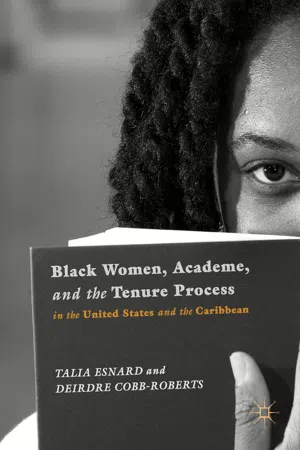
Black Women, Academe, and the Tenure Process in the United States and the Caribbean
- English
- ePUB (mobile friendly)
- Available on iOS & Android
eBook - ePub
Black Women, Academe, and the Tenure Process in the United States and the Caribbean
About this book
This book explores the meanings, experiences, and challenges faced by Black women faculty that are either on the tenure track or have earned tenure. The authors advance the notion of comparative intersectionality to tease through the contextual peculiarities and commonalities that define their identities as Black women and their experiences with tenure and promotion across the two geographical spaces. By so doing, it works through a comparative treatment of existing social (in)equalities, educational (dis)parities, and (in)justices in the promotion and retention of Black women academics. Such interpretative examinations offer important insights into how Black women's subjugated knowledge and experiences continue to be suppressed within mainstream structures of power and how they are negotiated across contexts.
Information
Topic
EducationSubtopic
Education General© The Author(s) 2018
Talia Esnard and Deirdre Cobb-RobertsBlack Women, Academe, and the Tenure Process in the United States and the Caribbeanhttps://doi.org/10.1007/978-3-319-89686-1_11. The Stony Road We Trod: Black Women, Education, and Tenure
Talia Esnard1 and Deirdre Cobb-Roberts2
(1)
University of the West Indies, St. Augustine, Trinidad and Tobago
(2)
University of South Florida, Tampa, FL, USA
Introduction
The focal point of our book is the comparative examination of Black women in higher education across the United States and the Caribbean, their professional experiences, and strategies for negotiating their institutional climates. We start therefore with an acknowledgment and shared epistemological position that while (post)colonialism , imperialism, and capitalism, as systems of domination, provide common sociohistorical experiences and structural realities for Black women in the United States and in the Caribbean, they do not represent a monolithic group; their localized experiences, and related specificities of such social locations, will produce diverse responses to systemic systems of oppression (Collins, 1990, 2000; Richardson, Bethea, Hayling, & Williamson-Taylor, 2010). Through our comparative examination of Black women in academe therefore we center the experiences of African American and Afro-Caribbean scholars (including those who work in the United States and in the Caribbean). In so doing, we explore the commonalities and peculiarities of experiences; while strengthening the understanding of Black women academics as a collective group.
We start our exploration of Black women in academe with a statement that Black women have historically struggled with limited opportunities and a wealth of structurally related challenges in their educational pursuits. We also contend, that it is these very challenges, namely; the historical legacy of slavery , its’ legacies of racism , sexism, and classism, the gendered role that women were expected to adopt, and the perception of their primary roles as caregivers, that have collectively constrained and enabled the personal and professional experiences of Black women . In many ways, we also assert that sociopolitical, ideological, and economic factors have historically contributed to, and continue to affect their marginalized status . These factors have also shaped the ways in which they are perceived and received, as well as, their experiences within institutions of higher education , (albeit to varying degrees and with varied complexities across geographies).
In the contemporary era, these structures of power have not only grown in complexity, but also continue to challenge the access to and positionality of Black women within higher education . We also see this as ultimately shaping the ways in which they perceive, experience and attempt to negotiate their professional journeys, as well as, their own experiences with tenure and promotion within their institutionalized spaces. Collectively, these domains of power condition and position the prospects for Black women in higher education ; specifically, as it relates to their recruitment , retention , and promotion. We specifically use that examination of the historical and contemporary context as a starting point not just to underscore issues of institutionalized marginality and vulnerability of Black women in academe , (who already lack a critical mass to sustain their presence), but to also call attention to the meaning and value of tenure within such milieu. We move our discussion therefore with a reflection on the challenges Black women have encountered within academe in both the United States and the Caribbean as well as an exploration of the meaning, value, and challenges of tenure . In so doing, we particularly center the situations and narratives of Black women in academe.
History of Black Women and Education in the United States
So far, how Black women have been viewed within United States society has remained part of a secondary conversation . Perhaps, this secondary nature of Black experience in the United States can be linked to the fact that they live in a society that “historically and routinely derogates women of African descent” (Collins, 2000, p. 42). When discussing the history of Black women in academe , it is important therefore to reflect on their overall experiences with education; including personal desire and commitment, as well as, how the larger society regarded their ability to become educated. We center the issues of Black women therefore to show how the legacies of slavery have particularly affected them.
As a starting point, we draw attention to the fact that these women (as well as Black men) had been historically isolated from educational opportunities . In reality, being educated during the period of slavery was illegal and the consequence often meant death or the loss of limbs (Anderson, 1988). This emerged out of the fact that southern planters saw the education of African Americans as unnecessary and as the source of potential problems (i.e. slave uprisings, notions of superiority). However, we note that this reality did not deter nor quell the desire of Blacks to want to pursue learning and higher education . Once they entered into the educational realm, their pursuit of education would not only distance them from their communities but seek to threaten their relationship with Black men.
Historically Black women were not afforded the luxury of occupying a social space that was separate from Black men; they shared the same legacy of lacking humanness and having their worth measured through the lens of representing 3/5 of a person (Perkins, 1983). This fact would begin to change following the period of enslavement to a degree but one that is rather insignificant. Du Bois (2003, p. 169) for instance stressed on the “crushing weight of slavery … on Black women ”; that is, how they conceived themselves, their struggles with identity , legitimacy across various social institutions and processes within their respective societies. Such scholarship remains part of a broader discussion on how Black people were systematically denied access to basic civil and human rights as a result of the institution of slavery . This institution provided the foundation and framework from whence socialization around race and gender began. Blacks in general would still endure the legacy of slavery for years to come along with the stigma attached to having been victimized by the institution of slavery . With the institution of slavery came the subsequent effects that Black people in general and Black women in this particular case, are facing the exigencies of racism within the academy.
Women’s access to education however have changed. Following the signing of the Emancipation Proclamation in 1863 , Historically Black Colleges and Universities1 (HBCU ’s), mainly in the southern region of the United States, were the only institutions open to and responsible for providing higher education for Blacks in general and in the case of this work, Black women . There was a proliferation of colleges that had been founded as early as the mid-sixteenth century (i.e. Harvard, Yale, and Princeton) and the other institutions that followed, including small women’s colleges. However, these predominately White universities (PWIs)2 were closed to Blacks (Dawkins, 2012; Glover, 2012) and it was not until the 1964 with the Civil Rights Act and later in 1974 with the Equal Opportunities Act that government intervention provided support for African Americans to access higher education (Bruner, 2010). After this period, Black women sought an education and understood the necessary sacrifice in advancing their knowledge. Many Black women traveled to attend an HBCU in an effort to receive a college education. Further, as a result of the political economy following the period of enslavement Black women also understood that to pursue education beyond what was offered at HBCU ’s they would have to travel north, where seemingly they were allowed greater access to graduate education at PWI ’s, although the numbers of Black women in attendance was rather low, as these institutions were more “open” but still restricted Black female enrollment. The exception perhaps to the rule was Oberlin College, where it appears they admitted Black students which included Black women at fairly competitive rates (Perkins, 1988). Southern White institutions were closed to Black women and as such HBCUs generated the majority of Black graduates, including women (Evans, 2007). However, it is critical to note that although education was being afforded to both Black men and Black women , the women suffered an additional layer of marginality . Black women were regarded as less capable than their White female and Black male counterparts.
Linda Perkins (1983) in her work “The Impact of the ‘Cult of True Womanhood ’ on the Education of Black Women ” describes a situation, a contrasting societal view and expectation of Black women from what White women experienced. Black women were not adorned with the notion of true womanhood . Perkins stated, this ‘true womanhood ’ model was designed for the upper- and middle-class White woman, although poorer White women could aspire to this status. However, since most Blacks had been enslaved prior to the Civil War and the debate as to whether they were human beings was a popular topi...
Table of contents
- Cover
- Front Matter
- 1. The Stony Road We Trod: Black Women, Education, and Tenure
- 2. Changing Educational Landscapes: The Challenge of Academic Capitalism
- 3. Experiences of Black Women in Academe: A Comparative Analysis
- 4. Black Women in Higher Education: Toward Comparative Intersectionality
- 5. Comparative Intersectionality: An Intra-Categorical Approach
- 6. Black Women in Academe: A Duo-Ethnography
- 7. Experiences of Black Women in the Caribbean Academy
- 8. Afro-Caribbean Women in the US Academy
- 9. Black Women in the US Academy
- 10. Still We Rise: Struggle, Strength, Survival, and Success
- Back Matter
Trusted by 375,005 students
Access to over 1.5 million titles for a fair monthly price.
Study more efficiently using our study tools.
Frequently asked questions
Yes, you can cancel anytime from the Subscription tab in your account settings on the Perlego website. Your subscription will stay active until the end of your current billing period. Learn how to cancel your subscription
No, books cannot be downloaded as external files, such as PDFs, for use outside of Perlego. However, you can download books within the Perlego app for offline reading on mobile or tablet. Learn how to download books offline
Perlego offers two plans: Essential and Complete
- Essential is ideal for learners and professionals who enjoy exploring a wide range of subjects. Access the Essential Library with 800,000+ trusted titles and best-sellers across business, personal growth, and the humanities. Includes unlimited reading time and Standard Read Aloud voice.
- Complete: Perfect for advanced learners and researchers needing full, unrestricted access. Unlock 1.5M+ books across hundreds of subjects, including academic and specialized titles. The Complete Plan also includes advanced features like Premium Read Aloud and Research Assistant.
We are an online textbook subscription service, where you can get access to an entire online library for less than the price of a single book per month. With over 1.5 million books across 990+ topics, we’ve got you covered! Learn about our mission
Look out for the read-aloud symbol on your next book to see if you can listen to it. The read-aloud tool reads text aloud for you, highlighting the text as it is being read. You can pause it, speed it up and slow it down. Learn more about Read Aloud
Yes! You can use the Perlego app on both iOS and Android devices to read anytime, anywhere — even offline. Perfect for commutes or when you’re on the go.
Please note we cannot support devices running on iOS 13 and Android 7 or earlier. Learn more about using the app
Please note we cannot support devices running on iOS 13 and Android 7 or earlier. Learn more about using the app
Yes, you can access Black Women, Academe, and the Tenure Process in the United States and the Caribbean by Talia Esnard,Deirdre Cobb-Roberts in PDF and/or ePUB format, as well as other popular books in Education & Education General. We have over 1.5 million books available in our catalogue for you to explore.