Combining the conceptual tools of interactionist and social constructionist positions, this book presents an in-depth investigation of emotions in digital interactions. Through the central case study of online bereavement communities for women who have suffered perinatal loss, this volume highlights the significance of affective sanctioning as constitutive of group dynamics and practice. The authors chart the emergence of a new ethnopsychology of motherhood—the category of 'Angels' Mothers'—arising from the localized practices of a community whose experience of grief is otherwise disenfranchised. Through their detailed theoretical exploration of the centrality of micro-situational dynamics, alongside the rich empirical illustration of collectively shared feeling rules and norms, Rafanell and Sawicka develop a naturalistic approach to the analysis of empirical data, providing insights for policy-making interventions.
eBook - ePub
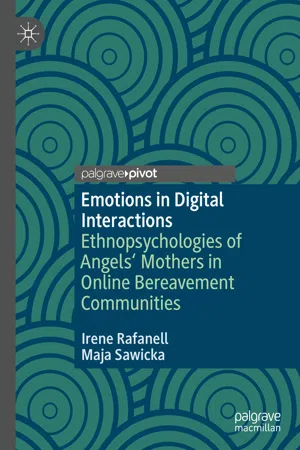
Emotions in Digital Interactions
Ethnopsychologies of Angels' Mothers in Online Bereavement Communities
- English
- ePUB (mobile friendly)
- Available on iOS & Android
eBook - ePub
Emotions in Digital Interactions
Ethnopsychologies of Angels' Mothers in Online Bereavement Communities
About this book
Information
© The Author(s) 2020
Irene Rafanell and Maja SawickaEmotions in Digital Interactionshttps://doi.org/10.1007/978-3-030-21998-7_11. Introduction
Irene Rafanell1 and Maja Sawicka2
(1)
Division of Social Sciences, University of the West of Scotland, Paisley, UK
(2)
Institute of Sociology, University of Warsaw, Warsaw, Poland
Abstract
This introductory chapter outlines the theoretical framework developed, and the empirical investigation undertaken, in order to explore the emergence of a new ethnopsychology of motherhood in online bereavement communities. It adopts a constructionist approach which claims that new reality emerges from the coinage of new linguistic terms to refer to individuals’ experiences. Key to this position is the claim that linguistic categories emerge as collective goods, i.e. social conventions. Such a claim, in itself, is not novel in the field of the sociology of emotions, which recognizes that emotions are both psycho-physiological and social in nature, and that social factors (including linguistic terms through which individuals identify and name their feelings) participate in the constitution of emotional experiences. However, the authors point out that such approaches perceive emotions as the result of social forces, neglecting their constitutive nature. Emotions not only emerge from social arrangements, but also act as causal forces that bring particular social phenomena into being. A central aim of the book is to identify the methods and mechanisms underpinning the emergence of a new emotional life-world. Such an approach builds upon symbolic interactionist and ethnomethodological tenets, further developing them by incorporating insights from the sociology of knowledge.
Keywords
LanguageLife-worldSociology of emotionsPhenomenologyInteractionismEthnopsychologyThe limits of my language are the limits of my world, noted Wittgenstein. This well-known statement can be interpreted as declaring that without categories which describe particular individual experiences, such experiences can pass unrecognized both by society and, crucially, by the individual herself. In this book, we aim to expose how, in order to make real a particular experience, collectives must have the adequate linguistic terms. When linguistic terms that are available to community members are inadequate to describe experiences, new terms must be created. We reveal how a particular subjective emotional experience becomes a reality by the coining of a new set of language categories, which allow it to exist. We do so by investigating online bereaved communities of women who have experienced perinatal loss. The core of this exploration rests on the tenet that the individual sense of an emotional experience being real emerges as a collective convention. Such collective conventions, we argue, are the product of dynamics of identifiable mechanisms operating in and through interaction, such as affective sanctioning, inter-group inclusion or exclusionary practices, and, in particular, the establishment of shared knowledge and linguistic categories. The aim of this book is to reveal the mechanisms by which communities of individuals, who do not find appropriate recognition of their subjective experience in their communities of origin, constitute new social phenomena to validate their personal emotional experience.
In the field of the sociology of emotions, it has been widely acknowledged that subjective emotional experiences are shaped by localized cultural factors (Denzin, 1990; Gordon, 1990; Hochschild, 2003; Lofland, 1985; Thoits, 1989; Wierzbicka, 1999; for an anthropologist account see also Wikan, 1990). Such an approach recognizes that emotions are not merely psycho-physiological phenomena but social as well. Social factors, such as linguistic categories through which individuals identify and name their feelings, participate in the constitution of the feelings themselves. The concept of ethnopsychology—that is, the emotional life-world that individuals share and experience together—captures the relation between cultural factors and the individual psychic structures that emerge from being embedded in a particular social context. In the understanding proposed by Thoits (1989), ethnopsychology encompasses the body of shared beliefs about emotions existing within a collective, including:
rules regarding what one should and should not feel or express; ideologies about emotions such as romantic love; shared understandings of the typical onsets, sequences, and outcomes of emotional experiences and interactions; socially defined exemption periods from expectations of emotional conformity; and beliefs about which emotions can and cannot be successfully controlled. (Thoits, 1989: 322)
As such, an ethnopsychology circumscribes individual subjective emotional experiences with reference to the collectively held norms which regulate feeling. In this sense, the concept of ethnopsychology is a useful analytical tool to capture and understand the differentiation of emotional subcultures, allowing light to be shed on the variable and changing nature of emotional life-worlds. This is a sociological position which perceives emotions as the result of the social context and the interactive dynamics present in such a context (e.g. Gordon, 1990).
The concept of ethnopsychology allows for the identification and description of phenomena such as norms, vocabularies, and beliefs, pertaining to emotions. In other words, that which emerges from social dynamics in terms of what are to be the relevant emotions to be experienced by members of a particular ethnopsychology. However, important as it is in terms of recognizing the social nature of emotions, such an approach is not conducive to the understanding and explanation of how these phenomena come to be, or how exactly they operate in generating, patterning, and ordering the subjective emotional life-worlds.
In this book, we argue that emotions should not only be understood as the result of social arrangements, but also as causal forces that bring particular social phenomena into being. We claim that a more in-depth explanatory framework of the emergence of an emotional life-world must uncover and identify those methods and mechanisms underpinning its generation. Central to our position is the claim that in and through interaction, new forms of collective identity, and patterns of feelings and actions, emerge. Such an approach explains an ethnopsychology as a collective phenomenon which goes beyond individual experience and derives from the interactional micro-situational dynamics. Further, we claim that particular methods, in particular affective sanctioning mechanisms, are key to the constitution of ethnopsychologies. In this sense, we argue that emotions should be seen not only as outcomes of social dynamics, but also as possessing a key causal and thus constitutive role in forming social phenomena, including (paradoxically) emotions themselves. We present a detailed analysis of how pride and shame operate as the methods which individuals who have suffered perinatal loss use when they interact with others, and which underpin the emergence of a local ethnopsychology of motherhood.
Our use of the concept of methods embraces, and further develops, the interactional approach. Symbolic interactionists, following Heidegger’s phenomenological premise that the self should be understood as being in the world ‘in the context of being with others’ (Heidegger, 2011 [1927]: 152), have widely acknowledged the existential modality of the ‘social’, and defined individual subjectivity as emerging in and through interaction. Based on a long tradition emerging from the philosophical movement of phenomenology, particular schools of sociology have highlighted the profound significance of inter-subjective communication as the basis for the construction of social reality (Berger and Luckmann, 1991 [1966]). Ethnomethodology in particular, an interactionist approach developed by Garfinkel (1999), has provided a rich conceptual foundation to help understand how, through the dynamics of ‘being with others’, social life emerges. Ethnomethodology, as its name reveals, has placed emphasis on the ‘methods’ employed by individuals when interacting with each other, in order to make sense of each other’s actions and accounts. Methods, in this context, have to be understood as the procedures, techniques, strategies, tactics, means, and routines which individuals use in order to successfully navigate such interactions. The ‘ethno’ prefix denotes both the fact that ordinary people engage in these kinds of methods in everyday interactions, and that they do so within demarcated groups. Thus, in ethnomethodological parlance, methods refers to the ways and means which individuals employ to produce stable and intelligible social order and smooth interactions. The suffix ‘ology’ implies the study or logic of these methods (Rawls, 2003: 123).
In applying such an understanding to the set of emotions existing within a demarcated group, we can likewise argue that those methods also order and produce the emotional constellation of said group, generating particular ethnopsychologies. This means that through such methods, feelings also become normalized—and thus commonsensical—within recognizable constellations of emotions to all the members of a community. In other words, these feelings become taken for granted and unquestionable for those members, and such normalized emotions become the background platform underpinning the set of emotional practices. More significant, however, is that such taken-for-granted categories of feelings, beliefs, and practices not only generate that which is to be taken as normal, but, consequently, define what is considered deviant. Becker, a symbolic interactionist author of similar methodological orientation to ethnomethodology, defines as deviant those who break the rules agreed by a group and, as such, they become outsiders (Becker, 1963). Therefore, deviance must be understood as relative in nature and linked to a particular set of rules a...
Table of contents
- Cover
- Front Matter
- 1. Introduction
- Part I. Emotions, Social Interaction, and Structural Phenomena
- Part II. The Emergence of a New Ethnopsychology of Motherhood
- Back Matter
Trusted by 375,005 students
Access to over 1.5 million titles for a fair monthly price.
Study more efficiently using our study tools.
Frequently asked questions
Yes, you can cancel anytime from the Subscription tab in your account settings on the Perlego website. Your subscription will stay active until the end of your current billing period. Learn how to cancel your subscription
No, books cannot be downloaded as external files, such as PDFs, for use outside of Perlego. However, you can download books within the Perlego app for offline reading on mobile or tablet. Learn how to download books offline
Perlego offers two plans: Essential and Complete
- Essential is ideal for learners and professionals who enjoy exploring a wide range of subjects. Access the Essential Library with 800,000+ trusted titles and best-sellers across business, personal growth, and the humanities. Includes unlimited reading time and Standard Read Aloud voice.
- Complete: Perfect for advanced learners and researchers needing full, unrestricted access. Unlock 1.5M+ books across hundreds of subjects, including academic and specialized titles. The Complete Plan also includes advanced features like Premium Read Aloud and Research Assistant.
We are an online textbook subscription service, where you can get access to an entire online library for less than the price of a single book per month. With over 1.5 million books across 990+ topics, we’ve got you covered! Learn about our mission
Look out for the read-aloud symbol on your next book to see if you can listen to it. The read-aloud tool reads text aloud for you, highlighting the text as it is being read. You can pause it, speed it up and slow it down. Learn more about Read Aloud
Yes! You can use the Perlego app on both iOS and Android devices to read anytime, anywhere — even offline. Perfect for commutes or when you’re on the go.
Please note we cannot support devices running on iOS 13 and Android 7 or earlier. Learn more about using the app
Please note we cannot support devices running on iOS 13 and Android 7 or earlier. Learn more about using the app
Yes, you can access Emotions in Digital Interactions by Irene Rafanell,Maja Sawicka in PDF and/or ePUB format, as well as other popular books in Social Sciences & Social Psychology. We have over 1.5 million books available in our catalogue for you to explore.