eBook - ePub
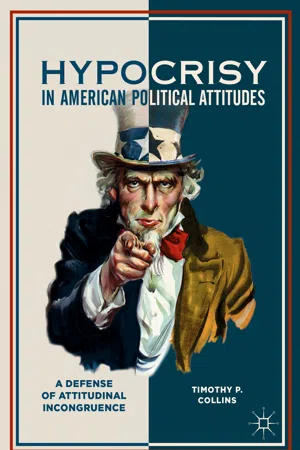
Hypocrisy in American Political Attitudes
A Defense of Attitudinal Incongruence
- English
- ePUB (mobile friendly)
- Available on iOS & Android
eBook - ePub
About this book
This book illuminates, and ultimately defends, attitudinal hypocrisy within the personal politics of Americans by utilizing statistical analyses within political history, social psychology, public opinion, and political science. Within a simple and parsimonious model of political attitudes, along with a novel method of calculating and operationalizing what attitudinal hypocrisy is, the book argues that the wielding of conflicting attitudes is a necessary characteristic of the American electorate. It uses an innovative multidisciplinary approach to answer some of the most pervasive questions in American politics: Why do conservatives preach the value of economic libertarianism, but decry the lack of government involvement in social issues and the military? Why do liberals extol the virtues of a regulatory economic state, but not a cultural or military state?
Information
© The Author(s) 2018
Timothy P. CollinsHypocrisy in American Political Attitudeshttps://doi.org/10.1007/978-3-319-54012-2_11. Introduction
Timothy P. Collins1
(1)
Political Science, St. Olaf College, Northfield, Minnesota, USA
BURR: The Constitution’s a mess
HAMILTON: So it needs amendments!
BURR: It’s full of contradictions
HAMILTON: So is independence!
—“Non-Stop” by Lin-Manuel Miranda ( 2015 )
To human society, hypocrisy is a negative trait (see Grant, 1997, pp. 1–2; Hale & Pillow, 2015; Kurzban, 2010). Akin to the contradictions in the US Constitution—as illustrated in the exchange from Hamilton: An American Musical above—the contradiction that emerges with the betrayal of one’s espoused principles is a universally disreputable characteristic throughout nearly all communities (Kurzban, 2010), and has been for millennia: a regular character flaw in Greek comedies (Oliver, 1960, p. 24); an engine for subjugation in Taoism (see Aronson, 2003, p. 97); and a sin of horror in the Christian Gospels (see Oliver, 1960, pp. 54–55) and Satanism (Lott, 2006, p. 77). Within the Eighth Circle of Hell in Dante’s Inferno is a ditch reserved for hypocrites who, because of their transgressions, had been damned to forever trudge in tightly packed circles while under the leaden weight of dazzling and golden hooded cloaks heavier than anything humans could make (Canto XXIII: 64–66; see Durling, 1996, pp. 348–349).
The moral hypocrisy in the examples above serves as a vibrant and vital area of interdisciplinary study (see Lott, 2006), with constantly updating volumes of exemplifications in American politics (see Lott, 2006; Stark, 1997; e.g., Rhodes, 2009; Van Natta, 2002). But, moral hypocrisy is not the focus of this book.
Instead, this book’s focus is on attitudinal hypocrisy.
The wielding of hypocritical attitudes in politics—that is, opinions that conflict with and logically contradict each other—is internalized and weaponized as an off-shoot of moral hypocrisy (Runciman, 2008; see, e.g., Schultz, 2016, pp. 24–25). As illustrated in the accusatory and brazen examples below, the interrogative of “Isn’t that hypocritical” has served as a leitmotif of American political discourse in syntheses of government intervention or indifference for centuries, in various but interrelated forms—for example, the supposed violation of government philosophy (viz., limited government versus active government), or the supposed violation of one issue stance’s underlying logic (e.g., abortion rights and the death penalty). The treachery in the ditch of general hypocrisy still swirls around in this realm, but—as I hope to demonstrate in this book—it takes very little thought to realize that having logically contradictory political attitudes is not even in the same moral universe as the damned souls of Dante : Instead, the dichotomy of government having a role to play in one political arena but not another is a stipulation of involvement in any society with any type of government and a net positive for American politics. In other words, brandishing attitudes that do not logically fit with each other is an absolute necessity for those who wish to have any degree of an effect on politics in the United States.
But, in spite of attitudinal hypocrisy being a required component of modern democracy and political participation, it has not stopped its use as an attack since even the foundations of the American experiment.
1.1 Illustrating Attitudinal Hypocrisy and Attacks Because of It
Illustration 1: Hamilton on Jefferson. As an early example, Alexander Hamilton attacked the logical inconsistency of Thomas Jefferson and his acolytes for failing to, essentially, think things through, writing in 1792,
A certain description of men are for getting out of debt; yet are against all taxes for raising money to pay it off; they are amongst the foremost for carrying on war, and yet will have neither loans nor taxes. They are alike opposed to what creates debt, and to what avoids it. (Hamilton, 1851, p. 31)
Later, after calling Jefferson “a contemptible hypocrite” who is, nonetheless, not enough of a “zealot … to do anything in pursuance of his principles which will contravene his popularity, or his interest” in 1801 (Hamilton, 1879, p. 454), Hamilton was quietly “amused” when his synthesis was supported in Jefferson’s 1803 orchestration of the Louisiana Purchase (Chernow, 2004, p. 671). This series of actions by Jefferson doubled US territory, which, without question, stood in direct violation of Jefferson’s oft-stated core values, principles, and doctrines of government: constructionism and at-all-costs limitations on federal power (Balleck, 1992, p. 692)—which, critically, have also come to define modern libertarianism (Iyer, Koleva, Graham, Ditto, & Haidt, 2012). Jefferson did what he could to keep his close and direct involvement with the Louisiana Purchase plan from being known, because he feared that Federalists would oppose and “attack any sentiment or principle” that came from him with “bloody teeth and fangs,” and feared “what blackguardisms and personalities they make it the occasion of vomiting forth” (Peterson, 1970, pp. 781–782).
Jefferson was correct in this prediction (Peterson, 1970, p. 782), with most Federalists opposing the Louisiana Purchase , and doing so on—ironically and hypocritically—strict-constructionist grounds (Chernow, 2004, p. 671). For example, John Quincy Adams—whose own principles of government are “Hamiltonian” themselves (Nester, 2013, p. 304)—wrote in an 1821 diary entry that,
the Louisiana purchase was in substance a dissolution and recomposition of the whole Union. It made a Union totally different from that for which the Constitution had been formed. It gives despotic powers over the territories purchased. It naturalizes foreign nations in a mass. It makes French and Spanish laws a part of the laws of the Union . It introduces whole systems of legislation abhorrent to the spirit and character of our institutions, and all this done by an Administration which came in blowing a trumpet against implied powers. After this, to nibble at a bank, a road, a canal, the mere mint and cummin of the law, was but glorious inconsistency. (Adams, 1875, p. 401)
Incidentally, Adams’s own presidency began in 1825 with an inaugural address that laid out ambitious plans and policy proposals in line with a philosophy of expansive, powerful government unconstrained by the strict constructionists’ reading of the Constitution (Nester, 2013, p. 304). This lies in obvious and plain contrast to Adams’s criticisms of Jefferson for doing just that.
Put simply, Jefferson indeed acted in direct violation of his philosophy of government and was attacked for that violation. But, along with some of the most vehement charges of hypocrisy came elegant exemplifications of hypocrisy.
Illustration 2: Mailer on Buckley. In a 1962 debate with William F. Buckley , Norman Mailer granted Buckley’s earlier premise on liberal elites ’ policy failures before calling out the “contradictory stew of reactionaries and individualists, of fascists and libertarians” who subscribe to Buckley’s conservatism at the group level (Mailer, 1963, p. 163). Many within “the Right Wing,” Mailer contends, are not individualists (p. 167). He continues,
The Right Wing knows better than I would know how many of them are collectivists in their own hearts, how many detest questions and want answers, loathe paradox, and live with a void inside themselves, a void of fear, a void of fear for the future and for what is unexpected, which fastens upon Communists and equal, one to one, with the Devil. The Right Wing often speaks of freedom when what it desires is iron law, when what it really desires is collectivism managed by itself. If the Right Wing is reacting to the plague, all too many of the powerful people on the Right—the presidents of more than a few corporations in California, for example—are helping to disseminate the plague. (Mailer, 1963, pp. 167–168)
In essence, Mailer argued that the philosophy of small and limited government for which Buckley so vociferously advocated was simultaneously contradicted by the militarism that was also advocated, and—to Mailer—this was a core dissonance in contemporary conservative thought (Schultz, 2016, pp. 24–25).
Illustration 3: Reed and Ingraham’s Defense. In mid-April 2013, a debate for the podcast and radio show Intelligence Squared U.S. was held in New York City on the topic of the future of the Republican Party and conservative principles. About one hour in, Ralph Reed—among the most important organizers behind several iterations of the conservative vot...
Table of contents
- Cover
- Frontmatter
- 1. Introduction
- 2. What Is Attitudinal Hypocrisy and Why Does It Matter?
- 3. Psychological Dispositions, Political Orientations, and a Theoretical Framework of Ideological Differences in Attitudinal Hypocrisy
- 4. Gay Is the New Black (but Black Is Still Black): The History and Current Trends of Attitudinal Hypocrisy
- 5. Analyzing and Predicting Hypocrisy in the Electorate
- 6. Having Your Cake and Eating It Too: Using Cognitive Dissonance to Explore Attitudinal Hypocrisy
- 7. What Good Is Cake If You Can’t Eat It? Prescriptions for and Conclusions About American Attitudinal Hypocrisy
- Backmatter
Trusted by 375,005 students
Access to over 1.5 million titles for a fair monthly price.
Study more efficiently using our study tools.
Frequently asked questions
Yes, you can cancel anytime from the Subscription tab in your account settings on the Perlego website. Your subscription will stay active until the end of your current billing period. Learn how to cancel your subscription
No, books cannot be downloaded as external files, such as PDFs, for use outside of Perlego. However, you can download books within the Perlego app for offline reading on mobile or tablet. Learn how to download books offline
Perlego offers two plans: Essential and Complete
- Essential is ideal for learners and professionals who enjoy exploring a wide range of subjects. Access the Essential Library with 800,000+ trusted titles and best-sellers across business, personal growth, and the humanities. Includes unlimited reading time and Standard Read Aloud voice.
- Complete: Perfect for advanced learners and researchers needing full, unrestricted access. Unlock 1.5M+ books across hundreds of subjects, including academic and specialized titles. The Complete Plan also includes advanced features like Premium Read Aloud and Research Assistant.
We are an online textbook subscription service, where you can get access to an entire online library for less than the price of a single book per month. With over 1.5 million books across 990+ topics, we’ve got you covered! Learn about our mission
Look out for the read-aloud symbol on your next book to see if you can listen to it. The read-aloud tool reads text aloud for you, highlighting the text as it is being read. You can pause it, speed it up and slow it down. Learn more about Read Aloud
Yes! You can use the Perlego app on both iOS and Android devices to read anytime, anywhere — even offline. Perfect for commutes or when you’re on the go.
Please note we cannot support devices running on iOS 13 and Android 7 or earlier. Learn more about using the app
Please note we cannot support devices running on iOS 13 and Android 7 or earlier. Learn more about using the app
Yes, you can access Hypocrisy in American Political Attitudes by Timothy P. Collins in PDF and/or ePUB format, as well as other popular books in Politics & International Relations & American Government. We have over 1.5 million books available in our catalogue for you to explore.