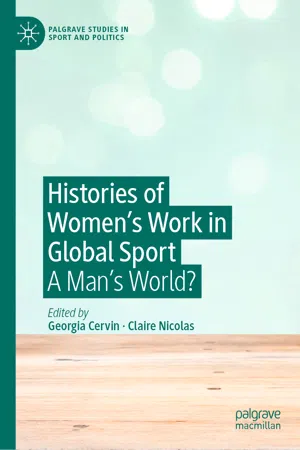
Sport has never been a man's world. As this volume shows, women have served key roles not only as athletes and spectators, but as administrators, workers, decision-makers, and leaders in sporting organizations around the world. Contributors excavate scarce archival material to uncover histories of women's work in sport, from swimming teachers in nineteenth-century England to national sports administrators in twentieth-century Côte d'Ivoire, and many places in between. Their work has been varied, holding roles as teachers, wives, and secretaries in sporting contexts around the world, often with diplomatic functions—including at the 1968 and 1992 Olympic Games. Finally, this collection shows how gender initiatives have developed in sporting institutions in Europe and international sport federations today. With a foreword by Grégory Quin and afterword by Anaïs Bohuon, this is a pioneering study into gender and women's work in global sport.
eBook - ePub
Histories of Women's Work in Global Sport
A Man’s World?
- English
- ePUB (mobile friendly)
- Available on iOS & Android
eBook - ePub
Histories of Women's Work in Global Sport
A Man’s World?
About this book
Information
© The Author(s) 2019
G. Cervin, C. Nicolas (eds.)Histories of Women's Work in Global SportPalgrave Studies in Sport and Politicshttps://doi.org/10.1007/978-3-030-26909-8_11. Introduction
Georgia Cervin1 and Claire Nicolas2
(1)
The University of Western Australia, Crawley, WA, Australia
(2)
University of Lausanne, Lausanne, Switzerland
Georgia Cervin (Corresponding author)
Claire Nicolas
Introduction
Sport has been referred to as a man’s world, a masculine domain, and similar varieties of this idea appear across all disciplines that have studied it. Historians of sport are no exception. Certainly, the idea of sport as a male-dominated pursuit is supported by most literature in sport history, wherein women protagonists are so exceptional that they become part of a sub-sub-discipline of their own: women’s sport history. Yet, can this really be the case? In this book, we question the assumption of sport as a man’s world even within the apparently tight male networks of sport administrative leadership, hence our title. Indeed, we show that women have long been present in the world of sport as wives, administrators, officials, volunteers, and professionals. These relations and roles have evolved over the last century, but we demonstrate that around the world, women have long been present in sport.
One challenge in proving this is in the way historians often find information about the past. Archives are as much reflections of the priorities and worldviews of past cultures as they are repositories of the information they hold. Since the institutionalization of modern sport around the turn of the twentieth century, many sporting archives have upheld the values of their time: heroism, masculinity, and a fundamental idea that men occupy the public space. Thus, we find that such archivists failed to record or preserve information about what women were doing in sport as a public place, where they were often not allowed to compete, hence not able to become heroic victors worthy of recording.
Underlying this problem in sport historians’ principle data source is the very conception of what is important in sport. Athletes are obvious protagonists in many sport histories, and not without cause. They perform central roles in sport and are often the most visible characters in the culture. But such a focus perpetuates a bias towards men in the way we record and write sport history. Challenging this assumption; critically questioning our focus, allows us to see more women come into view as we broaden our gaze. This is the essential premise of this collection. Our contributors reflect on methods, frameworks, and ways of doing sport history, as well as the challenge of finding women in the sporting past. But fundamentally, each of these chapters shows that employing a broader gaze on the sporting past sees new, often female, characters come to light. The result that we try to illuminate here, is not only a more diverse sport history canon, but also one that is more comprehensive in the way it addresses the past.
Aims and Objectives
The aim of this book is twofold: first, to demonstrate the many ways women have been involved in sport over the last century, and second, to reflect on historical practices that have hindered and helped sport historians to include women in their work . Our objectives are to anchor women’s sport history through the use of biography and questions around women’s private lives and lived experiences in the sporting world. We asked our contributors to “find” women in their various sporting contexts; different nations, sports and institutions, and write about them. We aimed for their analyses to include assessment of how and why women have been present, visible, or hidden in each of these contexts. And we called on our authors to critically reflect on the challenges, methods, and sources required to answer this call.
In this volume, we show that removing the emphasis on athletes and instead focusing on work, brings new figures into view. Equally, some of our authors offer commentary on the absence of women figures in various places. The scope of the following chapters runs from the late nineteenth century to today, with historians and sociologists evaluating the various personalities, initiatives, and steps forward and backward, that women have faced in their engagement in sport around the world. This is history from below, while focusing our view, in many cases, on the elite organizations that sustain sport.
Background
As Pascal Delheye has shown, sport history has flourished in kinesiology departments around the world. However, as a result it has been approached from many disciplines, seeking to legitimize its place in such departments.1 Conversely, sport history as it is approached by trained historians seeks to go further than “recovering” facts about the sporting past.2 Indeed, spurred by E. H. Carr’s What Is History?, “historians are seeking to not only understand sport itself but to use sport as a lens through which to understand the historical development of the wider society they are studying.”3 Our contributors, are for the most part, historians seeking to do just that. But it is impossible to understand sport itself if we do not take account of those governing it, and that is what we seek to uncover in this volume. The chapters nearer the end of this collection demonstrate how historians can engage in dialogue with other disciplines: sociologists of sport demonstrate the different methods they use for their more contemporary studies, and in doing so offer solutions to some of the challenges historians of sport face.
This volume is built at the intersection of three fields of the history of sport: gender history, history of sporting institutions and biographical history. We argue that this intersection allows a more nuanced understanding of sports administration, re-placing women within a broader social context. We contend that in examining sporting institutions, one enquires into the sub-discipline itself in its production of male-centric works. Delheye questions whether feminists have been compelled to use male techniques to obtain scientific status in interdisciplinary departments, or indeed, whether the entire field is “masculinized” because of the Western masculine conception of sport.4 Indeed, Patricia Vertinsky observed that feminist sport historians have struggled with “the complex gendered power relations sustaining the role of the life sciences in legitimizing irreconcilable differences and the inferiority of the female sex.”5 That is, when writing about “women’s sport history” historians have perpetuated the separation of gender (and all its associated qualities) within the sports they study. Indeed, Osbourne and Skillen found that, despite the proclivity for women’s sport history in the early 1990s, it still remains understudied in the British context.6 Meanwhile Scott argued that “the history of women has kept ‘women’ outside of history. And the result is that ‘woman,’ as a natural phenomenon is reinscribed even as we assert that women are discursively constructed.”7
As the very vivid field of intersectional scholars showcased, understanding gender as “relational”8 quickly led sport historians to deconstruct9 their understanding of sporting institutions in terms of overlapping dominations: gender, but also social class, race, ability, and sexual orientation. Therefore, this book aims at questioning the presence of women at the top of the sporting hierarchy but also to explore the presence, absence and forgetting of non-“Northern” women leaders, as well as women gravitating around international sporting institutions: family or friendship networks, subaltern positions within the institutions.
As a growing number of scholars has been showing for the past few decades,10 feminist history of sport is more than studying women’s past involvement in sports and recovering a forgotten history (doing her-story instead of his-story). It also deals with raising new questions about women’s and men’s sporting culture and gender issues (for instance in terms of social domination, image, body control) within international administrations11 as well as reflexive and methodological issues12 on archive creation, data collection and so on. Therefore, we can ask ourselves how the presence, absence or the forgetting of women within international sporting institutions has shaped them? And, equall...
Table of contents
- Cover
- Front Matter
- 1. Introduction
- 2. Women in Sport Organizations: Historiographical and Epistemological Challenges
- 3. Late Nineteenth-Century Swimming Teachers in England
- 4. Gender Performances of Sports Organization Leaders: A Comparative (Re)Examination of Alice Milliat’s, Suzanne Lenglen’s and Marie-Thérèse Eyquem’s Trajectories
- 5. Ghost Administrators: Re-centring Marisa Bonacossa, Lydia Zanchi and Suzanne Otth Within International Sport Organizations
- 6. Unsung Women Federal Leaders Within the Labour Sport Federation in France, from Its Establishment to the Second Post-war Period
- 7. A Case Study Comparison of the Presence of Women in Two Olympic Organizing Committees: Mexico 1968 and Barcelona 1992
- 8. Having a Place of One’s Own: Doing a Feminist Ethnography of the Swiss Shooting Museum’s Archives
- 9. From Handball Courts to Ministries: The Cousins of Côte d’Ivoire
- 10. From the Carpet to the Executive Committee: Women Leading Women’s Gymnastics
- 11. The Promotion of Women in Sport Within the Council of Europe and the European Sport Conference from the 1960s to the 1990s
- 12. Women Within International Sports Federations: Contemporary Challenges
- 13. Afterword: Doing History of Gender and Sport—A Feminist Perspective as a French Sports Historian and Practitioner
- Back Matter
Trusted by 375,005 students
Access to over 1.5 million titles for a fair monthly price.
Study more efficiently using our study tools.
Frequently asked questions
Yes, you can cancel anytime from the Subscription tab in your account settings on the Perlego website. Your subscription will stay active until the end of your current billing period. Learn how to cancel your subscription
No, books cannot be downloaded as external files, such as PDFs, for use outside of Perlego. However, you can download books within the Perlego app for offline reading on mobile or tablet. Learn how to download books offline
Perlego offers two plans: Essential and Complete
- Essential is ideal for learners and professionals who enjoy exploring a wide range of subjects. Access the Essential Library with 800,000+ trusted titles and best-sellers across business, personal growth, and the humanities. Includes unlimited reading time and Standard Read Aloud voice.
- Complete: Perfect for advanced learners and researchers needing full, unrestricted access. Unlock 1.5M+ books across hundreds of subjects, including academic and specialized titles. The Complete Plan also includes advanced features like Premium Read Aloud and Research Assistant.
We are an online textbook subscription service, where you can get access to an entire online library for less than the price of a single book per month. With over 1.5 million books across 990+ topics, we’ve got you covered! Learn about our mission
Look out for the read-aloud symbol on your next book to see if you can listen to it. The read-aloud tool reads text aloud for you, highlighting the text as it is being read. You can pause it, speed it up and slow it down. Learn more about Read Aloud
Yes! You can use the Perlego app on both iOS and Android devices to read anytime, anywhere — even offline. Perfect for commutes or when you’re on the go.
Please note we cannot support devices running on iOS 13 and Android 7 or earlier. Learn more about using the app
Please note we cannot support devices running on iOS 13 and Android 7 or earlier. Learn more about using the app
Yes, you can access Histories of Women's Work in Global Sport by Georgia Cervin, Claire Nicolas, Georgia Cervin,Claire Nicolas in PDF and/or ePUB format, as well as other popular books in History & Social History. We have over 1.5 million books available in our catalogue for you to explore.