- English
- ePUB (mobile friendly)
- Available on iOS & Android
eBook - ePub
Editors Construct the Renaissance Canon, 1825-1915
About this book
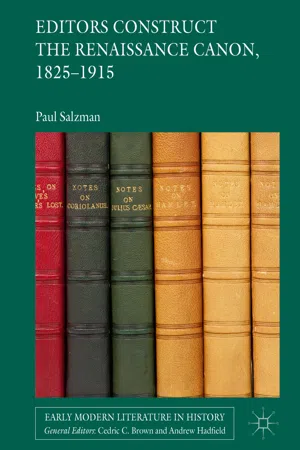
This book argues that nineteenth-century editors created the modern idea of English Renaissance literature. The book analyses the theories and practices of editors who worked on Shakespeare, but also on complete editions of a remarkable range of early modern writers, from the early nineteenth century through to the early twentieth century. It reassesses the point at which purportedly more scientific theories of editing began the process of obscuring the work of these earlier editors. In recreating this largely ignored history, this book also addresses the current interest in the theory and practice of editing as it relates to new approaches to early modern writing, and to literary and book history, and the material conditions of the transmission of texts. Through a series of case studies, the book explores the way individual editors dealt with Renaissance literature and with changing ideas of how texts and their contexts might be represented.
Information
© The Author(s) 2018
Paul SalzmanEditors Construct the Renaissance Canon, 1825-1915Early Modern Literature in Historyhttps://doi.org/10.1007/978-3-319-77902-7_11. Introduction: Redeeming the Editorial Tradition
Paul Salzman1
(1)
La Trobe University, Bundoora, VIC, Australia
1 Redeeming
In 1825, at the age of twenty-seven, Alexander Dyce edited an anthology of women’s poetry, beginning with the medieval writer Juliana Berners and ending with Dyce’s contemporary, Laetitia Landon. Dyce would go on to edit a considerable quantity of what we might now see as the heart of English Renaissance literature: Marlowe , Shakespeare , Middleton , Ford , Webster , Skelton , Beaumont and Fletcher , Peele , Shirley . And yet by the early twentieth century, Dyce and his editorial labours were almost invisible, made so by the purportedly more scientific editing which dominated the period from about 1920 to 1980 (as discussed in detail in my final chapter). For the small number of people who pore over the fine print of scholarly editions, including the lists of previous emendations that are confined to tiny print at the foot of the page or the back of the volume, Dyce’s name will appear on occasion, like a faint ghost whose intermittent bright idea is barely registered. Within the dominant field of Shakespeare editing , names like Dyce , Halliwell-Phillipps , Collier , Wright, pop up from time to time because Shakespeare scholars have in recent years developed a more acute sense of the history of their approaches to editing as well as to criticism. However, the detailed endeavours that marked nineteenth- and early twentieth-century editing have been largely ignored.1 This book is intended to remedy that neglect. I contend not only that these editorial endeavours are an important yet neglected aspect of literary and intellectual history, but that they played a significant role in shaping modern conceptions of the literary and cultural field of Renaissance literature.
This is not intended to be an exhaustive history of editing, as my focus is on some especially interesting and representative case studies. But my overall approach is intended to avoid the teleological error that seems to shape most accounts of the transmission of Renaissance writing. It is perhaps understandable that working editors need to justify their (extensive) labours by arguing that their editions supersede those of their predecessors. But editing is driven by ideology and fashion as much as any other endeavour within the humanities, and while there may be technical advances, it is far from the case that each edition is ‘better’ or more reliable than its predecessor. At the same time, the editing examined in this book shifted the very notion of what a suitable editorial subject might be, and the eliding of this process means that a key historical context for the transmission of early modern writing has been ignored. Editing changed radically from 1825 to 1915, but one significant factor that holds for much of the work done during this period is a generosity, and accompanying perseverance, that led to a massive expansion of access to Renaissance writing, from the sustained Complete Works editions undertaken by editors like Dyce , through to the collections and individual editions of pamphlets, jest-books , and other material once considered to be ephemeral and not worthy of notice. The result was an expanded notion of what could be known about the sixteenth and seventeenth centuries in Britain.
2 Canonising
Only in recent years have we caught up with the expansive notion of Renaissance literature explored and presented to readers by the editors discussed in this book. In his groundbreaking and influential analysis of the concept of the canon , John Guillory argued that the issue at stake in disputes over a literary canon is not the individual items/authors/works that might be slotted in and out of lists that constitute syllabuses, but rather the social forces at work in the very idea of a canon.2 Guillory’s subtle and detailed analysis underlines the nexus between systems of education and canon formation following the Enlightenment. In Guillory’s argument, the eighteenth century saw the category of ‘literature’ harnessed to a pedagogical imperative, and Guillory maintains that the social as well as cultural effects of repositioning the canon have to be viewed as part of a totality, rather than simply a shifting of individual items on a scale of evaluation:
It is always a mistake, then, to read the history of canon formation as though individual acts of revaluation had specific and determinable ideological effects simply determined by the choice of authors revalued, as though the revaluation, say, of Donne, could somehow infuse literary culture with attitudes, beliefs, or values peculiar to Donne or his milieu. The question before us is rather how the revaluation of particular authors alters the set of terms by which literature as a whole, or what we now like to call the canon, is represented to its constituency, to literary culture, at a particular historical moment.3
I have set out to show, in this book, how the activity of editing in the nineteenth century and into the early twentieth shifted what might perhaps be more accurately called a field, rather than a canon , of Renaissance literature. The nineteenth-century’s eclectic and wide-ranging representation of the Renaissance through a comprehensive, or at least vastly more comprehensive, editing process was reversed as the twentieth century turned away from nineteenth-century achievements to produce a restricted canon. This is the narrowing that has been analysed in relation to the teaching of Renaissance drama by Jeremy Lopez, who argues that the generous anthologies of the eighteenth and nineteenth centuries gave way in the twentieth century to a narrow series of collections of plays aimed at the tertiary student market.4 This process of bringing into being a Renaissance field, I argue here, is replicated across the creation of Complete Text Editions in the nineteenth century, as well as in the editing of more ephemeral works and authors. At the same time, the history of this process has been skewed by the unrelenting focus on Shakespeare. I have placed the editing of Shakespeare during this period in a much broader context, because it occurred within a general move to uncover what might be seen as the historically informed idea of early modern or Renaissance writing.
In part because of the work that has been done on the history of Shakespeare editing , the nineteenth century has been seen as a continuation of the eighteenth century focus on how ‘Shakespeare’ might be constituted as the exceptional Renaissance author, and how his works might properly be assembled and edited. As I will discuss in more detail in Chaps. 2 and 3, the trajectory of this Shakespearean focus has been explored most cogently by Margreta de Grazia in her study of how the Malone edition of Shakespeare worked towards a stabilisation of the Shakespeare text, and a focus on the singular author and his developing ‘career’ over time.5 Of course, it is not that there was no focus at all in the eighteenth century on Renaissance authors other than Shakespeare. Indeed, Jonathan Kramnick has argued that the notion of a select group of early authors (Spenser , Shakespeare, and Milton ) as a canon was a product of eighteenth-century critics’ anxieties over the encroachment of modernity , seeing a parallel in the fierce discussions over a literary tradition with the 1990s ‘crisis’ over the canon and its place in society.6 I would add to this that what one can see, generally, in the eighteenth century in terms of access, if not critical commentary, is an increasing focus on Shakespeare. It is not that this diminished in the nineteenth century, but, as the following chapters will show, the idea of what should be accessible moved from ‘just’ Shakespeare to the notion of a literary or even a writing culture that encompassed a large body of writers and works from the sixteenth and seventeenth centuries. Editing , in the broadest sense of ‘curated transmission’, placed in readers’ hands an idea of a valued and ever expanding amount of material that could characterise Renaissance culture in Britain.
3 Recovering
Accordingly, this book traces a new history of the transmission of Renaissance writing through a rich and heterogeneous editorial tradition. While, as I have noted, this is not an exhaustive account of all the editors and their editions in this period, it is a representative and chronological history of how editing brought into being a concept of the Renaissance as a literary/cultural field. At the same time, my research has revealed a considerably more impressive achievement than the received view of these editors has established in the minds of many scholars. Understanding this history also, I will argue, casts a useful light on recent developments in editing and editorial theory.
In Chap. 2, my focus is on the career of Alexander Dyce , which exemplifies the stock image of the indefatigable labours of a nineteenth-century bachelor-amateur-scholar. As I have already noted, Dyce’s editing began with...
Table of contents
- Cover
- Front Matter
- 1. Introduction: Redeeming the Editorial Tradition
- 2. Alexander Dyce
- 3. Constructing a Perfected Shakespeare Text
- 4. Amateurs, Professionals, and the Second Half of the Century
- 5. Scientific Professionals and Learned Amateurs
- 6. Conclusion: Forgetting the Past
- Back Matter
Trusted by 375,005 students
Access to over 1.5 million titles for a fair monthly price.
Study more efficiently using our study tools.
Frequently asked questions
Yes, you can cancel anytime from the Subscription tab in your account settings on the Perlego website. Your subscription will stay active until the end of your current billing period. Learn how to cancel your subscription
No, books cannot be downloaded as external files, such as PDFs, for use outside of Perlego. However, you can download books within the Perlego app for offline reading on mobile or tablet. Learn how to download books offline
Perlego offers two plans: Essential and Complete
- Essential is ideal for learners and professionals who enjoy exploring a wide range of subjects. Access the Essential Library with 800,000+ trusted titles and best-sellers across business, personal growth, and the humanities. Includes unlimited reading time and Standard Read Aloud voice.
- Complete: Perfect for advanced learners and researchers needing full, unrestricted access. Unlock 1.5M+ books across hundreds of subjects, including academic and specialized titles. The Complete Plan also includes advanced features like Premium Read Aloud and Research Assistant.
We are an online textbook subscription service, where you can get access to an entire online library for less than the price of a single book per month. With over 1.5 million books across 990+ topics, we’ve got you covered! Learn about our mission
Look out for the read-aloud symbol on your next book to see if you can listen to it. The read-aloud tool reads text aloud for you, highlighting the text as it is being read. You can pause it, speed it up and slow it down. Learn more about Read Aloud
Yes! You can use the Perlego app on both iOS and Android devices to read anytime, anywhere — even offline. Perfect for commutes or when you’re on the go.
Please note we cannot support devices running on iOS 13 and Android 7 or earlier. Learn more about using the app
Please note we cannot support devices running on iOS 13 and Android 7 or earlier. Learn more about using the app
Yes, you can access Editors Construct the Renaissance Canon, 1825-1915 by Paul Salzman in PDF and/or ePUB format, as well as other popular books in Literature & European Literary Criticism. We have over 1.5 million books available in our catalogue for you to explore.