New Models of Financing and Financial Reporting for European SMEs
eBook - ePub

New Models of Financing and Financial Reporting for European SMEs

A Practitioner's View

  1. English
  2. ePUB (mobile friendly)
  3. Available on iOS & Android
eBook - ePub

New Models of Financing and Financial Reporting for European SMEs

A Practitioner's View

About this book

-Gathers content in finance, economics, accounting and regulation by 13 top professional business and policy makers

-Unifies two sectors, state and private, and their stance towards SMEs

-Looks at the International Financial Reporting Standards (IFRS) for SMEs and how the SMEs report in a new financial environment

-Explains the EU approach in crowdfunding and ICOs in the context of the Commission's Fintech Task Force

-Argues that governments in Europe should start to more actively support certain method of financing rather than others

Frequently asked questions

Yes, you can cancel anytime from the Subscription tab in your account settings on the Perlego website. Your subscription will stay active until the end of your current billing period. Learn how to cancel your subscription.
No, books cannot be downloaded as external files, such as PDFs, for use outside of Perlego. However, you can download books within the Perlego app for offline reading on mobile or tablet. Learn more here.
Perlego offers two plans: Essential and Complete
  • Essential is ideal for learners and professionals who enjoy exploring a wide range of subjects. Access the Essential Library with 800,000+ trusted titles and best-sellers across business, personal growth, and the humanities. Includes unlimited reading time and Standard Read Aloud voice.
  • Complete: Perfect for advanced learners and researchers needing full, unrestricted access. Unlock 1.4M+ books across hundreds of subjects, including academic and specialized titles. The Complete Plan also includes advanced features like Premium Read Aloud and Research Assistant.
Both plans are available with monthly, semester, or annual billing cycles.
We are an online textbook subscription service, where you can get access to an entire online library for less than the price of a single book per month. With over 1 million books across 1000+ topics, we’ve got you covered! Learn more here.
Look out for the read-aloud symbol on your next book to see if you can listen to it. The read-aloud tool reads text aloud for you, highlighting the text as it is being read. You can pause it, speed it up and slow it down. Learn more here.
Yes! You can use the Perlego app on both iOS or Android devices to read anytime, anywhere — even offline. Perfect for commutes or when you’re on the go.
Please note we cannot support devices running on iOS 13 and Android 7 or earlier. Learn more about using the app.
Yes, you can access New Models of Financing and Financial Reporting for European SMEs by Eva Kaili, Dimitrios Psarrakis, Raz van Hoinaru, Eva Kaili,Dimitrios Psarrakis,Raz van Hoinaru in PDF and/or ePUB format, as well as other popular books in Business & Financial Accounting. We have over one million books available in our catalogue for you to explore.

Information

Š The Author(s) 2019
Eva Kaili, Dimitrios Psarrakis and Raz van Hoinaru (eds.)New Models of Financing and Financial Reporting for European SMEshttps://doi.org/10.1007/978-3-030-02831-2_1
Begin Abstract

1. The SMEs Literature Review: Perspective of Studies

Raz van Hoinaru1, 2 and Georgiana Oana Stănilă3
(1)
European Parliament, Brussels, Belgium
(2)
Queen Mary University of London, London, UK
(3)
The Bucharest University of Economic Studies, Bucharest, Romania
Raz van Hoinaru (Corresponding author)
Georgiana Oana Stănilă
End Abstract

Introduction and Purpose of the Chapter

The purpose of this chapter is (1) to unite the two parts of the book, (2) provide a further reading insight into the subject area, and (3) position the book in the literature. The first point (1) is important as generally the literature treats SMEs financing and financial reporting independently one from the other. There is a small amount of research, not necessarily binding them together but touching upon the two subjects, casting analysis in a different light compared to our study. In this sense, specialised literature presents research similar to ours, but their direction is slightly different. It is, of course, important to understand certain aspects, like, for instance, correlations between growth accounting, economic growth and healthy businesses in regard to a new world of SMEs and a new accounting system,1 among other things. Accounting is still considered the language of business and any access to finance can be understood at the very beginning via accounting numbers, unless other resources and reports are being used. Considering the first part of the book, some of our research is new and developed in parallel with certain EU legislation dealing with FinTech and related technologies like blockchain, giving original input. It is important to understand how the International Financial Reporting Standards (IFRS) addresses these. The literature review chapter will show many interesting connections and conclusions resulting from other publications, looking in fact for second opinions, when they exist. As we are performing an up-to-date literature review, we only took into consideration recent publications in connection with point (2).
On the third point (3), this book can be positioned in the literature considering its informational perspective, but also its analysis angle. Worth mentioning is that none of the studies known by the authors of this chapter are as consistent as the present book or have a similar practical perspective in uniting financing and financial reporting. The present book comes with new knowledge on funding SMEs, and the IFRS for SMEs, as well as with a new perspective: that of the practitioners. Such a view is new and stands rather isolated in the discipline, as inside information is hard to get, not to mention a proper inside perspective. Nearby approaches are applied research, empirical research, professional impact assessment or practical guides. For example, some researchers interviewed practitioners or asked them to provide input which was later on translated into academic language. Generally, these studies argue in a broader sense about funding, decision usefulness and utility of the IFRS, financing and business management.2 It is important to understand how new ways of funding and the IFRS for SMEs interact, if and how they properly influence one another. Whether the IFRS for SMEs, as not ‘full IFRS’, is (not) good enough and appropriate for the new ways of funding may lead to some different conclusions from author to author and institution to institution. A replication of the present study would be interesting. Up to now, some of the commenters have been more reserved, such as in the position papers published by the European Commission and EIB, while others take a more daring and business oriented approach. In effect, this chapter scans through the literature for a better understanding of the positioning and integration of the present book in the specialised literature. Next, the IFRS for SMEs type of literature will be presented, as it has some special characteristics. By this it is meant that even academic studies on this subject matter carry a big touch of professional dimension to them. This chapter has no conclusion, but only a sum up at the end, as we have saved our comments for the concluding chapter of the book.

Part I

Financing

This section looks at various perspectives: academic, professional and political, for a complete understanding. In the SME world, specialisation is usually not very high, sometimes forcing a general perspective. Studies look at both government financing and private sector variants, including new ones such as shadow banking and initial coin offerings (ICOs). Certain publications that may not necessarily be considered dealing with SMEs are included.
Access to finance by SMEs has always been treated in the literature due to its capital importance. There are a few literature reviews on this subject matter. Abdulsaleh and Worthington present financial behaviour of SMEs,3 Roman shows country by country comparisons,4 and Kersten et al. look at low income countries and policies towards SMEs5, while Zabri et al. reference sustainability and owners/managers preferences,6 and Macado focuses on growth of SMEs.7 Some of the research taken into consideration considers both government-owned firms and private funding as well as behaviour of SMEs in the market. Sources of financing presented are among the most varied: from personal loans and friends’ money, to venture capitalists and sales self-support. It can be argued that an SME can use all of them during its various development phases; shareholders’ own money or business angels are typical to the start-up phase, progressing to more complicated financing schemes later on when the SME can be internationalised. Some authors counted sources and possibilities, while others even establish patterns of financing.8 It looks like there are 13 ways of financing SMEs around the world, some of them typical to some communities only (even in Europe), like Islamic banking. Research discovered that financing is influenced by location of the firm, age, industry sector and legal structure. It is interesting that even where money and solutions do exist, between 70% and 90% of SMEs fail, and the most common among surviving ones are micro companies, under a million dollar equivalent capitalisation.9
Books on financing of SMEs are subject to many designs, as sometimes the situation in Europe is not properly considered, but rather regarded in comparison, Europe being a good model to be judged against and compared to. This may give the impression that EU SME titles are rarer to encounter; an opinion which is not necessarily true when reviewing contents of the books. On the economic and political situation of SMEs financing in Europe there are more general and more specific works, which in our case can be divided into three categories: books on (1) framing the EU economy for SMEs, (2) EU SMEs, and (3) EU SME financing. One general title simply reads as Change in SMEs: Towards European Capitalism by Bluhn and Smith. This book provides general understanding of varieties of capitalism in Europe and entrepreneurship in various Member States, presenting organisational cultures and corporate finance. For the second category of books, those framing the SME world, some representative titles are: SME Performance: Separating Myth from Reality by John Watson, or SMEs, Unknown Stakeholder: Entrepreneurship in the political area by Massimiliano Di Bitetto. Some critics may argue that books on SMEs are too narrow, generally considering and analysing only the smaller companies, including start-ups and sole-proprietor companies. In this way, the old fashioned perception still persists, contrary to the EU definition, which presents an SME of a certain economic standard. Considering the third category, books on access to finance by SMEs, one great title is The Customer-Funded Business: Start, Finance or Grow Your Business with Your Customers’ Cash by John Mullins. This book is great when considering an organic way to grow your company from within the market, getting self-financed by a good sales strategy and more. Great case studies and even examples of day-to-day running of SMEs are provided. Other authors, including some contributors of this present book, would disagree with such an approach, favouring MTFs, or the more traditional bank-centred approach.
Before presenting some relevant books which primarily discuss our subject, it is worth mentioning that there is a special category of relevant books, practical but not that obvious, dealing with leadership, planning, self-development, and so on. A good publication is Who Moved My Cheese? by Spencer Johnson, which is a very good allegory of how business can be done, businesses ‘sniffed for’, and what sort of skills and mindset a businessman needs. From the same category: The 4-Hour Workweek by Timothy Ferriss and the ‘oldies but goodies’ Ricardo Semler’s Maverik and The Seven Day Weekend. Extrapolating other classical titles, like The Prince by Niccolò Machiavelli, can be considered. Far too many academic business books present business as an easy-to-play game, creating the impression that anyone can do it. Business is something you can ‘try at home’ up to a certain level. However, at its heart, business takes place in a risk-taking environment, where scarcity exists, markets are not that rational, and even though win-win situations are the norm, overall the ‘business industry’ tends to be a zero-sum game that never ends. It is for this Machiavellian reason, The Prince, an old European classical, fits in. After all, when financing an SME, skilful managers, owners’ credibility, and image-capital and networking may prove to be decisive, more than numbers shown in the balance sheet. Profit must be seen, whatever the means.10
An excellent contribution to the study of SMEs can be found in David Munro’s A guide to SME financing, which in many ways has closed the gap between theory and practice. Munro’s research is very consistent. The book has a holistic approach and concentrates not only on the entity of the SME as such, b...
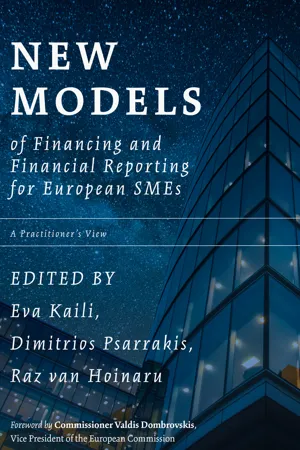
Table of contents

  1. Cover
  2. Front Matter
  3. 1. The SMEs Literature Review: Perspective of Studies
  4. Part I. Financing
  5. Part II. Financial Reporting
  6. Back Matter