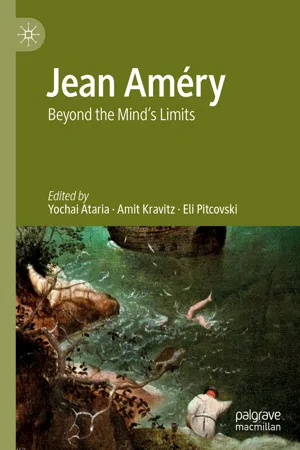
This volume explores themes originating from the work of Jean Améry (1912–1978), a Holocaust survivor and essayist—mainly, ethics and the past, torture and its implications, death and suicide. The volume is interdisciplinary, bringing together contributions from philosophy, psychology, law, and literary studies to illuminate each of the topics from more than one angle. Each essay is a novel contribution, shedding new light on the relevant subject matter and on Jean Améry's unique perspective. The ensuing picture is rich and multifaceted, uncovering unforeseen traits of Amery's thought, and surprising correlations that have so far been under-researched.It invites further studies of the Holocaust and its consequences to take their cue from non-neutral first person reflections.
eBook - ePub
Jean Améry
Beyond the Mind's Limits
- English
- ePUB (mobile friendly)
- Available on iOS & Android
eBook - ePub
Jean Améry
Beyond the Mind's Limits
About this book
Information
© The Author(s) 2019
Y. Ataria et al. (eds.)Jean Améryhttps://doi.org/10.1007/978-3-030-28095-6_11. Jean Améry and Primo Levi: The Differences in Likeness
Berel Lang1
(1)
State University of New York at Albany, Albany, NY, USA
Keywords
AuschwitzTortureAgingSuicideResponsibility1.1 Overture
At first glance, the intersections of their biographies link Jean Améry and Primo Levi as a natural or at least historical couple. Separated in age by seven years (Améry, born 1912 in Vienna; Levi, in Turin, 1919) and educated in the interwar period, both were touched by the intellectual currents of the time: Améry, by the Vienna Circle and its circles, Levi, at the University of Turin. As young adults, both faced the Nazi threat in the 1930s, with Améry’s Jewish identity forced on him—he claims—by Austria’s 1938 racial rules, Levi’s were nurtured earlier in a consciously Jewish household. Against the Nazis, both joined resistance groups and both were captured in their occupied countries (Améry, in his adopted Belgium, Levi, in Italy); both were then deported to camps in the East and, in common, to Auschwitz where they encountered each other (although with differing memories of that). Both survived Auschwitz (Améry was then sent to other camps), and each had a large impact later in their post-Holocaust writings about their wartime lives as well as in their reflections on the Holocaust in the context of European history. Both were also one-time visitors to the new state of Israel whose efforts for independence they had supported although with no inclination before or after their trips for emigrating. And both died by suicide before reaching the age of seventy: Améry in 1978, Levi in 1987. Améry, after more than one earlier failed attempt, also published a book about suicide two years before his death; Levi, who wrote about Améry’s death in his own last book, published that in the year Levi himself died. Even the inscriptions on their two gravestones are concisely similar, their names and dates joined only by their six-digit Auschwitz numbers [A: 172364; L: 174517]. (Levi’s stone also includes the formulaic Hebrew initials: Taf, Nun, Tsadi, Bet, Hay, acronyms for the expression: ‘May his soul be bound up in the grip of life’.)
1.2 First Movement
Such external likeness is, however, no assurance of personal affinity or even acceptance, and aside from a few restrained expressions of mutual regard, Améry and Levi recognized their significant differences both in their understanding of their own histories and in their address to the inevitable post-Holocaust question of ‘What is to be done now?’ That is, in relation to the Holocaust’s implications for world politics and, still more immediately, for their personal ways forward in its shadow. The differences between them on these questions amount to an estrangement, one that is more revealing because of their biographical intersections. These differences surfaced, furthermore, without apology on either side, although with Améry more vocal and sharper in criticizing Levi than the other way round. Améry’s anger at history—at his own and at history as such—was closer to the surface, as was his expression of emotion in general. But that same intensity also spurred Améry to a more self-reflective analysis of that reaction’s origins than did Levi whose intensity, although no less strong, expressed itself more guardedly. I attempt here to show these features of Améry’s thinking specifically in three of Améry’s later books in which his sustained reflections on three significant but rarely analyzed in ethical terms—torture, aging, and suicide—warrant attention even apart from his wartime experience on which he drew in addressing them.
One symptomatic difference between Améry and Levi appears in their writing as writing: the difficulty of mistaking the sentences written by one of them for the other’s. Consider, for example, these brief passages from the Prefaces to their principal books on the Holocaust (Améry’s, Beyond Guilt and Atonement [Jenseits von Schuld und Unsühn]; in English, as At the Mind’s Limits (1966) and Levi’s If This Is a Man [Se Questo e un Uomo]; in its English translation, Survival in Auschwitz) (1947)1: So, Améry: “If in the first lines of the Auschwitz essay [here] I had still believed that I could remain circumspect and distant and face the reader with refined objectivity, I now saw that that was simply impossible”. And Levi: “[This book of mine] … has not been written to formulate new accusations; it should be able, rather, to furnish documentation for a quiet study of certain aspects of the human mind”. For the one, a rejection of even the possibility of objectivity; for the other, a conscious effort at disinterest. And indeed these respective characterizations of their writing are compelling, with the distancing effect that Améry rejects having been deliberately adopted by Levi in his ‘quiet study’. The differences in their expression of what was for both strong emotion provides an unusual lesson in contrasting styles of rhetorical discourse.
An additional contributory factor to the differences between Améry and Levi as authors was their respective economic situations: Levi with a secure post-Holocaust career in a commercial chemical company; Améry hustling for a living as an ostensibly independent novelist and journalist. (In a midcareer interview in 1957, Améry said regretfully, “I wanted to be a poet, and I am a journalist, a reporter”.) Whether as cause or effect of this difference, the current world loomed larger in Améry’s thought than in Levi’s, and this surfaces in the chronology of their writings about the Holocaust. Even before Levi reached Turin after eleven months in Auschwitz, he had begun to compose his thoughts and to write them down. Only a year and a half later, his book, If This Is a Man, was not only completed but published, no doubt a result of good fortune but even more of the author’s urgency. Améry, by contrast, waited twenty years before systematically addressing his wartime experience (he had earlier, in 1945, begun to add to an autobiographical novel about it, but that difference in genre was crucial).
Améry himself commented on his deferral of writing about the Holocaust in his Preface to Beyond Guilt and Atonement, explaining that he wrote then (1968) in reaction to what he saw as the forgetfulness in Europe of the Holocaust past. That past had obviously been present for Améry in the intervening two decades, and both Améry and Levi had followed the 1961 Eichmann trial in Jerusalem closely (with Levi in a comment exemplifying both the emotional and intellectual gap between the two, that although he agreed with the death sentence on Eichmann, he ‘doubted that he could have carried it out himself’). It is notable in any event that Améry chooses in the opening essay of Beyond Guilt and Atonement to write not about the magnitude or character of the Nazi crime and guilt, but about ‘the Intellectual in Auschwitz’, turning then rather to experience within the camp as though the quality of the Nazi ‘project’ had, on the one hand, been so fully analyzed morally as to require no further elaboration and/or, on the other hand, was of such intrinsic quality as to be not only beyond ‘redemption’ as his book’s title asserted, but beyond language or the telling as well. It was his then contemporary world, as it was always his immediate surroundings, that triggered his delayed writing—the combination of anger and despair at what he sees then as indifference to, even the denial of the history of those wartime years, including of course the torture he had undergone which he saw in retrospect as an intrinsic expression of Nazism.
The focus in that opening essay (titled ‘At the Mind’s Limits’; note: it is the reaction to the camps from within, not the Nazis that pushes at the mind’s limits), is thus on what he sees as a characteristic failing of intellectuals in the camps—the way their will for transcendence and abstraction blocked them in confronting the camps’ immediate and urgent contingencies, and the afterlife of which taints still the abstractions by which Nazism has been diluted if not erased. All that in contrast (he claims) to the resilience of captives whose ideological (presumably ‘non-intellectual’) visions of history sustained them. It did not matter, Améry insists, which political or religious commitments underwrote those ideologies; the commitments themselves were the resource.
Améry does not say in this diagnosis whether he includes himself among the ‘disabled’ intellectuals, but a more basic issue is his choice of that topic as foremost among many possible ones for his systematic analysis—returning us again to the claim in his Preface of Europe’s forgetfulness. He is thus writing about the past through the lens of the present, and no less about the one than the other: the role of the intellectual, in other words, as it had been and as it then also continued. (Julian Benda’s The Treason of the Intellectuals2 was a familiar text to him in lodging this accusation.)
It is not in this context, however, that Améry criticizes Primo Levi as a ‘forgiver’—a term of opprobrium for Améry in relation to the Nazis. But Levi’s reading of that opening essay saw in it what he took to be the substantive differences between him and Améry. In an opening volley in his essay on Améry, Levi criticizes Améry’s definition of the ‘intellectual’ as excluding Levi’s own culture of science as a source for intellectuals (Levi gives that criticism an ironic turn by suggesting that perhaps his survival showed that he wasn’t that much an intellectual).3 More directly confronting Améry’s charge, Levi, who had no more ideological commitment of the sort Améry commended than Améry himself, reports as key to his survival his attentiveness to the minutiae of daily life: bed-making to meet the absurd camp requirements, how to get to the richer bottom of the daily soup ration, and most of all how to avoid being singled out in the frequent selections. All these taken together, he claims, were so consuming as to leave little room for ideological rationalization. This attentiveness to the immediate and the concrete undoubtedly built on Levi’s ‘hands-on’ work as a chemist, but he also finds in If This Is a Man no significant differences among fellow captives who did or did not have ideological commitments. Indeed, Levi directs his harshest words for any of his fellow captives at an Orthodox Jew who in praying, thanked God for having spared him from a selection, surely aware that his place there had been filled by someone else. And his warmest words of admiration were for an Italian worker who at risk to himself smuggled extra rations to Levi but cared and knew nothing of ideology.
When Améry does criticize Levi by name as a ‘forgiver’ (in his correspondence with a common acquaintance), the inadequacies of intellectuals again hover over that charge. And Levi disputes Améry also on that claim, protesting that he continued to hold the Nazis to account, notwithstanding his efforts to understand them which were for Améry a first step toward forgiveness. A passage in If This Is a Man exemplifies this difference between the two. Here the Kapo Alex, guiding Levi back to his barracks, grasps a greasy cable wire in order to clamber over an obstacle, and then (in Levi’s words), “[w]ithout hatred and without sneering, Alex wipes his hand on my shoulder”. “He would be amazed,” Levi concludes, “if someone told him that today, on the basis of this action, I judge him … and the innumerable others like him, big and small, in Auschwitz and everywhere”.4 But this retelling might only reinforce Améry’s charge, gi...
Table of contents
- Cover
- Front Matter
- Part I. Limits: Bound to the Past
- Part II. The Mind: Torture and Consequences
- Part III. Beyond: Philosophy and Literature
- Back Matter
Trusted by 375,005 students
Access to over 1.5 million titles for a fair monthly price.
Study more efficiently using our study tools.
Frequently asked questions
Yes, you can cancel anytime from the Subscription tab in your account settings on the Perlego website. Your subscription will stay active until the end of your current billing period. Learn how to cancel your subscription
No, books cannot be downloaded as external files, such as PDFs, for use outside of Perlego. However, you can download books within the Perlego app for offline reading on mobile or tablet. Learn how to download books offline
Perlego offers two plans: Essential and Complete
- Essential is ideal for learners and professionals who enjoy exploring a wide range of subjects. Access the Essential Library with 800,000+ trusted titles and best-sellers across business, personal growth, and the humanities. Includes unlimited reading time and Standard Read Aloud voice.
- Complete: Perfect for advanced learners and researchers needing full, unrestricted access. Unlock 1.5M+ books across hundreds of subjects, including academic and specialized titles. The Complete Plan also includes advanced features like Premium Read Aloud and Research Assistant.
We are an online textbook subscription service, where you can get access to an entire online library for less than the price of a single book per month. With over 1.5 million books across 990+ topics, we’ve got you covered! Learn about our mission
Look out for the read-aloud symbol on your next book to see if you can listen to it. The read-aloud tool reads text aloud for you, highlighting the text as it is being read. You can pause it, speed it up and slow it down. Learn more about Read Aloud
Yes! You can use the Perlego app on both iOS and Android devices to read anytime, anywhere — even offline. Perfect for commutes or when you’re on the go.
Please note we cannot support devices running on iOS 13 and Android 7 or earlier. Learn more about using the app
Please note we cannot support devices running on iOS 13 and Android 7 or earlier. Learn more about using the app
Yes, you can access Jean Améry by Yochai Ataria, Amit Kravitz, Eli Pitcovski, Yochai Ataria,Amit Kravitz,Eli Pitcovski in PDF and/or ePUB format, as well as other popular books in Psychology & Clinical Psychology. We have over 1.5 million books available in our catalogue for you to explore.