Blending critical theory, conjunctural cultural studies, and assemblage theory, Making Sport Great Again introduces and develops the concept of uber-sport: the sporting expression of late capitalism's conjoined corporatizing, commercializing, spectacularizing, and celebritizing forces. On different scales and in varying spaces, the uber-sport assemblage is revealed both to surreptitiously reinscribe the neoliberal preoccupation with consumption and to nurture the individualized consumer subject. Andrews further probes how uber-sport normalizes the ideological orientations and associate affective investments of the Trump assemblage's authoritarian populism. Even as it articulates the regressive politicization of sport, Making Sport Great Again serves also as a call to action: how might progressives rearticulate uber-sport in emancipatory and actualizing political formations?
eBook - ePub
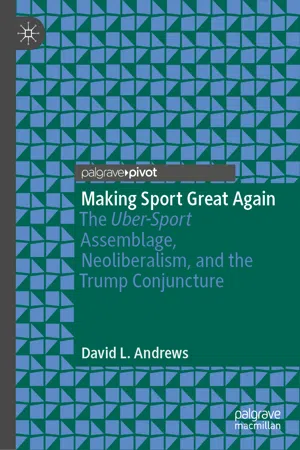
Making Sport Great Again
The Uber-Sport Assemblage, Neoliberalism, and the Trump Conjuncture
- English
- ePUB (mobile friendly)
- Available on iOS & Android
eBook - ePub
Making Sport Great Again
The Uber-Sport Assemblage, Neoliberalism, and the Trump Conjuncture
About this book
Information
Print ISBN
9783030150013
Subtopic
Politics© The Author(s) 2019
David L. AndrewsMaking Sport Great Againhttps://doi.org/10.1007/978-3-030-15002-0_11. Introduction: Uber-Sport as Culture Industry
David L. Andrews1
(1)
Physical Cultural Studies Research Group, Department of Kinesiology, University of Maryland, College Park, MD, USA
Abstract
This chapter provides an on overview of the focus of the book’s primary focus: examining the relationship between sport and politics in the contemporary U.S. It introduces uber-sport as the project’s primary object of study, and situates it as the sporting expression of a late capitalist society driven and defined by the processes of corporatization, commercialization, spectacularization, and celebritization. The discussion turns to the critical theory of the Frankfurt School as a way of explaining how uber-sport is reified; ascribed sense of independent materiality, which obscures the broader social, cultural, political, and economic forces shaping the structure and experience of uber-sport. Adorno’s, Horkheimer’s, and Marcuse’s respective theories of consumer capitalism are used in identifying uber-sport as a culture industry reinforcing the practices and values of late capitalist society.
Keywords
SportPoliticsUber-sportLate capitalismCritical theoryAdornoHorkheimerReificationCulture industriesMarcuseOne-dimensional sportThis project was initiated in July 2015, when Donald J. Trump had only just announced his intention to run for the Republican nomination for the 2016 US presidential election. At the time, few took the Trump campaign seriously, it being widely considered another public relations stunt from an individual preoccupied with building his eponymous brand. As originally imagined, this book was to critically examine high-profile sport’s role in normalizing, and thereby corroborating, neoliberalism’s position as an epoch-defining economic-political-cultural project that had radically reworked the nature and experience of US society. Trump may have appeared somewhere in the discussion in reference to his golf course developments or failed bid to purchase an NFL franchise, but I doubt it. Derailed by a series of unforeseen personal events, the project re-commenced exactly two years later in a US instant that appeared and certainly felt unrecognizable from that which preceded it.
On its resumption, I anticipated the project would need to be radically revised and updated to reflect the new America and sport’s position therein. However, the more I reflected upon and experienced it, the less transformed the Trump nation revealed itself to be. Rather than indicative of some epochal break, the political rise of Donald Trump (and, for that matter, Trumpism: the ideologies and affective investments enacted by the Trump campaign , and subsequently materialized through the pronouncements and policies of the Trump administration) is better explained as the latest iteration of the American reactionary right’s ideological mobilization: a process going back at least to the early 1960s. Americanizing Stuart Hall (1983), the great moving right show of US politics was manifest in the policies, if not the persona , of presidencies from Reagan through Obama . Albeit expressed in a more bombastic and populist register, the Trump regime thus represents more a continuation—if a frequently contradictory and meandering one—rather than a conclusive rupture from the politics which preceded it. Hence, the rationale for this project remained the same: a desire to expose the “political-cultural work” implicating the sport industry in “spreading, installing, universalising and naturalising neoliberalism ” (Clarke, 2016, p. 239), as an iniquitous, divisive, and undemocratic political formation (Brown, 2015; Giroux, 2011). In Braidotti’s terms , explicating the relationship between a popular cultural practice (uber-sport ) and the operations of neoliberal power and domination within the contemporary US is impelled by a “radical aspiration to freedom through” understanding: an “epistemophilic yearning for the empowerment that comes with knowledge…of the specific conditions and relations of power that are imminent to our historical locations ” (Braidotti, 2013, pp. 11–12). Such is the epistemic yearning motivating this critical contextual undertaking.
The revisited and reworked version of this project is not as radically different as initially anticipated. Yes, the relationship between sport and Trump’s rise to the presidency, and Trumpist practices of governance, demand analysis, but only following an explication of sport’s corroborative relationship with neoliberalism , which arguably laid the ideological-affective groundwork for the instinctual and selective mobilization of sport by the Trump agenda. However, before getting to unpack the politicized and politicizing nature of contemporary sport, the first two chapters of the book introduce the conceptual and theoretical approach to uber-sport extended throughout the project, and outline the ontological complexity and in-determinacy of late capitalist uber-sport . Having established this analytical groundwork, it will then be possible to move into discussions (Chapters 3 and 4) illuminating uber-sport’s contribution to the instantiation of both US neoliberalism and Trump’s authoritarian populist campaigning and presidential performativity. This unpacking of the politics of contemporary sport culture is followed by a conclusion explicating the points and possibilities for political opposition developed within and through uber-sport, both in response to the machinations of neoliberalism in general, and the orchestrations of the Trump regime in particular. Less an overt contribution to the “teeming shelf of Trump-lit” (McCrum, 2018), the book seeks to understand the politicized and politicizing nature and influence of contemporary sport, a brief that, for now, leads unavoidably to a detour through the sporting aspects of Trump’s America .
This project is informed by the work of numerous critical scholars who have examined the role of modern sport in expressing, and reinforcing, prevailing political ideologies (i.e., Brohm, 1978; Brownell, 1995; Gruneau , 1983, 2017; Hargreaves , 1986; Hoberman , 1984; Hoch , 1972; Ingham, 1982; Perelman, 2012; Rigauer, 1969; Whannel , 2008). Albeit with different emphases, each of these scholars scrutinized the institutional and experiential manifestations of modern sport (be they anchored within early, mid, or late capitalist, socialist, or communist formations), as vehicles of the political ideologies that authorize the power and influence of dominant groupings, relations, and hierarchies within specific societies. According to McDonald (2009, p. 43), the collective influence of these works was “winning the argument that sport is political: that there is a politics of sport and there is politics in sport.” The politics of/in sport genie has been irrevocably decamped from the bottle in which it previously resided (Burneko, 2018). Even the mainstream US media landscape—a cultural setting that long exhibited a unilateral and commercially strategic disavowal of any sport-politics relation—now advances its cultural acuity through event-embellishing nods to topical identity politics issues within sport. Oftentimes through the depiction of the personal journeys and struggles of athletes (particularly in regard to challenging raced, classed, abled, gendered , and/or sexed structures of dominance in/through sport), the micro-politics of sport are routinely engaged as part of the popular representation of a sports event, or the focus sports-related news, features, and/or commentaries. Conversely, discussions of sporting macro-politics—the relationship between sport and broader systems, forces, and ideologies of societal organization and governance—continue to be subsumed under the cultural weight of formulaic and anodyne popular sport discourse. Within the US, if acknowledged at all, the macro-politics of sport is usually only discussed in relation to external sport settings (as in the macro-political contextualization of sporting mega-event host locations, most often when the host nation fails to adhere to the normalized precepts of neoliberal democracy, i.e., Beijing 2008, Sochi 2014, Russia 2018, Beijing 2022, and Qatar 2022). So, there exists a discernible suspension of macro-political sporting consciousness related to the US context, as if sport and macro-politics interpenetrate only on foreign playing fields, and not on the reified gridiron, baseball diamond, ice rink, or hardwood floor.
Through a critical explication of the politics of uber-sport—and informed by a cultural studies’ commitment to attempting to understand, thereby generating knowledge informing interventions into, the relations of popular culture and power (Bennett, 1992; Chen, 1996)...
Table of contents
- Cover
- Front Matter
- 1. Introduction: Uber-Sport as Culture Industry
- 2. Assembling Uber-Sport
- 3. Uber-Sporting Neoliberalisms
- 4. Trumping the Uber-Sport Assemblage
- 5. Conclusion—How and Why to Read Uber-Sport?
- Back Matter
Trusted by 375,005 students
Access to over 1.5 million titles for a fair monthly price.
Study more efficiently using our study tools.
Frequently asked questions
Yes, you can cancel anytime from the Subscription tab in your account settings on the Perlego website. Your subscription will stay active until the end of your current billing period. Learn how to cancel your subscription
No, books cannot be downloaded as external files, such as PDFs, for use outside of Perlego. However, you can download books within the Perlego app for offline reading on mobile or tablet. Learn how to download books offline
Perlego offers two plans: Essential and Complete
- Essential is ideal for learners and professionals who enjoy exploring a wide range of subjects. Access the Essential Library with 800,000+ trusted titles and best-sellers across business, personal growth, and the humanities. Includes unlimited reading time and Standard Read Aloud voice.
- Complete: Perfect for advanced learners and researchers needing full, unrestricted access. Unlock 1.5M+ books across hundreds of subjects, including academic and specialized titles. The Complete Plan also includes advanced features like Premium Read Aloud and Research Assistant.
We are an online textbook subscription service, where you can get access to an entire online library for less than the price of a single book per month. With over 1.5 million books across 990+ topics, we’ve got you covered! Learn about our mission
Look out for the read-aloud symbol on your next book to see if you can listen to it. The read-aloud tool reads text aloud for you, highlighting the text as it is being read. You can pause it, speed it up and slow it down. Learn more about Read Aloud
Yes! You can use the Perlego app on both iOS and Android devices to read anytime, anywhere — even offline. Perfect for commutes or when you’re on the go.
Please note we cannot support devices running on iOS 13 and Android 7 or earlier. Learn more about using the app
Please note we cannot support devices running on iOS 13 and Android 7 or earlier. Learn more about using the app
Yes, you can access Making Sport Great Again by David L. Andrews in PDF and/or ePUB format. We have over 1.5 million books available in our catalogue for you to explore.