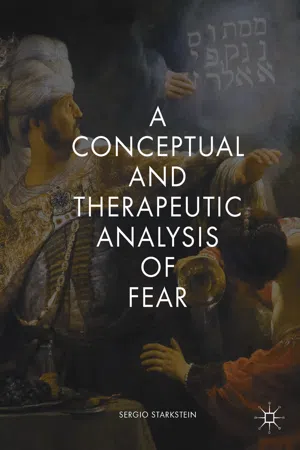
There is an important gap in the philosophical literature concerning the concept of fear and its remedies, and this book has been designed to examine different concepts of fear that inform its therapy. Structured as a historical-philosophical investigation of the concept of fear, this book is not a purely historical analysis of fear but also provides a broad brushwork rendition of the main concepts of fear as presented by selected philosophers and thinkers, and how they have approached its therapy.
- English
- ePUB (mobile friendly)
- Available on iOS & Android
eBook - ePub
A Conceptual and Therapeutic Analysis of Fear
About this book
Information
Topic
PhilosophySubtopic
Ethics in Medicine© The Author(s) 2018
Sergio StarksteinA Conceptual and Therapeutic Analysis of Fearhttps://doi.org/10.1007/978-3-319-78349-9_11. Introduction
Sergio Starkstein1
(1)
University of Western Australia, Fremantle, WA, Australia
Empty is the argument of the philosopher by which no human disease is healed; for just as there is no benefit in medicine if it does not drive out bodily diseases, so there is no benefit in philosophy if it does not drive out the disease of the soul.Porphyry, To Marcella (Inwood and Gerson 1994, p. 82)
Fear is one of the most significant emotions in shaping human life. Fear permeates many of our minor and major decisions, and explicitly or implicitly influences our choices and behaviour. We fear events, such as making mistakes at work, and we fear real objects, such as snakes and spiders, fictional objects, such as running into ghosts in the dark, or non-material objects, such as the uncertainty of the future. Fear sometimes protects us from short- and long-term dangers, but it may also be a source of severe distress. We may appreciate this distinction in the life of Pyrrho of Ellis (c.360 BCE–c.270 BCE), one of the most fearless philosophers of Antiquity. His ethics of suspension of judgment included a remarkable impassivity in daily life events. Diogenes Laertius describes Pyrrho as “taking no precaution, but facing all risks as they came, whether carts, precipices, dogs or what not…he was kept out of harm’s way by his friends who…used to follow close after him” (Laertius 1925: 9.61).1 Pyrrho lived in a state of extraordinary tranquillity and emotional indifference. It was his friends who suffered the fear Pyrrho seems to have lacked.
Fear has been relatively neglected as an object for philosophical study in proportion to its importance. In its more detrimental severity, fear has been addressed by sociologists writing on the concept of ‘risk society’ (Adam et al. 2004, p. 88),2 as well as historians and psychologists conceptualising the twentieth Century as the ‘age of anxiety’ (Dunant and Porter 1996).3 During the twentieth century severe manifestations of fear, such as anxiety, panic and phobias have been increasingly managed by psychiatrists and psychologists. A personal anecdote related to this trend may help to illustrate the interest of anxious individuals about philosophical therapies.
While working as a practicing psychiatrist in an anxiety clinic, I began studies on Epicurean and Stoic philosophy and became markedly impressed by the relevance of fear in Hellenistic texts, and especially by the variety of remedies recommended by these philosophical schools. I then assembled a short pamphlet that included brief remarks from Epicurus, Cicero and Seneca with advice on managing fear, for patients to read in the waiting area. To my surprise, that little pamphlet was strongly demanded and ran through several reprints including expansions and revisions. Furthermore, a sizeable number of patients reported feeling better after reading the short text. This personal experience kindled my interest in providing a conceptual analysis of fear and its therapies as proposed by philosophers and major thinkers.
It is necessary at this stage to provide more clarification of the object of this work. I shall examine the concept and therapies of fear, where I take fear to include several semantically-related emotional conditions, such as anxiety, phobias, dread, panic, and anguish. The reason for this broad take on fear is justified by a brief lexical analysis presented below which shows that these terms have crisscrossing uses and intertwined histories that do not allow for exhaustive distinctions between them and the phenomena they denote.
1.1 A Lexical Introduction to the Concept of Fear
In the secular Old Greek lexicon, phobos had the meaning of “someone or something that is to be feared,” of terror (usually when referring to a single individual), or panic (when referring to a group) (Liddell and Scott 1996, p. 1947).4 In Homer, phobos was used to denote panic or flight (Konstan 2006a); Herodotus used it as generic fear or terror; Hippocrates used phobos in the milder sense of doubt or scruple; and it also had the theological connotation of awe and reverence for a divine being, as well as meaning dread and the act of, or the object for, striking terror into someone (Liddell and Scott 1996, p. 1947). The Old Greek also included the noun alusmos to denote the somatic aspects of fear (e.g. restlessness, palpitations, sweating, tremor) (Liddell and Scott 1996, p. 74). The root aluo had the meaning of wandering restlessly and being uneasy, whereas alusmos meant “anguish, inquietude, uneasiness, being troubled,” as well as “tossing about” in the specific case of the sick. The derivation alusis had the meaning of distress and anguish, and in the colloquial Greek, the adjective lusiteles meant “unprofitable”, whereas in medicine it was used to mean “unfavourable prognosis” (Liddell and Scott 1996, p. 74). Other derivatives of alusmos were used as medical terms only. For instance, in the Hippocratic corpus the adjective allusmotes was used to denote states of feeling uneasy or troubled (Liddell and Scott 1996, p. 74).5
Despite these relevant semantic differences, recent texts on the philosophy of emotions define ‘fear’ and ‘anxiety’ in rather idiosyncratic ways, and a few words on the current technical use of these terms is in order. In her translation of Cicero’s Tusculan Disputations Graver (2002) takes the Latin noun aegritudo to denote mental pain at present and metus for mental pain in the future. However, this categorical distinction is rendered more equivocal by the fact that aegritudo derives from aeger, an adjective denoting sickness from both body and mind. In the latter case (“aeger animus”), this term not only has the connotation of pain but also of “any agitation of the passions or feelings, of love, hope, fear, anxiety, sorrow” as well as being “troubled, anxious, dejected, sad, sorrowful” (Lewis and Short 1891, p. 53) (my italics). Moreover, the early use of aegritudo only had the connotation of illnesses of the body (“of men and brutes”), and it was Cicero who began using aegritudo in the psychological sense of mental grief and sorrow (Lewis and Short 1891, p. 84). Another important difference in translation is Graver’s rendering of the Latin passio as ‘emotion’. Graver acknowledges the different etymologies of these terms, but based on an analysis of Stoic fragments and current use, she considers it is more reasonable to use ‘emotion’ rather than the old ‘passion’ (Graver 2002, pp. 2–3). While this is a debatable decision, these lexical dilemmas show the difficulty of rendering, psychological terms used many centuries ago in a non-anachronistic way. In this book, I have also used ‘emotion’ to render the Latin passio , except when the text being analysed requires using the original term, for example when addressing Descartes’s The Passions of the Soul , where he uses the terms passion and emotion with different technical connotations (see Chapter 6).
This brief lexical description of Old Greek and Latin terms demonstrates that even in antiquity the noun ‘fear’ had a rich semantic network and its meanings acquired specificity when analysed in their proper contexts. As argued by Dixon, coining new words or endowing old ones with new meanings “can create new concepts, and even new worldviews, which may strongly influence people’s capacity to understand the world and themselves” (Dixon 2012, p. 338). Some philosophers addressed in this book used the noun ‘passion’, a term largely replaced around the middle of the nineteenth century in both the philosophical and medical literature by ‘emotion’ (Dixon 2003). However, whereas ‘passion’ has the connotation of passivity and disease, ‘emotion’ has been used since the early nineteenth century with the connotation of a vivid feeling, usually detached from pathological considerations (Dixon 2003). It is also the case that the same word may remain in use in different historical times, but gain different connotations with each successive period. An example of such a lexical rejuvenation is provided by the noun ‘anxiety’, which was rarely used in its current psychological meaning in the psychiatric or philosophical literature before the late nineteenth century (Berrios 1999), but became of common technical and vernacular use after Freud described the syndrome of ‘anxiety neurosis’ in 1895 (see Chapter 8). Other terms conceptually related to fear such as ‘phobia’ and ‘panic’ acquired a strong medical connotation during the twentieth century, and have acted as a linchpin for the medicalization of fear (see Chapter 9). In contemporary colloquial use the sense of fear is implicit whenever using semantically related words such as ‘fright’, ‘dread’, ‘terror’, ‘horror’, ‘panic’, ‘alarm’, ‘dismay’, ‘consternation’, ‘trepidation’, ‘apprehension’, ‘anxiety’ and ‘timidity’, and the selection of which term is used is influenced by a host of variables, such as the acuteness and severity of the event producing the emotion, the presence of people, the age and social status of the agent, the possibility of escape, and other contextual factors (Hollander 2004).
Finally, it is important to remark that there is no single concept of fear, given that this emotion may be analysed from the different perspectives of philosophy, theology, psychology, sociology, psychiatry, the neurosciences, the history of emotions and lexical uses. Nevertheless, some philosophers consider it is possible to provide categorical definitions to fear-related terms. For instance, the philosopher Jesse Prinz suggests that the “folk” category of fear consists of two different states, which he termed panic and a...
Table of contents
- Cover
- Front Matter
- 1. Introduction
- 2. The Epicurean Concept of Fear and the Road to Ataraxia
- 3. Roman Fears: Cicero’s and Seneca’s Remedies
- 4. Montaigne’s Essays: A Humanistic Approach to Fear
- 5. Thomas Hobbes and Fear: The Political Use of a Human Emotion
- 6. Descartes and the Mechanization of Fear
- 7. James’s Fears and Wittgenstein’s Therapy
- 8. Sigmund Freud and the Psychoanalytical Concept of Fear and Anxiety
- 9. The Medicalization and Social Construction of Fear in the Age of Anxiety
- 10. Conclusions
- Back Matter
Trusted by 375,005 students
Access to over 1.5 million titles for a fair monthly price.
Study more efficiently using our study tools.
Frequently asked questions
Yes, you can cancel anytime from the Subscription tab in your account settings on the Perlego website. Your subscription will stay active until the end of your current billing period. Learn how to cancel your subscription
No, books cannot be downloaded as external files, such as PDFs, for use outside of Perlego. However, you can download books within the Perlego app for offline reading on mobile or tablet. Learn how to download books offline
Perlego offers two plans: Essential and Complete
- Essential is ideal for learners and professionals who enjoy exploring a wide range of subjects. Access the Essential Library with 800,000+ trusted titles and best-sellers across business, personal growth, and the humanities. Includes unlimited reading time and Standard Read Aloud voice.
- Complete: Perfect for advanced learners and researchers needing full, unrestricted access. Unlock 1.5M+ books across hundreds of subjects, including academic and specialized titles. The Complete Plan also includes advanced features like Premium Read Aloud and Research Assistant.
We are an online textbook subscription service, where you can get access to an entire online library for less than the price of a single book per month. With over 1.5 million books across 990+ topics, we’ve got you covered! Learn about our mission
Look out for the read-aloud symbol on your next book to see if you can listen to it. The read-aloud tool reads text aloud for you, highlighting the text as it is being read. You can pause it, speed it up and slow it down. Learn more about Read Aloud
Yes! You can use the Perlego app on both iOS and Android devices to read anytime, anywhere — even offline. Perfect for commutes or when you’re on the go.
Please note we cannot support devices running on iOS 13 and Android 7 or earlier. Learn more about using the app
Please note we cannot support devices running on iOS 13 and Android 7 or earlier. Learn more about using the app
Yes, you can access A Conceptual and Therapeutic Analysis of Fear by Sergio Starkstein in PDF and/or ePUB format, as well as other popular books in Philosophy & Ethics in Medicine. We have over 1.5 million books available in our catalogue for you to explore.