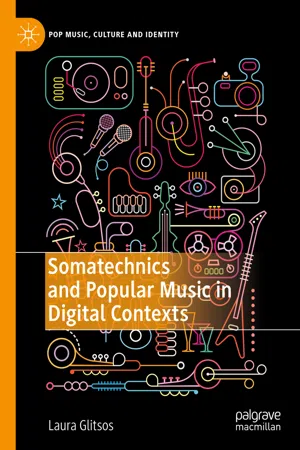
This book is a celebration and explication of the body in the world and the ways that our body situates our consciousness as a lived formation, one which is oriented by the experience of music listening. The book examines the relationship between bodies, technics, and music, using the theoretical tools of somatechnics. Somatechnics calls for a recognition of the body in the world as an artefact wrapped up, entangled and produced by the materialities of that world. It traverses discussions on materiality, live music, touchscreen media, the personal computer, and new modes of listening such as virtual reality technologies. Finally, the book looks at music itself as a kind of technology that generates new modes of bodily being.
- English
- ePUB (mobile friendly)
- Available on iOS & Android
eBook - ePub
Somatechnics and Popular Music in Digital Contexts
About this book
Information
© The Author(s) 2019
L. GlitsosSomatechnics and Popular Music in Digital ContextsPop Music, Culture and Identityhttps://doi.org/10.1007/978-3-030-18122-2_11. Introduction: Listening Through the Body
Laura Glitsos1
(1)
Faculty of Humanities, Edith Cowan University, Perth, Australia
Laura Glitsos
There is more sagacity in thy body than in thy best wisdom.
Nietzsche ([1883] 2009, 16)
End AbstractIntroductory Thoughts
Following the epigraph from Nietzsche above, this work is both a celebration and explication of the body in the world and the ways that our body situates our consciousness as a lived formation, one which is oriented by the experience of music listening ([1883] 2009). However, philosophical traditions may never succeed in apprehending the extent of bodily wisdom, largely because apprehending it thus conflates and reduces it. Gayatri Spivak refers to the body as that which “cannot be thought” (1994, 177). The body may be biologically thought-through, perhaps, but Spivak would say biology is only “one way of thinking the systematicity of the body” (177). Rather, she ruminates that:
From the very start, this book begins with both concession and paradox, in that this work pursues an examination of that which cannot be entirely known. Yet, I would marvel that this is the compelling status of the body in the world as it is torn between—and sewn together with—language, materiality, technology and philosophical treatments, which are all, ultimately, technicities. Though we might never fully reach a complete ‘outline’ of the body, we might still lend ourselves to a project which touches, perhaps even only briefly, on the breathtaking potentialities of its scope.If one really thinks of the body, there is no possible outline of the body as such … There are thinkings of the systematicity of the body, there are value codings of the body. The body, as such, cannot be thought, and I certainly cannot approach it. (Spivak 1994, 177)
This book, of course, is not only about the body, but how an individual mobilizes bodily systems through and with technicities for the pursuit of listening pleasure in popular music. In order to approach such a task, this book borrows tools and language from a range of fields, in particular, from Cultural Studies, Popular Music Studies, Philosophy, Somatechnics, and Internet Studies. Thus, this study is multidisciplinary in its approach in that it crosses a range of modes in the category of social inquiry. I would briefly note, too, that this book focuses on the function of music listening , as opposed to the experience of making music or producing music. However, at times, I may refer to the creation and production of music, but only as it relates to constructing the experience for the listener, as these processes often converge (which we will uncover especially in the discussion of live music).
Moreover, this book situates the listening subject in the context of contemporary digital culture. How can we think through the digital? Technically, it is a process whereby data is translated and stored in binary form as zeros and ones. This is a process which emerges from an ancient means of counting and mathematics, that is, a mechanism (or technicity) through which to interact with the world of numbers (Peters 2016). Benjamin Peters contemplates the historical narrative of ‘the digital discourse,’ suggesting it dates back to “the Latin source of the term itself—the original digit, or the index finger” (94). He writes that:
This remark is a prescient summary of the following research, considering my interest here is in the production of digitization and the body as they emerge as simultaneous artifacts, the primary conditions of which are perhaps not so far apart. In fact, Nick Prior suggests that if “we stripped the digital back down to the digit” we would be “reuniting fingers and technologies to the origins of counting” (2018, 123). In a striking parallel, he also posits that this resonates with the examination of popular music and digitization, because, “Maths and music are close bedfellows, as we know” (123). In relation to somatechnics, too, I would suggest that this conceptual pairing—that is, the relationship between the finger (sôma) and digitization (techné)—positions the arguments in this book as primary entanglements from the very beginning. The digital, in its ancient roots, is primarily corporeal.Digits do what index fingers do—namely, count, point, and manipulate. … Ever since we evolved extensor digitorum muscles, ours has quite literally been what media theorist Teil Heilmann calls a “digital condition”: digital media do what fingers do. (2016, 94; my emphasis)
In moving forward to the contemporary world, I put forth digital culture as a formation of discourses, and practices that revolve around an increasing reliance on complex computerized systems. We might think of ‘formations’ following Prior, as “loose configurations, less rigid than institutions but characterized by constituent material and non-material elements sharing enough properties in common to produce systemic effects” (2018, 14). Prior’s characterization is vital to the context of this project because I suggest that the ‘digital music context’ should be thought about with just as much emphasis on new technologies and new media devices as the production of meaning around the value and affective potential of listening practices.
To expand on this point, I suggest that new media forms do not cultivate new emotional experiences only for individuals who are active in digital Internet technology but for everyone situated within the framework of the digital context. It is the social and historical moment of digitization as a contemporary phenomenon that I theorize, rather than just those practices we can single out as specifically digital (although, I do take single practices as examples in order to illustrate my points). For instance, listening to music on the radio in a contemporary context implies a very different experience than what it meant for individuals listening to music on the radio in the 1920s. The materiality of the practice is mostly the same (i.e., the radio unit is still a wireless device that transmits audio content programmed by someone other than the user). However, the affective encounter is different because, in the 1920s, listening to music on the radio was brand new; a “magical” phenomenon where songs could be snatched out of “thin air” and were free to anyone (Fisher 1926, 12). Radio meant the liberation of music and content. It also led to the emergence of new family bonding activities because the family unit could sit and listen to the radio together, singing songs and listening to favorite programs. Now, radio is considered a secondary medium that many people use for background noise or while driving in their car (Berland 1990, 179). The way the listener is affected by music as it is mediated through the radio has changed in both meaning and intensity and continues to change against shifting historical contexts. In Althusserian terms, the subject is ‘always-already’ presupposed in and by the cultural lexicon (1971). This is to say that digitization is working upon the listening experiences of everybody who is situated within the paradigm of digital technology, which is now a global phenomenon.
Of course, while digital culture is global, it is by no means universal. Digital culture crosses many geographic and geopolitical boundaries but still excludes participants along demographic lines. Many people do not have access to digital or Internet technologies as a result of various factors such as financial inequity or Internet censorship restrictions. This inequality is referred to as the digital divide (Castells 2001; Kirkman et al. 2002; Norris 2001). Therefore, I situate this argument in what are the privileged communities participating in digital culture. Levels of participation vary not only across nations but within nations, such as the disparity which is often found between rural and metropolitan regions. Digital culture cannot be considered as an exclusively Western phenomenon either; many non-Western nations have digital and Internet technology of varying speeds and accessibility. However, it is important to note that the uptake of, and access to, Internet technologies is considerably less in developing nations (Guillén and Suárez 2005, 681). This imbalance does result in disenfranchisement for many people living in these communities, particularly concerning education or employment opportunities and should be noted in any study of ‘global’ digital culture.
Somatechnics as Theoretical Tool and Mode of Apprehension
While situated in the context of digitization, I pursue this examination using the theoretical tools of somatechnics. Somatechnics calls for a recognition of the body in the world as an artifact wrapped up, entangled, and produced by the materialities of that world (Sullivan and Murray 2009). The field emerges from a series of conferences and research collaborations based at Macquarie University in Sydney involving Nicki Sullivan, Joseph Pugliese, Samantha Murray, and Elizabeth Stephens, as well as Susan Stryker from the U.S. (Pugliese and Stryker 2009, 1), who wished to collapse the counterfeit binaries delimiting the discourse of human-technology relationships. It is also critical to note that since its emergence, the field of somatechnics has attended to questions of race. The first issue of the Somatechnics journal was edited by Suvendrini Perera and Joseph Pugliese, titled “Combat Breathing” (2011) and was concerned with the effects of transnational state violence on the body.
Somatechnics puts forth, in its very etymology, “the inextricability of sôma and techné” (2012, 3). That is, the term emphasizes that soma, or ‘the body,’ cannot be thought about other than in its production by and through in-worldness. Thus, it is an approach to understanding the body as irretrievable and indistinguishable from that which produces that body in the world, both through language and the technics of being and becoming. Sullivan explains that somatechnics, as a field, can be thought about in terms of:
Heidegger casts a long shadow over somatechnics, and this particular work, as well as other phenomenol...The bodily-being-in-the world, and the dispositifs in and through which corporealities, identities, and difference(s) are formed and transformed, come to matter … Somatechnics, then, supplants the logic of the ‘and’ (thereby moving beyond instrumentalist logic), suggesting that technés are not something that are added or applied to ‘the body,’ nor are they simply tools the already-constituted body-subject manipulates to its own ends. Rather, technés—in the Heideggerian sense—are techniques and/or orientations (ways of seeing, knowing, feeling, moving, being, acting and so on) which are learned within a particular tradition or ontological context (are, in other words, situated), and function (often tacitly) to craft (un)becoming-with in very specific ways. (Sullivan 2012, 4)
Table of contents
- Cover
- Front Matter
- 1. Introduction: Listening Through the Body
- 2. Materiality, the Bodymind, and Music Listening
- 3. Liveness in the Age of Digitization
- 4. Screen as Skin: The Somatechnics of Touchscreen Music Media
- 5. The ‘Creative Listener:’ Internet, Music, and the Computer-Bodymind Somatechnic
- 6. Future Bodies, Future Music
- 7. Conclusion: Music as Somatechné
- Back Matter
Trusted by 375,005 students
Access to over 1.5 million titles for a fair monthly price.
Study more efficiently using our study tools.
Frequently asked questions
Yes, you can cancel anytime from the Subscription tab in your account settings on the Perlego website. Your subscription will stay active until the end of your current billing period. Learn how to cancel your subscription
No, books cannot be downloaded as external files, such as PDFs, for use outside of Perlego. However, you can download books within the Perlego app for offline reading on mobile or tablet. Learn how to download books offline
Perlego offers two plans: Essential and Complete
- Essential is ideal for learners and professionals who enjoy exploring a wide range of subjects. Access the Essential Library with 800,000+ trusted titles and best-sellers across business, personal growth, and the humanities. Includes unlimited reading time and Standard Read Aloud voice.
- Complete: Perfect for advanced learners and researchers needing full, unrestricted access. Unlock 1.5M+ books across hundreds of subjects, including academic and specialized titles. The Complete Plan also includes advanced features like Premium Read Aloud and Research Assistant.
We are an online textbook subscription service, where you can get access to an entire online library for less than the price of a single book per month. With over 1.5 million books across 990+ topics, we’ve got you covered! Learn about our mission
Look out for the read-aloud symbol on your next book to see if you can listen to it. The read-aloud tool reads text aloud for you, highlighting the text as it is being read. You can pause it, speed it up and slow it down. Learn more about Read Aloud
Yes! You can use the Perlego app on both iOS and Android devices to read anytime, anywhere — even offline. Perfect for commutes or when you’re on the go.
Please note we cannot support devices running on iOS 13 and Android 7 or earlier. Learn more about using the app
Please note we cannot support devices running on iOS 13 and Android 7 or earlier. Learn more about using the app
Yes, you can access Somatechnics and Popular Music in Digital Contexts by Laura Glitsos in PDF and/or ePUB format, as well as other popular books in Social Sciences & Music. We have over 1.5 million books available in our catalogue for you to explore.