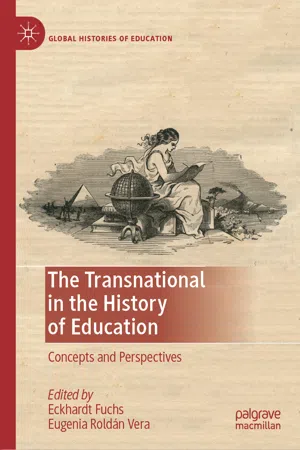
This edited volume reflects on how the "transnational" features in education as well as policies and practices are conceived of as mobile and connected beyond the local. Like "globalization," the "transnational" is much more than a static reality of the modern world; it has become a mode of observation and self-reflection that informs education research, history, and policy in many world regions. This book examines the sociocultural project that the "transnational turn" evident in historical scholarship of the last few decades represents, and how a "transnational history" shapes how historians construct their objects of study. It does so from a multinational perspective, yet with a view of the different layers of historical meanings associated with the concept of the transnational.
eBook - ePub
The Transnational in the History of Education
Concepts and Perspectives
- English
- ePUB (mobile friendly)
- Available on iOS & Android
eBook - ePub
The Transnational in the History of Education
Concepts and Perspectives
About this book
Information
Topic
Bildung© The Author(s) 2019
Eckhardt Fuchs and Eugenia Roldán Vera (eds.)The Transnational in the History of EducationGlobal Histories of Educationhttps://doi.org/10.1007/978-3-030-17168-1_11. Introduction: The Transnational in the History of Education
Eugenia Roldán Vera1 and Eckhardt Fuchs2
(1)
Department of Educational Research, Center for Research and Advanced Studies (Cinvestav), Mexico City, Mexico
(2)
Georg Eckert Institute for International Textbook Research, Braunschweig, Germany
Keywords
International educationConceptual historyNarrativesConstitution of realityEducational knowledgeSelf-reflexivityThe Concept of the Transnational
The aim of this book is to open up a critical space for reflection on the concepts and categories associated with the description of the transnational realm and their uses in the history of education: How these concepts and categories have emerged and developed historically, how they influence and direct the way we do research, and how we can gain a better sense of their theoretical and methodological contours so we can obtain the full benefit of research that goes beyond a specific locality or nation-state as a unit of analysis.
Our point of departure is the assumption that the language we use to talk about reality not only describes that reality but it is constitutive of it. That is, when we talk about the international arena, the global sphere, or the transnational space, we are not simply describing something that exists; we are making an experience of reality intelligible and simultaneously constructing an abstraction of that reality. Concepts are mechanisms through which we articulate and mobilize the experience of reality; they are words that condense a large number of experiences and, in becoming abstract, create a broader space of signification.1 Some concepts develop a further level of abstraction and become analytical categories in the social sciences; the articulation of a number of ideas into concepts gives direction to the way in which we define our object of study and conduct research.
We take as the premise of the history of political and educational languages the assumption that language constitutes the set of rules of a historically given system of thought, rules which determine what is possible—and what is not possible—to perceive, discuss, and analyze in relation to a certain topic.2 In line with this premise, we commence by asking: Since when has it been possible to think about a transnational realm, and how? When and why did we begin to think “transnationally” or “internationally” in education? What related concepts do we use to speak of that realm that lies beyond the nation, and what do they evoke? What historical and historiographical conditions make it possible for us to think that researching the transnational is possible?
We also take from conceptual history and historical semantics the assumption that concepts carry layers of past meanings which may overlap in their different uses by various actors.3 We acknowledge that the abstract character of concepts permits their transferral across geographic places, disciplines, and academic cultures, and that in the process of their transfer their meanings change, as a number of studies on “traveling” or “nomadic” concepts have shown.4 Are we, then, referring to the same “transnational” or “international” today as were our predecessors in the interwar period or in the 1970s? How much of those early meanings does our present use carry? Are we speaking of the same “transnational” whether we are in Calcutta, Naples, or Dakar? To what extent is our current experience of the transnational articulated in concepts that were shaped by experiences of a different time and place, and how does that divergent experience, entailing as it does a “distance,” affect communication?
The abstract, social, and historical character of concepts makes them necessarily ambiguous, polysemic, and open to disagreement and debate. If we take into account the performative component of language,5 we see that the meanings of concepts are also affected by the fact that they are invoked for different purposes, in the service of different agendas, within different theoretical or political frameworks, and in dialog with specific interlocutors. This notwithstanding, concepts remain “the tool of intersubjectivity”: “they facilitate discussion on the basis of a common language.”6 Not because they mean the same for everybody, but precisely because they evoke many different things, superimposed on a shared substrate, which makes academic discussion possible. The intention of this volume is therefore to historicize and problematize the very categories we use in our research on a history of education that extends beyond the nation as a unit of analysis. Accordingly, in this introductory chapter we first examine the emergence of what is known as the “transnational history of education” in the confluence of discourses and concepts on international education and the transnational research project in the historical sciences (2). We then present an overview of recent transnational research in the history of education, considering areas of study as well as theoretical and methodological approaches (3). Finally, we discuss the ways in which the chapters that constitute this book challenge our current conceptualizations of the transnational, its concepts and methodologies (4).
A Transnational History of Education: Between International Education and Transnational Historical Research
If we turn our attention to the terms used to describe—and thus construct—a “transnational reality,” we need first to differentiate between two distinct spheres of reference which are built into what we nowadays call a “transnational approach” to the history of education. The first of these is a discourse on education which emerged at the dawn of the nineteenth century and which utilized the terms “international” and “internationalism.” “International,” a hundred and thirty years ago, referred to the sphere of the state and its foreign policy vis-à-vis other states; the concept of “international education” first appeared at the turn of the nineteenth century to the twentieth century and has continued to dominate the semantics of national and global discourses on education to this day. The second sphere of reference we can associate with a transnational history of education is a research approach. In recent years, the use of a transnational perspective in the history of education has enabled us to describe phenomena that transcend national scales, yet have not been primarily perceived as “transnational” by those who experienced them. This perspective has pointed us to other dimensions of educational processes. What follows will provide a brief history of the discourse and concepts related to these two spheres of reference.
The Discourse on “International Education”: A Field of Research Emerges
The development of a discourse on internationalism is closely linked to the emergence of nation-states and the processes of their modernization which began in the second half of the nineteenth century. Both the adjective “international” and the noun “internationalism” can be traced back to the eighteenth century, although the terms did not appear in French and English dictionaries until the final third of the nineteenth century.7 From its emergence, the term “internationalism” covered a range of meanings, all related to a realm of relations among nations. First, it referred to the limits of national and state-defined spheres of and claims to sovereignty in the context of the regulation of relations between states. Second, it was part of the discourse of the workers’ movement. Third, it has been attached as an epithet to an era characterized by international relationships that since the second half of the nineteenth century have been increasingly intertwined, relations fostered by both intergovernmental and non-governmental organizations.8 And fourth, the term appeared in academic discourses reflecting the academics’ view of themselves as members of an “imagined community”9 sharing a consensus that international cooperation was a normative condition of the generation and circulation of knowledge. A conception held sway of science, in regard to its societal effects, as fundamentally in the service of humanity’s advancement and the development of communication and harmony among nations.10 This academic universalism, with its implication that academic research was “international,” assumed the existence of a unique universalist methodology, regarded academic research as an abstract means to the attainment of universal knowledge and general progress—but not as a practical activity or a social institution—and presumed that the abstract value of “internationality” represented the actual and non-negotiable basis upon which academics conducted their work.
The internationalist discourse on education which arose at the turn of the nineteenth century to the twentieth century was likewise marked by a dominant normative tone. In Germany, the concept of a “world education”11 was developed on the ass...
Table of contents
- Cover
- Front Matter
- 1. Introduction: The Transnational in the History of Education
- 2. The Transnational and Transcultural: Approaches to Studying the Circulation and Transfer of Educational Knowledge
- 3. Day Nurseries in Europe in the Nineteenth and Twentieth Centuries: The Challenge of the Transnational Approach
- 4. Conversations About the Transnational: Reading and Writing the Empire in the History of Education
- 5. Transnationalism and the Engagement of Empire: Precursors of the Postcolonial World
- 6. Adaptations of Adaptation: On How an Educational Concept Travels from the Heartlands to the Hinterlands
- 7. Analyzing Toru Dutt’s Oeuvre Today: How a Transnational Literary-Educational Case from Colonial India Can Enrich Our Conception of Transnational History
- 8. Temporalities and the Transnational: Yoshi Kasuya’s Consideration of Secondary Education for Girls in Japan (1933)
- 9. (De)Constructing the Global Community: Education, Childhood and the Transnational History of International Organizations
- 10. Transnational as Comparative History: (Un)Thinking Difference in the Self and Others
- Back Matter
Trusted by 375,005 students
Access to over 1.5 million titles for a fair monthly price.
Study more efficiently using our study tools.
Frequently asked questions
Yes, you can cancel anytime from the Subscription tab in your account settings on the Perlego website. Your subscription will stay active until the end of your current billing period. Learn how to cancel your subscription
No, books cannot be downloaded as external files, such as PDFs, for use outside of Perlego. However, you can download books within the Perlego app for offline reading on mobile or tablet. Learn how to download books offline
Perlego offers two plans: Essential and Complete
- Essential is ideal for learners and professionals who enjoy exploring a wide range of subjects. Access the Essential Library with 800,000+ trusted titles and best-sellers across business, personal growth, and the humanities. Includes unlimited reading time and Standard Read Aloud voice.
- Complete: Perfect for advanced learners and researchers needing full, unrestricted access. Unlock 1.5M+ books across hundreds of subjects, including academic and specialized titles. The Complete Plan also includes advanced features like Premium Read Aloud and Research Assistant.
We are an online textbook subscription service, where you can get access to an entire online library for less than the price of a single book per month. With over 1.5 million books across 990+ topics, we’ve got you covered! Learn about our mission
Look out for the read-aloud symbol on your next book to see if you can listen to it. The read-aloud tool reads text aloud for you, highlighting the text as it is being read. You can pause it, speed it up and slow it down. Learn more about Read Aloud
Yes! You can use the Perlego app on both iOS and Android devices to read anytime, anywhere — even offline. Perfect for commutes or when you’re on the go.
Please note we cannot support devices running on iOS 13 and Android 7 or earlier. Learn more about using the app
Please note we cannot support devices running on iOS 13 and Android 7 or earlier. Learn more about using the app
Yes, you can access The Transnational in the History of Education by Eckhardt Fuchs, Eugenia Roldán Vera, Eckhardt Fuchs,Eugenia Roldán Vera in PDF and/or ePUB format, as well as other popular books in Bildung & Vergleichende Erziehungswissenschaft. We have over 1.5 million books available in our catalogue for you to explore.