- English
- ePUB (mobile friendly)
- Available on iOS & Android
eBook - ePub
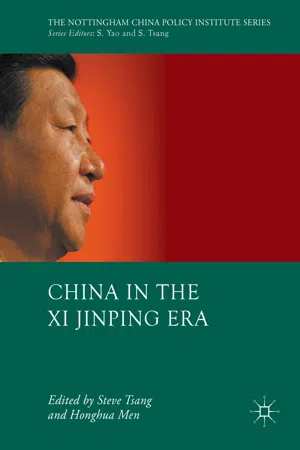
China in the Xi Jinping Era
About this book
This book examines the driving forces behind national-level politics, changes to the judiciary, social control, economic reform, environmental protection, urban development, the management of ethnic relations, as well as foreign and security policy orientation in China under Xi Jinping. It explains Xi's ambition, examines the limitations he has to confront, and maps the direction of reform he pursues. The book starts off by examining how the consultative Leninist nature of the political system continues to shape politics and policy in China under Xi, and what the China dream Xi advocates actually entails domestically and beyond China. It ends by highlighting the megatrends that will prevail in the decade when Xi is expected to stay in power. The book also includes contributions from five Central Party School professors whose views are taken seriously by the Chinese leadership.
Information
© The Editor(s) (if applicable) and The Author(s) 2016
Steve Tsang and Honghua Men (eds.)China in the Xi Jinping EraThe Nottingham China Policy Institute Series10.1007/978-3-319-29549-7_11. Genesis of a Pivotal Decade
Honghua Men1 and Steve Tsang2
(1)
School of Political Science and International Relations, Tongji University, Shanghai, China
(2)
School of Contemporary Chinese Studies, University of Nottingham, Nottingham, UK
As Xi Jinping took the reins of the Communist Party of China (CPC) as its General Secretary at the 18th Party Congress in November 2012, he made it clear he would take the People’s Republic of China to a new stage of development—one of deepening reform. This was not just about rebalancing the economy but also about substantially improving governance and enhancing the role China would play in the world. Xi’s accession to power at the 18th Congress marked the turning of a new chapter in the era of post-Mao reforms.
The decade under Xi’s leadership, from 2012 to 2022, is going to be a pivotal one as he is determined to lead China towards national rejuvenation at a time when sustaining a fast rate of growth is becoming increasingly challenging. China’s reforms have reached a stage where a crucial decision has to be made. Just prior to Xi taking over in 2012, when all Chinese leaders were reformers, it was not clear where that reform was heading or what the next stage would look like. China could stay the course or embark on an ambitious process of rebalancing the economy, with all the potential benefits and risks this would entail. As top leader Xi is not happy to rest on his laurels or muddle through. He is determined to use his decade in power to leave his mark.
As China steps into the second decade of the 21st century, it has already greatly enhanced its overall national strength. It is the second ranking power in the world by this measure or, for that matter, by economic prowess. It has become the top trading country and the fastest growing major industrial economy. But the need to rebalance the economy, after the benefits of the established model had been nearly exhausted in the decade under Hu Jintao, meant fresh impetus to sustain the economic miracle would need to be found. Full of confidence and determined to face this challenge squarely, Xi takes to heart an axiom of one of the great Chinese classics: ‘Great achievements cannot be attained without ambition; success is impossible without hard work’.1 Xi thus promptly put forth the concept of ‘the China Dream’ to encapsulate the ambitions he had for the country, and has since then been driving the Party hard to pursue them. There is no doubt that China faces a complex and difficult decade during which changes and challenges, both domestic and global, will be daunting. But Xi is committed to lead a rapidly rising and confident China to overcome them.2
By the end of the decade of his presidency, Xi intends to turn the rhetoric of the China Dream into reality. More specifically this means converting the country into a moderately prosperous society, giving the amazingly rapid economic growth a new lease of life, and preparing it to transform itself from a regional power into a superpower, or at least a leading global power. The domestic and external goals are intertwined, and reaching them will have profound implications, both for the country and for the world. The prospect of the Xi transformation is therefore a matter of great significance and is the central focus of this book. How it shapes China’s approach to dealing with the rest of the world is the subject of Chap. 12 by Honghua Men.
Opportunities and Challenges
China is in the midst of a great transformation. It has already changed from being a regional power to a global power and is on a trajectory to become a superpower. As it does so, its global interests and capabilities are developing fast.3 The rise or, depending on one’s perspective, re-emergence of China and the changes this brings is increasingly becoming a subject of great interest in the world (see Chap. 10 by Xi Xiao). Its rise from being one of the major regional powers to one of the leading global powers is making other great powers readjust strategically. This gives rise to risks and opportunities and makes the international situation more complex and complicated (see Chap. 11 by Christopher Hughes).
Under Xi, China is making the most of the capacities and progress it made in the last three decades of reform to seek new opportunities for further development and advancement. The steady improvement in the living conditions of its citizens and landmark achievements, such as becoming the second largest economy in the world, have helped the Chinese leadership to refine its objectives. What Xi’s administration aims to achieve by 2022 is to double the size of the gross domestic product (GDP) both nationally and on a per capita basis, whether in the urban centres or in the rural regions. This is what becoming a moderately prosperous society is intended to mean. The Party plans to build a strong national consensus around its commitment to make the China Dream a reality, and to use this process to galvanize everyone to join the efforts to build a rich, powerful, socialist-democratic, civil, and harmonious country. This approach is meant to shape the development strategy for the next three decades (see Chap. 8 by Tianyong Zhou).
At the same time, Xi seeks to improve China’s relations with the great powers and its neighbours. China is already the largest trading partner of nearly 130 countries and plans to build on this to promote mutually beneficial collaboration. The setback to economic advancement in the world brought about by the global financial crisis has been seized on by China as an opportunity to leave its mark. Its commitment to sustained growth has prevented the global economy from slipping further and led to it expanding its investment and interests far and wide. Since the global financial crisis, China is contributing to improvement in infrastructure and industrial capacity, not only domestically but also elsewhere through its outward investment. In its efforts to reach out, China is creating new opportunities and challenges for others.
The environment in which China needs to achieve its ambitions is tough and testing. The successful reforms of the previous three decades have also produced deep economic and societal contradictions. This is recognized by Xi:
Since the 18th Party Congress, China has embarked on the journey to rebalance the economy and seek a ‘new normal’ for sustainable growth and development. How to do so is the crux of the matter (see Chap. 6 by Baojiang Han and Shiping Qi).In development, China faces a series of sharp contradictions and challenges, which means there are plenty of problems and difficulties in the way forward. They include the lack of balance, co-ordination and sustainability in development, inadequate capacity in innovation, irrational industrial structure, the lack of clarity and precision on how to develop the country, wide disparity in development and income between the cities and rural regions, and the increase in social contradictions … To solve these problems the key lies in deepening reform.4
The wider international and strategic condition is even more complex. There is a gap between China’s capacity to fulfil its wish to take on more international responsibilities and what the wider international community expects of it. This has given rise to suspicion about its intentions. The rise of ‘the China threat’ narrative and the contradicting demand that China should be ‘a responsible stakeholder’ has made the task more daunting. As the advanced countries led by the United States of America (USA) seek to tighten rules and conventions in the international community to tame a rising China, China’s neighbours also become concerned. They have consequently heightened cooperation with the USA. In other words, the more China develops rapidly, the more others suspect and worry about its intentions, and their responses in turn pose extra challenges and difficulties for China (see Chap. 10 by Xiao, Chap. 11 by Hughes, and Chap. 12 by Men).
Putting the domestic and external challenges and opportunities together, the Chinese Government still sees scope to seize the opportunities despite the difficult environment. As the celebrated poet Su Dongpo of the Song Dynasty observed: ‘not letting something that lands on your hand slip away is good timing; not letting someone who passes by go unutilized is seizing the moment’.5 Under Xi, China is taking a proactive approach, looking carefully at the domestic and international environment to make the most of the opportunities and to confront the challenges as they arise. This means staying true to the bottom line and focusing on planning at the top level, as it presses on with deepening reform across the board. This spirit was summed up by Xi in a speech delivered at the Institute for International Relations at Moscow on 23 March 2013: ‘we must march in sync with progress brought about by the age we live in, which means that in the 21st century we must not retain a mind-set of the past—mentally stay in the era of colonial expansion, think the thoughts of the Cold War period or retain the zero-sum mentality’.6
Strategic Framework for Comprehensively Deepening Reform
Xi has advocated the upholding of the bottom line and high level planning from when he came to power. As members of the Politburo Standing Committee of the 18th Congress attended ‘The Road to National Revival’ exhibition in November 2012, Xi declared a commitment to implementing the China Dream. He said: ‘the China dream is about turning national revival, the greatest aspiration of the Chinese people in the modern era, into a reality’.7 In his conception, ‘the goal of making China into a moderately prosperous society will be met by the centenary year of the CPC [2021]. The objective of transforming it into a rich, powerful, democratic, civil and harmonious modern socialist country will be met by the centenary year of the People’s Republic of China (PRC) [2049]. The China dream will be turned into reality’.8 While the Chinese leadership takes both a very long and a shorter view of strategic planning, its policies are in fact guided by the latter. This was clarified by Xi in ‘the decision of the CPC central leadership on comprehensively deepening reform’, in which he said ‘the missions of the reform should be implemented by 2020’. This means the most important goal is that of making China into a moderately prosperous society by 2021. As Xi takes charge he is confident of the guiding principles behind reform, of the direction of reform, and of the strength of the political system (see Chap. 2 by Steve Tsang). He is also keen to make the most of China’s cultural inheritance (see Chap. 9 by Yingchun Sun). Xi sees Communism and Chinese civilization as complementary, and the blending of them a great asset for national revival.
Based on the above ...
Table of contents
- Cover
- Frontmatter
- 1. Genesis of a Pivotal Decade
- 2. Consolidating Political and Governance Strength
- 3. Enhancing Credibility and Transparency Through Judicial Reforms
- 4. The Logic and Limits of the Party’s Social Management Approach in Maintaining Stability: Lessons from Bismarck
- 5. Forging a Harmonious Relationship Among the Ethnic Groups
- 6. Ageing, Urbanization, and the Search for a Sustainable Development Model
- 7. Striking a Balance Between Environmental Protection and Rapid Development
- 8. Overcoming the Dilemma of China’s Growth
- 9. Tradition, Cultural Modernization, and Soft Power
- 10. Defining and Safeguarding Priorities in China’s National Security
- 11. China as a Leading State in the International System
- 12. China’s Position in the World and Orientation of Its Grand Strategy
- 13. Megatrends of the Xi Decade
- Backmatter
Trusted by 375,005 students
Access to over 1.5 million titles for a fair monthly price.
Study more efficiently using our study tools.
Frequently asked questions
Yes, you can cancel anytime from the Subscription tab in your account settings on the Perlego website. Your subscription will stay active until the end of your current billing period. Learn how to cancel your subscription
No, books cannot be downloaded as external files, such as PDFs, for use outside of Perlego. However, you can download books within the Perlego app for offline reading on mobile or tablet. Learn how to download books offline
Perlego offers two plans: Essential and Complete
- Essential is ideal for learners and professionals who enjoy exploring a wide range of subjects. Access the Essential Library with 800,000+ trusted titles and best-sellers across business, personal growth, and the humanities. Includes unlimited reading time and Standard Read Aloud voice.
- Complete: Perfect for advanced learners and researchers needing full, unrestricted access. Unlock 1.5M+ books across hundreds of subjects, including academic and specialized titles. The Complete Plan also includes advanced features like Premium Read Aloud and Research Assistant.
We are an online textbook subscription service, where you can get access to an entire online library for less than the price of a single book per month. With over 1.5 million books across 990+ topics, we’ve got you covered! Learn about our mission
Look out for the read-aloud symbol on your next book to see if you can listen to it. The read-aloud tool reads text aloud for you, highlighting the text as it is being read. You can pause it, speed it up and slow it down. Learn more about Read Aloud
Yes! You can use the Perlego app on both iOS and Android devices to read anytime, anywhere — even offline. Perfect for commutes or when you’re on the go.
Please note we cannot support devices running on iOS 13 and Android 7 or earlier. Learn more about using the app
Please note we cannot support devices running on iOS 13 and Android 7 or earlier. Learn more about using the app
Yes, you can access China in the Xi Jinping Era by Steve Tsang, Honghua Men, Steve Tsang,Honghua Men in PDF and/or ePUB format, as well as other popular books in Business & International Business. We have over 1.5 million books available in our catalogue for you to explore.