Chapter 1, Chapter 3, Chapter 7 and Chapter 8 of this book are available open access under a CC BY 4.0 license at link.springer.com.
eBook - ePub
The Dutch Empire between Ideas and Practice, 1600–2000
- English
- ePUB (mobile friendly)
- Available on iOS & Android
eBook - ePub
The Dutch Empire between Ideas and Practice, 1600–2000
About this book
This volume explores the intellectual history of the Dutch Empire from a long-term and global perspective, analysing how ideas and visions of empire took shape in imperial practice from the seventeenth century to the present day. Through a series of case studies, the volume critically unearths deep-rooted conceptions of Dutch imperial exceptionalism and shows how visions of imperial rule were developed in metropolitan and colonial contexts and practices. Topics include the founding of the Dutch chartered companies for colonial trade, the development of commercial and global visions of empire in Europe and Asia, the continuities and ruptures in imperial ideas and practices around 1800, and the practical making of empire in colonial court rooms and radio broadcasting. Demonstrating the relevance of a long-term approach to the Dutch Empire, the volume showcases how the intellectual history of empire can provide fresh light on postcolonial repercussions of empire and imperial rule.
Information
© The Author(s) 2019
R. Koekkoek et al. (eds.)The Dutch Empire between Ideas and Practice, 1600–2000Cambridge Imperial and Post-Colonial Studies Serieshttps://doi.org/10.1007/978-3-030-27516-7_11. Introduction: Intellectual History in Imperial Practice
René Koekkoek1 , Anne-Isabelle Richard2 and Arthur Weststeijn3
(1)
Department of History and Art History, Utrecht University, Utrecht, The Netherlands
(2)
Institute for History, Leiden University, Leiden, The Netherlands
(3)
Department of Languages, Literature & Communication, Utrecht University, Utrecht, The Netherlands
Where does the Dutch empire fit in global intellectual history? The last twenty years have seen a burgeoning international literature on empire.1 However, the Dutch empire, writ large, has not benefitted from a similar scholarly engagement. What is the role of longstanding ideas circulating both in historiography and public debate, such as that the Dutch did not ‘do’ empire, just commerce , or that they did not develop (grand) visions about their empire, in this neglect? This volume is a step to integrating perspectives on Dutch empire into a broader global examination of visions of empire.2 It does so, on the one hand, by examining the trope of Dutch exceptionalism over the long term and from multiple perspectives. On the other hand, it argues that the Dutch case is particularly suited to connect with (recent) historiography that argues that not just canonical texts and speech acts but also meaningful practices are sources for intellectual history.3 In order to understand visions of empire, we need to look beyond systemic thinkers and also examine how various actors, ‘intermediate thinkers of empire ’, articulated their visions in practice.4 Drawing on the concepts of upward and downward hermeneutics , this entails examining the interactions between ideas and practice; how ideas formed and were formed by socio-cultural and political practice.5 An intellectual history thus informed by social and cultural history allows for uncovering visions of Dutch empire expressed by a range of Dutch and other actors as empire was being ‘done’.6 Such a history of visions of empire sheds new light on (current) historiography and public debate, precisely because dominant notions within this historiography and debate are rooted in the intellectual history of Dutch imperial practice.
Looking in the Mirror: The Dynamics of Dutch Imperial (Self-)Perception
The starting point of this volume is to show the possibility and importance of tracing ideas of Dutch empire across time. While avoiding teleology, connecting visions of empire of the early modern period to the state-led imperialism and postcoloniality of the nineteenth-twenty-first centuries allows for analysing the deep roots of dominant tropes in public discourse about the Dutch colonial past. A notorious example of these longstanding ideas in contemporary debate involved the then Prime Minister of The Netherlands, Jan Peter Balkenende . In June 2006, he was questioned in the Dutch House of Representatives by opposition parties about the recent recovery of the Dutch economy. Somewhat agitated, Balkenende replied: ‘I don’t understand why you’re so negative and unpleasant about it. Let’s be happy together. Let’s be optimistic! Let’s say: The Netherlands can do it. The VOC mentality, going abroad, dynamics!’ When an indignant murmur rose from the House, the Prime Minister added a somewhat desperate ‘…right (toch)?’
Balkenende’s reference to the Dutch East India Company (VOC) generated a storm of protest in the following days and weeks. Under pressure of public opinion, Balkenende clarified that he did not want to gloss over the mistakes of the VOC past. He had meant the spirit of commerce and the courage to cross the oceans, not ‘the dark age of slavery ’. It did not satisfy Dutch-Surinamese action groups who promptly organized a demonstration and demanded apologies from the Prime Minister for his words. The activists sought to underline the interconnectedness of the Dutch role in the history of slavery and a broader underlying colonial mentality. It was a revealing episode in an ongoing series of debates on the Dutch imperial past, in which histories of the VOC merge with discussions about the Indonesian War of Independence , the Black Pete tradition and everyday racism .7 In these debates there are those who wish to defend and highlight a positive image of Dutch colonial history and seek to separate the ‘golden days’ from the ‘dark pages’. Others argue that these aspects are necessarily entwined. Much like in other former imperial powers, the Dutch imperial past has become a site of contestation where conflicting visions of historical and cultural identity-formation clash.
In order to understand and contribute to these debates, it is important to situate the various visions of empire they draw upon. Invocations of an alleged great commercial imperial past or a Dutch exceptionalism have a long pedigree (and are not unlike claims about other empires). Particularly at moments of ‘national’ upheaval or reconstitution, the Dutch empire has been presented as a positive, benign phenomenon, for example in 1941, when Willem van Helsdingen , a retired high colonial official, published the book Daar werd wat groots verricht (‘Great things were achieved there’). While the Netherlands had recently fallen to German occupation, this book was advertised as providing a compelling argument for the continuation of Dutch colonial rule overseas: ‘We have developed the Indies as no other country in the world; we have brought peace and prosperity’.8
Such visions of a civilizing mission did not go unchallenged. Already in 1913 for example, Soewardi Soerjaningrat , nationalist and later Indonesian Minister of Education, published the pamphlet Als ik eens Nederlander was, … (‘If I were a Dutchman, …’) in response to plans to celebrate the centenary of Dutch independence from Napoleonic France . In it he stated that ‘If I were a Dutchman, I would never want to celebrate this centenary in a country that is occupied by us. First give them their freedom, then commemorate ours’.9 Soerjaningrat thus exposed the double standard that many visions of empire entail(ed). For this exposure he was ridiculed and banned from his home country.10
About a century earlier, when the Netherlands had just regained the independence they hoped to commemorate in 1913, an illustrious ‘Dutch’ commercial spirit rooted in the VOC was explicitly invoked in the two-volume Nederlandsche bezittingen in Azia, Amerika en Afrika (‘Dutch possessions in Asia , America , and Africa ’). Published in 1818 and written by the Dutch high military officer and future governor-general of the Dutch East-Indies, Johannes van den Bosch , this work offered the new Dutch state a comprehensive review of its imperial possessions—and suggestions how to increase their profitability. In his dedication to King William I , Van den Bosch stated that his work was informed by his wish to ‘restore our weighty possessions overseas and advance the colonial trade to its highest possible prosperity, to restore the good old days of our forefathers and return our fatherland its glory and wealth’.11
The good old days Van den Bosch had in mind were those of the mid-seventeenth-century, the alleged ‘Golden Age’ of Dutch mercantile primacy worldwide. The celebration of Dutch colonial glory and wealth originated in the imperial visions created when the Dutch Republic challenged Spanish and Portuguese global supremacy. In the late 1630s, the apex of early modern Dutch expansion in Asia and the Atlantic , Joost van den Vondel , the Dutch ‘prince of poets’, dedicated a poem to the Amsterdam headquarters of the VOC in which he praised its global commercial enterprise: ‘Wherever profit takes us, to every sea and shore, for love of gain the wide world’s harbours we explore.’12 There is no hint in Vondel’s poem of the Dutch involvement in the Atlantic slave trade , which took off exactly when he wrote these lines. The optimistic notion of a dynamic ‘VOC-mentality’ has long roots indeed.
These visions of a distinctly commercial Dutch empire were not only formulated in a Dutch context but also by other European observers. For example, in what has been called the ‘first antislavery play’, Oroonoko, the Royal Slave (1688), the British playwright Aphra Behn negatively compares the supposedly efficient, commercial and immoral Dutch to the—in her narrative—not too competent British. The assumption that the Dutch have a specific commercial mindset, allegedly different from that of other imperial powers, is a trope shared by Dutch and non-Dutch actors alike.
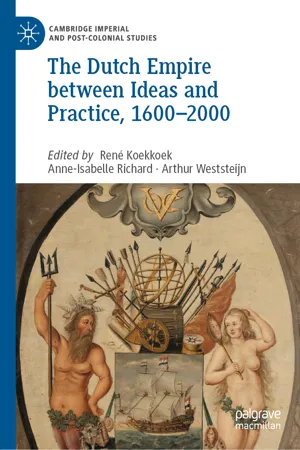
These brief insights into the deep and widespread roots of Balkenende’s notion of a ‘VOC-mentality’ show the relevance of holding up a mirror to the Dutch colonial past from a long term and transnational/transimperial perspective. Taking its clue from the coat of arms of the VOC, painted in 1651 and displayed on the cover, this volume seeks, firstly, to analyse the Dutch imperial (self-)perception of exceptionality: which image did the VOC present and evoke when it saw itself in the imperial mirror and how has that image influenced the way later (self-)perceptions are styled?
Arguably the most dominant trope in the representations of the Dutch empire is the idea that this empire was somehow ‘exceptional’ and ‘different’ from other empires. Most obviously, this discourse of exceptionalism can be observed in the recurring claim that the Dutch empire was essentially a maritime ‘trading empire’ rather than an example of expansionist imperialism —a claim also made manifest in the 1651 arms of the VOC , which show a merchant ship sailing between Neptune and a mermaid. The first part of this volume explores the origins and development of this rhetoric . Catia Antunes demonstrates why this ‘spin’ was useful in the contest of the Dutch Republic with the Portuguese and Spanish empires in the seventeenth century, and Arthur Weststeijn and Benjamin Schmidt show how it became a dominant vision of empire in the European Enlightenment . In essence, this early-modern ...
Table of contents
- Cover
- Front Matter
- 1. Introduction: Intellectual History in Imperial Practice
- Part I. Exceptionalism in Visions of Dutch Empire
- Part II. Visions of Dutch Empire in Practice
- Back Matter
Trusted by 375,005 students
Access to over 1.5 million titles for a fair monthly price.
Study more efficiently using our study tools.
Frequently asked questions
Yes, you can cancel anytime from the Subscription tab in your account settings on the Perlego website. Your subscription will stay active until the end of your current billing period. Learn how to cancel your subscription
No, books cannot be downloaded as external files, such as PDFs, for use outside of Perlego. However, you can download books within the Perlego app for offline reading on mobile or tablet. Learn how to download books offline
Perlego offers two plans: Essential and Complete
- Essential is ideal for learners and professionals who enjoy exploring a wide range of subjects. Access the Essential Library with 800,000+ trusted titles and best-sellers across business, personal growth, and the humanities. Includes unlimited reading time and Standard Read Aloud voice.
- Complete: Perfect for advanced learners and researchers needing full, unrestricted access. Unlock 1.5M+ books across hundreds of subjects, including academic and specialized titles. The Complete Plan also includes advanced features like Premium Read Aloud and Research Assistant.
We are an online textbook subscription service, where you can get access to an entire online library for less than the price of a single book per month. With over 1.5 million books across 990+ topics, we’ve got you covered! Learn about our mission
Look out for the read-aloud symbol on your next book to see if you can listen to it. The read-aloud tool reads text aloud for you, highlighting the text as it is being read. You can pause it, speed it up and slow it down. Learn more about Read Aloud
Yes! You can use the Perlego app on both iOS and Android devices to read anytime, anywhere — even offline. Perfect for commutes or when you’re on the go.
Please note we cannot support devices running on iOS 13 and Android 7 or earlier. Learn more about using the app
Please note we cannot support devices running on iOS 13 and Android 7 or earlier. Learn more about using the app
Yes, you can access The Dutch Empire between Ideas and Practice, 1600–2000 by René Koekkoek, Anne-Isabelle Richard, Arthur Weststeijn, René Koekkoek,Anne-Isabelle Richard,Arthur Weststeijn in PDF and/or ePUB format, as well as other popular books in History & European History. We have over 1.5 million books available in our catalogue for you to explore.