This path-breaking book addresses the oft-avoided, yet critical question: where are the women located in contemporary diplomacy and international negotiation? The text presents a novel research agenda, including new theoretical and conceptual perspectives on gender, power and diplomacy. The volume brings together a wide range of established International Relations scholars from different parts of the world to write original contributions, which analyse where the women are positioned in diplomacy and international negotiation. The contributions are rich and global in scope with cases ranging from Brazil, Japan, Turkey, Israel, Sweden to the UN, Russia, Norway and the European Union.
This book fills an important gap in research and will be of much interest to students and scholars of gender, diplomacy and International Relations. The volume also reaches out to a broader community of practitioners with an interest in the practice of diplomacy and international negotiation.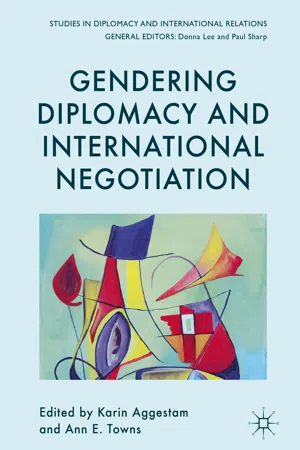
eBook - ePub
Gendering Diplomacy and International Negotiation
- English
- ePUB (mobile friendly)
- Available on iOS & Android
eBook - ePub
Gendering Diplomacy and International Negotiation
About this book
Information
© The Author(s) 2018
Karin Aggestam and Ann E. Towns (eds.)Gendering Diplomacy and International NegotiationStudies in Diplomacy and International Relationshttps://doi.org/10.1007/978-3-319-58682-3_11. Introduction: The Study of Gender, Diplomacy and Negotiation
Karin Aggestam1 and Ann E. Towns2
(1)
Lund University, Lund, Sweden
(2)
University of Gothenburg, Gothenburg, Sweden
Karin Aggestam (Corresponding author)
Ann E. Towns
Financial support for this research was provided by Riksbankens Jubileumsfond [P14-0644:1], Wallenberg Academy Fellowship from the Knut and Alice Wallenberg Foundation [252129202], funding from the Swedish Research Council [252129202]
Karin Aggestam
is Pufendorf chair professor at Lund University, visiting professor at Monash University and honorary professor at University of Queensland. Some of her recent publications include “Swedish Feminist Foreign Policy in the Making” (2016, Ethics and International Affairs), “Peace Mediation and the Minefield of International Recognition Games” (2015, International Negotiation) and Rethinking Peacebuilding (2013).
Ann E. Towns
is Associate Professor of Political Science at the University of Gothenburg and a Wallenberg Academy Fellow. She has a large research project on gender norms, practices and hierarchies in diplomacy. Towns is the author of Women and States: Norms and Hierarchies in International Society (2010).
1.1 Introduction
One of the most striking patterns of contemporary diplomacy is the overrepresentation of men and the gross underrepresentation of women in senior diplomatic and negotiation positions. While this may reflect the highly gendered character of diplomacy as an institution , this pattern also matches wider trends in global politics. Despite significant inroads of women into a number of public political spheres in recent decades, statistics still reveal a grim picture of inclusive political representation and gender equality : approximately 77% of the world’s parliamentary seats are occupied by men; 90% of heads of state or government are men, as are 82% of senior ministers (UN Women 2017). International organisations and institutions also have poor track records on women in senior diplomatic positions. For instance, the United Nations appointed its first-ever female mediator Mary Robinson only in 2013. The External Action Service of the European Union is headed by Federica Mogherini, but all nine Special Envoys are men (2017). Eighty-five per cent of the ambassadors in the world are men.
This bleak picture is changing, however. For one, women are seeking out diplomatic careers in increasing numbers, and they are rising in rank within diplomacy. A number of Ministries of Foreign Affairs (MFAs) across the world are taking active measures to encourage female applicants and to recruit women. The landmark resolution of the United Nations Security Council 1325, which was endorsed in 2000, is a significant milestone in the quest for inclusive representation and participation in peace negotiations. The resolution catapulted the problematic of Women, Peace and Security (WPS) on to the global agenda of the international community. The resolution underlines the important role women do and should play in the prevention and resolution of conflicts, peace negotiations and wider peace support operations. Moreover, it puts strong emphasis on the goals to achieve gender equality and the incorporation of gender perspectives in all UN peace and security efforts. Consequently, as part of the WPS agenda, the UN and other regional organisations have made serious attempts to gender-mainstream their organisations. Countries such as Australia, Canada, Sweden , the United States and the United Kingdom, have also pushed the WPS agenda, which now constitutes one of the core pillars of their foreign policies (True 2016).
This book takes off from the inspirational and poignant question raised by Cynthia Enloe (1990) over two decades ago: “Where are the women?” In the field of diplomacy and international negotiation, this problematic has received surprisingly scant attention. Lately, a number of relevant policy reports have been issued on women’s participation in peace processes (e.g. UN Women 2012) but academia still lags behind with very few studies that analyse gender and women in diplomacy and international negotiation (Boyer et al. 2009; Babcock and Laschever 2003; Enloe 1990; Florea et al. 2003; McCarthy 2014; Neumann 2008 and 2012; Paffenholz et al. 2016). This “gender blindness” has prevailed despite the rapidly expanding field of feminist studies in the subfield of International Relations (IR). Hence, the overarching rationale of this volume is ambitious, first in its quest to fill this void in research, and second in its aim to advance a novel research agenda on gender, diplomacy and international negotiation. In short, by utilising a gender-sensitive approach, the book aims to map where women are located and to analyse the ways in which diplomatic culture may contain gender norms, rules and practices. Although the empirical focus is on women, such an analysis is as much about men and masculinity as it is about women and femininity (Bjarnegård 2009).
Three core research questions set the overall framework of this book and guide the contributing chapters in their work to empirically map, analyse and conceptually advance theory. First, where are the women located and positioned in contemporary diplomacy and international negotiation? In this book, we strive to identify the location of women with regard to status , tasks and contexts as well as how these patterns may have changed over time. In this empirical mapping, the book makes visible broader gender patterns in contemporary diplomacy. At the same time, the rich empirical case studies, which range from Sweden , Brazil, the United States, Turkey to the UN, the EU and Russia , may point to diverse patterns and contexts.
The second question focuses on the diplomatic infrastructure and to what extent diplomatic norms and practices of negotiations are gendered. Here, we shift to paying more attention to dominant norms and gendered expressions that guide diplomatic practices. Our interest is to explore to what extent diplomatic culture contains gendered scripts and may pose structural barriers for female diplomats and negotiators. To what extent does homosociality pervade gendered institutions and pose as an obstacle for women? For instance, it may be hard to visualise women in leading diplomatic positions because they break with gender norms and homosocial diplomatic environments. In cases where women hold senior positions, they may also have to adapt to masculine norms and practices in order to advance in diplomacy. Such gender dynamics express a kind of “hegemonic masculinity” (Connell 1987) and can, for instance, partly explain the underrepresentation of women at the negotiation table. Peace negotiations , in particular, tend to have specific institutional characteristics, as gender roles in times of conflict become polarised (Aharoni 2011: 411). In short, these dynamics tend to legitimise a diplomatic hierarchy as well as a relational and gendered division of labour . Hence, it provides a deeper understanding of the central organising discourse and gendered meaning of diplomacy.
The third question explores to what extent the practice of diplomacy and international negotiation changes with a broader and more diverse group of diplomats. Obviously, women have more to gain from a more heterosocial diplomatic milieu, whereas an increased presence of women implies a loss of institutional power for men (Bjarnegård 2009: 21). For sure, the entry of women as diplomats in larger numbers in some countries, particularly above the threshold of tokenism , has brought changes to diplomacy as an institution . But to what extent are different diplomatic activities associated with masculinity and femininity? Here our focus shifts towards analysing gender as performing rather than being (Cohn 2013: 9). Such a shift is necessary in order to identify different gendered modes of negotiations without sliding into essentialism.
1.2 Diplomacy and Negotiation in Transition
Including more women in peacemaking is not just the right thing to do, it’s also the smart thing to do. (Hillary Clinton 2011)
Diplomacy is an institution containing practices of negotiation, representation, information gathering and communication. The origin is unclear and debatable but can be traced back to ancient Greece, from where some of the diplomatic vocabulary and practices emanate. Roman law and later Italian customs shaped much of the diplomatic practices, such as protocols, procedures, ceremonies and diplomatic rules. The professionalisation of the diplomatic corps also evolved during these times. Yet, for a long time, diplomacy was viewed as an art based on tradition, h...
Table of contents
- Cover
- Frontmatter
- 1. Introduction: The Study of Gender, Diplomacy and Negotiation
- 1. Gender in the Foreign Service
- 2. Gender in International Negotiation
- Backmatter
Trusted by 375,005 students
Access to over 1.5 million titles for a fair monthly price.
Study more efficiently using our study tools.
Frequently asked questions
Yes, you can cancel anytime from the Subscription tab in your account settings on the Perlego website. Your subscription will stay active until the end of your current billing period. Learn how to cancel your subscription
No, books cannot be downloaded as external files, such as PDFs, for use outside of Perlego. However, you can download books within the Perlego app for offline reading on mobile or tablet. Learn how to download books offline
Perlego offers two plans: Essential and Complete
- Essential is ideal for learners and professionals who enjoy exploring a wide range of subjects. Access the Essential Library with 800,000+ trusted titles and best-sellers across business, personal growth, and the humanities. Includes unlimited reading time and Standard Read Aloud voice.
- Complete: Perfect for advanced learners and researchers needing full, unrestricted access. Unlock 1.5M+ books across hundreds of subjects, including academic and specialized titles. The Complete Plan also includes advanced features like Premium Read Aloud and Research Assistant.
We are an online textbook subscription service, where you can get access to an entire online library for less than the price of a single book per month. With over 1.5 million books across 990+ topics, we’ve got you covered! Learn about our mission
Look out for the read-aloud symbol on your next book to see if you can listen to it. The read-aloud tool reads text aloud for you, highlighting the text as it is being read. You can pause it, speed it up and slow it down. Learn more about Read Aloud
Yes! You can use the Perlego app on both iOS and Android devices to read anytime, anywhere — even offline. Perfect for commutes or when you’re on the go.
Please note we cannot support devices running on iOS 13 and Android 7 or earlier. Learn more about using the app
Please note we cannot support devices running on iOS 13 and Android 7 or earlier. Learn more about using the app
Yes, you can access Gendering Diplomacy and International Negotiation by Karin Aggestam, Ann E. Towns, Karin Aggestam,Ann E. Towns in PDF and/or ePUB format, as well as other popular books in Politics & International Relations & Diplomacy & Treaties. We have over 1.5 million books available in our catalogue for you to explore.