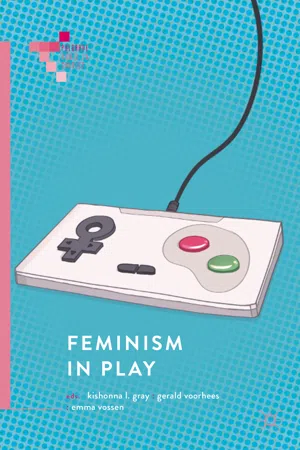
Feminism in Play focuses on women as they are depicted in video games, as participants in games culture, and as contributors to the games industry. This volume showcases women's resistance to the norms of games culture, as well as women's play and creative practices both in and around the games industry. Contributors analyze the interconnections between games and the broader societal and structural issues impeding the successful inclusion of women in games and games culture. In offering this framework, this volume provides a platform to the silenced and marginalized, offering counter-narratives to the post-racial and post-gendered fantasies that so often obscure the violent context of production and consumption of games culture.
eBook - ePub
Feminism in Play
- English
- ePUB (mobile friendly)
- Available on iOS & Android
eBook - ePub
Feminism in Play
About this book
Information
© The Author(s) 2018
Kishonna L. Gray, Gerald Voorhees and Emma Vossen (eds.)Feminism in PlayPalgrave Games in Contexthttps://doi.org/10.1007/978-3-319-90539-6_11. Introduction: Reframing Hegemonic Conceptions of Women and Feminism in Gaming Culture
Kishonna L. Gray1 , Gerald Voorhees2 and Emma Vossen2
(1)
University of Illinois, Chicago, IL, USA
(2)
University of Waterloo, Waterloo, ON, Canada
Kishonna L. Gray
Despite the disciplinary norms and institutional investments of games studies that malign and marginalize critical perspectives (Jensen and de Castell 2009), recent history has proven feminist lenses to be an essential facet in examining games, gamers, and gaming culture. As Nina Huntemann (2013) argues, feminist game studies examines how gender, and its intersections with race, class, sexuality, and so on, is produced, represented, consumed, and practiced in and through digital games. This volume continues and extends the project of feminist game studies, examining the varied representations, practices, and institutions of games and game cultures from a feminist perspective, exploring personal experiences, individual narratives, and institutional phenomenon inherent in the hegemonic, often patriarchal, structures of gaming.
Though current events make it all the more pressing, in fact there is a rich, far-reaching history of feminist theory and games criticism that the essays in this book build upon. Media scholars have long examined the presumption that games depict women in a manner that is both polarizing and marginalizing: as either sexual objects or damsels in distress (Gailey 1993; Dietz 1998). The continued under-representation (and erasure) of female game characters has been documented (Williams et al. 2009), as has the tendency to depict women in a sexualized manner with either less clothing (Beasley and Standley 2002; Taylor 2006), absurd or idealized body proportions (Schröder 2008; Martins et al. 2009), or narrative and discursive positioning as sexually promiscuous (MacCallum-Stewart 2009). Nevertheless, some studies examining the depiction of women in digital games have drawn attention to an increasingly diverse set of portrayals of female gender identity. One of the first game characters to warrant this attention is Lara Croft, the titular character of the Tomb Raider series. There is a small but significant body of feminist media criticism that argues that Croft functions (alternatively or simultaneously depending on the author) as an object of sexual desire, a femme fatale, a model of empowered womanhood, or a masculine style of femininity (Schleiner 2001; Kennedy 2002; Mikula 2003; Jansz and Martis 2007). Stang (2017) and Voorhees (2016) each finds an extremely capable and heroic figure in Ellie, the teenage girl from The Last of Us, who is nevertheless disempowered not through sexualization but rather by the game’s positioning of her as a daughter-figure to Joel, the other, and primary, playable character. Still, despite the proliferation of increasingly capable heroines, Summers and Miller’s (2014) recent study of game advertising demonstrates that while the more traditional depiction of the virtuous damsel in distress is less common in games, female game characters are simultaneously increasing sexualized.
As feminist game studies has developed, a number of focal points have emerged, notably: women and marginalized peoples’ erasure or unfavorable representation in games, exclusion and harassment in game cultures and communities, and participation in the game industry and other sites of production. More recently, it has become increasingly clear that the intersecting facets of these problems (which we discuss in detail in the next section) and the intersectional identities of the people who experience the greatest precarity in games and game cultures are vital sites of inquiry.
This volume aims to continue to propel feminist theory and criticism of games forward in the midst of the social, political, and material reality that is #Gamergate, Black Lives Matter, the Trump administration, and the general social trend toward a more reactionary, conservative politics of exclusion. As the chapters within this volume reveal, these conditions may shift the grounds of the complex conversations we continue to have about women within games, women and girls as gamers, and women within the industry, but they do not fundamentally redefine it.
Patriarchy and Power in Games
Whether visible in the persistent color line that shapes the production, dissemination, and legitimization of dominant stereotypes within the industry itself, or in the dehumanizing and hypersexual representations commonplace within virtual spaces, video games encode the injustices that pervade society as a whole. According to Williams, Martins, Consalvo , and Ivory (2009), gaming is a space defined by the “systematic over-representation of males, white and adults and a systematic under-representation of females, Hispanics, Native Americans, children and the elderly.” Similarly, rape culture, inscriptions of toxic masculinity, and homophobia are ubiquitous to gaming; the criminalization of black and brown bodies and the profiling of black and brown gamers is foundational to gaming culture; and the injustices that predominate in gaming culture also sit at the core of the political, social, and communal arrangements of mainstream US culture. In this way, games provide both training grounds for the consumption of narratives and stereotypes and opportunities to become instruments of hegemony. As many of the essays argue in Nick Taylor and Gerald Voorhees’ edited volume, Masculinities in Play, they offer spaces of white male play and pleasures, and create a virtual and lived reality where white maleness is empowered to police and criminalize the Other. Games provide opportunity to both share and learn the language of racism, sexism, and the grammar of empire, all while perpetuating cultures of violence and privilege (Gray 2012, 2014; Nakamura 2009; Leonard 2003, 2006, 2009, 2014).
No contemporary example of this hegemony is more salient than #Gamergate. #Gamergate gained media attention through misogynist and racist attacks on women gamers, critics, and developers. Followers of #gamergate attempted to justify their campaign as a move to restore ethics in video game journalism, resulting in hostile and violent environments for women, queer folk, and people of color. This is exceptional, given the way that “gaming capital” has been distributed, historically, in a manner that overwhelmingly centers heteronormative, white, masculinity, equating this perspective and identity as the default player (Consalvo 2008). However, it is not new. For women, the sexually marginalized, and people of color, this treatment reaches far back beyond this moment, and stems from certain elements fundamental to games and game cultures.
While #GamerGater may have been the “straw that broke the camel’s back,” it certainly does not represent the origins of harassment experienced by the marginalized in gaming communities. Kishonna Gray’s foundational work explores harassment campaigns and hostile environments experienced by women in console gaming since these spaces first went live (Gray 2012). She also explored the experiences of racial and ethnic minorities within gaming communities for failing to conform to the White male norm (Gray 2014). Additional work is emerging showcasing the disturbing realities for women, people of color, and queer gamers within streaming communities (Gray 2016). These examples rightfully demonstrate that #Gamergate did not create a culture of toxicity; rather, this reality is central to gaming contexts.
Prior to #Gamergate, harassment in gaming has been excused, minimized, and outright overlooked as a matter of boys and men too immature to understand the consequences of their vitriol. But now that the average age of a gamer is 31 (Shaw 2012), there is an increased urgency to acknowledge that the normalizing of this behavior is inherent to the patriarchal culture of digital games. This culture extends beyond the gamers; the devaluation of marginalized bodies is present in the games that we play, the developers who create them, and the culture and institutions that sustain them—making them all complicit in the continued oppression of the marginalized.
The attention generated by another recent controversy also highlights that women in games have always experienced marginalization and erasure. During the design and development of Assassin’s Creed: Unity, Ubisoft developers revealed that they viewed the task of creating a female playable character for the game’s multiplayer mode with customizable avatars to be an unreasonable burden. Their comments are illustrative of their stance:
Concerned gamers immediately took to Twitter to critique the legitimacy of the notion that creating a female character was double the work using the hashtag #WomenAreTooHardToAnimate. One commenter rightfully stated that, “unless you are killing her, buying her or selling her, @Ubisoft can’t animate a woman you can actually play #womenaretoohardtoanimate.” In short, this “inability” to animate women is a part of a larger culture of exclusion in which women gamers have always found themselves situated.It would have doubled the work on those things. And I mean it’s something the team really wanted, but we had to make a decision… It’s unfortunate, but it’s a reality of game development. (Williams 2014)
This blatant sexism has become a highly visible antagonist in an increasingly dominant narrative about the importance of diversity in the content and even production of games. But it bears repeating that #Gamergate doesn’t reflect some aberration or new subculture within gaming—this is the culture in gaming. This is our society. As Lisa Nakamura (2012) states, masculinity is performed by the display of technical knowledge, and gaming is the most recent iteration of this form of social display. Gaming itself becomes a mark of privilege within symbolic discourse. Following Adrienne Shaw (2012), through this project we endeavor to continue the work of dispelling the myth and imagery of the “dominant White, heterosexual, male, teen gamer image” (29). Arguments for the...
Table of contents
- Cover
- Front Matter
- 1. Introduction: Reframing Hegemonic Conceptions of Women and Feminism in Gaming Culture
- Part I. Neither Virgin Nor Vixen: Representations of Women
- Part II. All Made Up: Gendering Assemblages
- Part III. Beyond Feminization: Gaming and Social Futures
- Back Matter
Trusted by 375,005 students
Access to over 1.5 million titles for a fair monthly price.
Study more efficiently using our study tools.
Frequently asked questions
Yes, you can cancel anytime from the Subscription tab in your account settings on the Perlego website. Your subscription will stay active until the end of your current billing period. Learn how to cancel your subscription
No, books cannot be downloaded as external files, such as PDFs, for use outside of Perlego. However, you can download books within the Perlego app for offline reading on mobile or tablet. Learn how to download books offline
Perlego offers two plans: Essential and Complete
- Essential is ideal for learners and professionals who enjoy exploring a wide range of subjects. Access the Essential Library with 800,000+ trusted titles and best-sellers across business, personal growth, and the humanities. Includes unlimited reading time and Standard Read Aloud voice.
- Complete: Perfect for advanced learners and researchers needing full, unrestricted access. Unlock 1.5M+ books across hundreds of subjects, including academic and specialized titles. The Complete Plan also includes advanced features like Premium Read Aloud and Research Assistant.
We are an online textbook subscription service, where you can get access to an entire online library for less than the price of a single book per month. With over 1.5 million books across 990+ topics, we’ve got you covered! Learn about our mission
Look out for the read-aloud symbol on your next book to see if you can listen to it. The read-aloud tool reads text aloud for you, highlighting the text as it is being read. You can pause it, speed it up and slow it down. Learn more about Read Aloud
Yes! You can use the Perlego app on both iOS and Android devices to read anytime, anywhere — even offline. Perfect for commutes or when you’re on the go.
Please note we cannot support devices running on iOS 13 and Android 7 or earlier. Learn more about using the app
Please note we cannot support devices running on iOS 13 and Android 7 or earlier. Learn more about using the app
Yes, you can access Feminism in Play by Kishonna L. Gray, Gerald Voorhees, Emma Vossen, Kishonna L. Gray,Gerald Voorhees,Emma Vossen in PDF and/or ePUB format, as well as other popular books in Social Sciences & Cultural & Social Anthropology. We have over 1.5 million books available in our catalogue for you to explore.