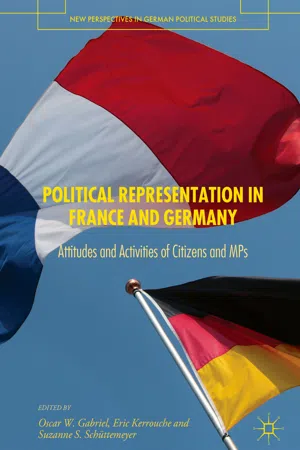
Notwithstanding its contemporary critics, political representation remains at the core of democratic politics. Based on a comparative research project that gathered data from observations, surveys, experiments and expert interviews, this book examines the process and the quality of political representation in France and Germany from a dual perspective. First, it analyzes MPs' behavior during their district activities. Second, it investigates the perceptions and evaluations of the represented, the French and German citizens. In ten chapters different facets of MPs' activities as well as citizens' attitudes are comparatively investigated. The book is relevant for Politics scholars and practitioners at national parliaments to better understand representative democracies, and it may also contribute to improve representation itself.
eBook - ePub
Political Representation in France and Germany
Attitudes and Activities of Citizens and MPs
- English
- ePUB (mobile friendly)
- Available on iOS & Android
eBook - ePub
Political Representation in France and Germany
Attitudes and Activities of Citizens and MPs
About this book
Information
© The Author(s) 2018
Oscar W. Gabriel, Eric Kerrouche and Suzanne S. Schüttemeyer (eds.)Political Representation in France and GermanyNew Perspectives in German Political Studieshttps://doi.org/10.1007/978-3-319-72029-6_11. Introduction: Political Representation in France and Germany
Oscar W. Gabriel1 , Eric Kerrouche2 , Suzanne S. Schüttemeyer3 and Sven T. Siefken3
(1)
University of Stuttgart, Institute of Social Sciences, Stuttgart, Germany
(2)
CNRS, Centre Emile Durkheim, Sciences-Po Bordeaux, Bordeaux, France
(3)
Martin-Luther-University Halle-Wittenberg, Halle (Saale), Germany
Oscar W. Gabriel (Corresponding author)
Eric Kerrouche
Suzanne S. Schüttemeyer
Sven T. Siefken
Somewhat surprisingly in view of the worldwide process of democratization (Haerpfer et al. 2009; particularly Berg-Schlosser 2009), the quality of political representation and, first and foremost, the quality of the linkages between the representatives and the represented have been a highly disputed issue in political science for several decades. The report of the Trilateral Commission on the Crisis of Democracy (Crozier, Huntington, and Watanuki 1975) raised the question of whether the alleged alienation of citizens from democratic institutions originated in a growing distance between citizens and their representatives. This is an ongoing debate in modern democracies such as France and Germany, among other, and pertains to theory as well as to empirical research.
In spite of the involvement of French and German political scientists in the international debates and research activities on the future of representation and representative democracy, there has been very little comparative French-German research on how the concept of political representation is implemented in these two political systems, what ideas the citizens of both nations hold regarding representation, and how they assess the quality of representation in their countries. This applies particularly to analyses of the practice of representation as being manifest in the activities of French and German Members of Parliament (MPs) in the national arena as well as in their local districts. Although research on representation in the two national political systems has been conducted for several years, this research was done in a state of splendid isolation from the neighbor country.
Roughly the same can be said about the investigation of civic attitudes towards the process of representation. Admittedly, France and Germany have been included in existing cross-national survey programs such as Eurobarometer, World/European Values Survey, the International Social Survey Program, the Comparative Study of Electoral Systems and the European Social Survey. These surveys have yielded a large number of publications, some of them addressing the issue of representation more or less broadly (particularly Thomassen 2014). However, neither can it be said that attitudes towards representation are at the core of these survey programs, nor do they give specific attention to France and Germany in the respective publications. Moreover, French and German scholars have not been eager so far to use the existing data sources for exploring what the two countries have in common with respect to the practice and culture of representation, how and why they differ, and what this implies about the prospects for democratic government in the two countries.
Thus, a comparison of political representation in France and Germany seems to be necessary and overdue for several reasons. First and foremost, representation is a key issue in the practice of democratic government, and both actual and perceived weaknesses of the process of representation create challenges for the French and German democratic regimes. Second, although a first impression of how representation works and is perceived in France and Germany is conveyed by national research and some cross-national programs, a systematic comparison between representation in France and Germany starting from a common scientific program is still missing. And third, the institutional arrangements and the cultural traditions of the two countries show some variation that could account for differences in the ideas and practices of the two nations. Although the relevance of these systemic variables cannot be examined systematically in a two-nation comparison, they may be helpful in the interpretation of the empirical findings.
A Crisis of Representative Democracy?
The concept of political representation is among the most important topics in the analysis of the idea and practice of modern democracy. Representation has been adopted alongside the principle of sovereignty of the people as the key mechanism of political decision-making in the wake of the French revolution and became even more indispensable with growing democratization, in particular with the introduction of equal voting rights in the course of the nineteenth and early twentieth century. In this process, countries developed quite diversified doctrines and practices of representative government.
During the last few years, the idea as well as the practice of representative democracy have been called into question by the demand for democratic innovations (e.g., Cain, Dalton, and Scarrow 2008; Smith 2009; Geissel and Newton 2012). Doubts about the legitimacy of the logic of representation are due to several factors: erroneous notions of democracy often offered by the media and opinion polls, the craving for the mechanisms of “direct” democracy, the idea of power being confiscated by a caste of politicians; each of these factors is further enhanced by processes of European integration and globalization. This is not new, since the concept and institutions of democratic representation have been criticized ever since they came into being. Thus, the “decline of parliament” and the “crisis of parliamentary representation” have been commonplace in studies on the subject for nearly a century (e.g., Bryce 1921; Schmitt 1923; Laski 1928; Mosca 1928; Speyer 1935; Perin 1960; Chandernagor 1967; Loewenberg 1971). The objections to representative democracy were and are manifold; some are directed at its principles and some at aspects of its practice at a given period in time.
Since the debate on the crisis of late capitalism reached its height in the 1970s, scholars emphasizing Marxist, liberal and conservative ideological premises have raised the issue of the “democratic malaise” in a countless number of publications (see as good summaries of the debate: Kaase and Newton 1995; Rosanvallon 2006; Thomassen 2015). Keywords in this debate are the decline of trust in the core institutions of representative democracy, a growing distance between the governing and the governed, and even a legitimacy crisis for representative democracy in general. In view of a mixed picture conveyed by the available data on regime support, attachment to the political community, and trust in political institutions (Dalton 2004, 21–48), Dalton presented a thoroughly critical summary on the state and prospects of contemporary representative democracies:
There is a contemporary malaise in the political spirit involving the three key elements of representative democracy (what I will refer as the three Ps): politicians, political parties, and parliament. Moreover, this is not a contemporary disenchantment with the present government or the present sets of political candidates. In many instances, these patterns have persisted over several decades and across changes in government administrations. (Dalton 2004, 38).
The supposed spread of negative feelings towards politicians, political institutions and the political system as a whole cannot be traced back to one single reason. Poor systemic performance, socioeconomic modernization and the shift from traditional to self-actualization values, the decline of social capital, and the negativist reporting of mass media are among the reasons often mentioned as promoters of changing political support (Dalton 2004, 62–74; Norris 1999, 21–26). Others point to a growth in education and political competence plus rising aspirations as having led to increasing political discontent (Norris 2011, 119–215). Finally, the social and political consequences of globalization, such as the weakening of national identity and the declining capacity of national political institutions to cope with global political challenges, might also have promoted citizens’ disenchantment with representative democracies. In an analysis of the loss of democratic responsiveness in the United States, Jacobs and Shapiro (2000, 5) identified unresponsive behavior of political representatives as a key to the currently felt democratic deficit:
The general decline in responsiveness of politicians since the 1970s is connected … to two of the most widely debated and worrisome trends in American politics: the mass media preoccupation with political conflict and strategy, and the record proportion of Americans who distrust politicians convinced that they no longer listen to them.
Along with a critical view of the present state of representative democracy, the hope of “curing the democratic malaise with democratic innovations” (Newton 2012) appeared as a viable alternative. Ironically, this optimism has been fostered by roughly the same processes of social and cultural change which were named as sources of the crisis of representative democracy: the spread of mass education, the rise of participatory values, the growth of “critical democrats”, and, finally, technical innovations as the increasing use of digital media open the possibility of a direct exchange between the governing and the governed. These together are the most important aspects of this development (see for more details: Norris 2002, 19–31).
In the normative debates on the doctrine of representation, the populist interpretation of the principle of sovereignty of the people has always stipulated a critical look at any kind of representative agencies. The populist view of democracy explicitly rejects an intermediary between the will of the people and the political decisions that bind all citizens. Thomas Jefferson can be taken as testimonial when it comes to proving that the representative form of democracy is per se inferior to direct democracy: he spoke of representative democracy as “popular government of the second degree of purity.” At more or less the same time, the founders of the American constitution “associated direct democracy with mob rule and with unwise policies” (Mezey 2008, 9). They did not argue defensively by citing practical obstacles to implement “true” (that is, direct) democracy but rather emphasized systematic and theory-based disadvantages to this form of government. In this they moved partly in line with Emmanuel Sieyes’ view that representation was a genuine principle of state organization. Indeed, for him it was the only form adequate for the emerging civil society with its specific feature of division of labor and its abandonment of the Aristotelian understanding of zoon politikon. The founding fathers were, however, also driven by a deep-rooted fear of the uneducated masses, their passions and their self-interest; thus, they favored the republic, and not direct democracy.
Although all these arguments were on the table, two hundred years later Robert Dahl declared representative democracy to be a “sorry substitute for the real thing” (Dahl 1982, 13), a makeshift system used because of the large size of populations and territories, and the scope and complexity of existing large-scale political communities. With emphatic tenacity, generations of democratic reformers as well as populist theorists have disregarded the logic of representation and have striven for the allegedly genuine form—direct democracy. In their eyes, it would overcome all the deficits of representative government and might even lead to true self-government by the people. Under these conditions, the civic community de...
Table of contents
- Cover
- Front Matter
- 1. Introduction: Political Representation in France and Germany
- 2. Parliament Centered or Constituency Centered? The Professionalization of the Parliamentary Mandate
- 3. Available, Accessible and Ready to Listen: MPs’ District Work
- 4. Where Is the Party? Party Work and Party Representation in the District
- 5. Show or Substance? The Exchange Between District and Parliamentary Activities
- 6. Can You Hear Me? Political Communication Between MPs and Citizens
- 7. “Oh, That Is a Big Word.” MPs’ and Citizens’ Perspectives on Parliamentary Representation
- 8. Substance or Behavior as Links? Explaining Representational Judgments
- 9. Participation and Representation: Background and Beliefs of Activists and the Inactive
- 10. Can We Trust Our Representatives? Attitudes Towards Representation and Political Trust
- 11. Do Candidates’ Ethnic Background and Gender Matter? An Experimental Approach
- 12. Some Conclusions on the Relationship Between Citizens and Their Representatives in France and Germany
- Back Matter
Trusted by 375,005 students
Access to over 1.5 million titles for a fair monthly price.
Study more efficiently using our study tools.
Frequently asked questions
Yes, you can cancel anytime from the Subscription tab in your account settings on the Perlego website. Your subscription will stay active until the end of your current billing period. Learn how to cancel your subscription
No, books cannot be downloaded as external files, such as PDFs, for use outside of Perlego. However, you can download books within the Perlego app for offline reading on mobile or tablet. Learn how to download books offline
Perlego offers two plans: Essential and Complete
- Essential is ideal for learners and professionals who enjoy exploring a wide range of subjects. Access the Essential Library with 800,000+ trusted titles and best-sellers across business, personal growth, and the humanities. Includes unlimited reading time and Standard Read Aloud voice.
- Complete: Perfect for advanced learners and researchers needing full, unrestricted access. Unlock 1.5M+ books across hundreds of subjects, including academic and specialized titles. The Complete Plan also includes advanced features like Premium Read Aloud and Research Assistant.
We are an online textbook subscription service, where you can get access to an entire online library for less than the price of a single book per month. With over 1.5 million books across 990+ topics, we’ve got you covered! Learn about our mission
Look out for the read-aloud symbol on your next book to see if you can listen to it. The read-aloud tool reads text aloud for you, highlighting the text as it is being read. You can pause it, speed it up and slow it down. Learn more about Read Aloud
Yes! You can use the Perlego app on both iOS and Android devices to read anytime, anywhere — even offline. Perfect for commutes or when you’re on the go.
Please note we cannot support devices running on iOS 13 and Android 7 or earlier. Learn more about using the app
Please note we cannot support devices running on iOS 13 and Android 7 or earlier. Learn more about using the app
Yes, you can access Political Representation in France and Germany by Oscar W. Gabriel, Eric Kerrouche, Suzanne S. Schüttemeyer, Oscar W. Gabriel,Eric Kerrouche,Suzanne S. Schüttemeyer in PDF and/or ePUB format, as well as other popular books in Politics & International Relations & Comparative Politics. We have over 1.5 million books available in our catalogue for you to explore.