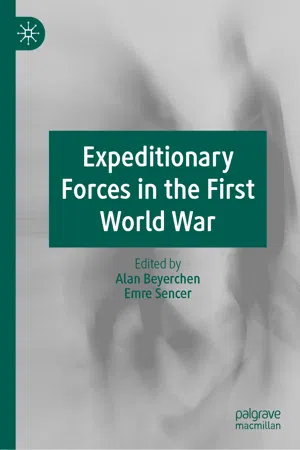
When war engulfed Europe in 1914, the conflict quickly took on global dimensions. Although fighting erupted in Africa and Asia, the Great War primarily pulled troops from around the world into Europe and the Ottoman Empire. Amid the fighting were large numbers of expeditionary forces—and yet they have remained largely unstudied as a collective phenomenon, along with the term "expeditionary force" itself.
This collection examines the expeditionary experience through a wide range of case studies. They cover major themes such as the recruitment, transport, and supply of far-flung troops; the cultural and linguistic dissonance, as well as gender relations, navigated by soldiers in foreign lands; the political challenge of providing a rationale to justify their dislocation and sacrifice; and the role of memory and memorialization. Together, these essays open up new avenues for understanding the experiences of soldiers who fought the First World War far from home.
eBook - ePub
Expeditionary Forces in the First World War
- English
- ePUB (mobile friendly)
- Available on iOS & Android
eBook - ePub
Expeditionary Forces in the First World War
About this book
Information
© The Author(s) 2019
A. Beyerchen, E. Sencer (eds.)Expeditionary Forces in the First World Warhttps://doi.org/10.1007/978-3-030-25030-0_11. Introduction: Concept and Themes
Alan Beyerchen1
(1)
Portland, OR, USA
Alan Beyerchen
Since a number of the belligerents were world colonial powers, when Europe became engulfed in war in 1914 the conflict immediately became global. France and Great Britain, in particular, drew at once on forces that had to be brought across the seas into Europe to stem the German advance. As the War raged onward, the enormous spaces and casualties increasingly consumed troops and resources from around the world. The conflict thus became a World War, not only because the conflict reverberated outward around the globe and ignited fighting on other continents, but because the desperate, black hole of the War pulled such vast quantities of men and materiel inward to the European and Ottoman lands. This was a global conflict not just because the War came to the world, but also because, quite literally, the world came to the War.
The manner in which these troops were gathered, transported, and deployed to other lands generally went by the designation “expeditionary forces.” The concept of setting out on a martial journey is older than the stories in Homer’s Iliad and Odyssey, and, according to the Oxford English Dictionary, the notion specifically of a military “expedition” was in use in English since the seventeenth century to designate “a body of persons, also a fleet, etc., sent out for a warlike or other definite purpose.” 1 Toward the end of the nineteenth century, it was commonly used to designate a journey of exploration organized in a military manner, such as to the Arctic or Antarctic regions, even when not involving military units as such. Recent military uses included the British “Punitive Expedition in Abyssinia” in 1868, the “Nile Expedition” (or the “Gordon Relief Column”) to Khartoum in 1884–1885, the “China Relief Expedition” (to lift the siege of the legation compounds in Peking [Beijing] in 1900) and the American “Punitive Expedition, U. S. Army” into Mexico in 1916–1917. But the British did not use the term in the Boer War, nor did the Americans use it in the Philippines . 2
Great Britain set the basic pattern of using the designation “expeditionary forces ” for those troops sent abroad in the Great War. The Haldane army reforms of 1907 created a distinction between regular army divisions in the Expeditionary Force (and their reserve components) available to be deployed on the continent versus those of the Territorial Force, assigned to serve at home. 3 Since the “Saturday Afternoon Soldiers” of the Territorial units were seen as beneath the standard of the regular army, when casualties mounted quickly in August and September 1914, Lord Kitchener as War Minister initially bypassed them in calling for a volunteer “New Army.” In the event, however, some of the more prepared Territorial battalions were called to France in the fall of 1914 well ahead of the arrival of the New Army units. In one sense, the British Expeditionary Force (BEF) ceased to exist as regular army units were shattered in the early battles of the War and Territorial and New Army battalions came into the field to fight, but the designation BEF continued to be employed for British troops on the Western Front for the duration of the conflict. 4
The Dominion countries mostly but not uniformly followed the British example. Although they were viewed as existing within the Imperial army for training and command purposes, their small territorial armies were designed for homeland defense and not for deploying abroad. The Dominions therefore created volunteer bodies to send to the aid of Great Britain. Thus arose the Canadian Expeditionary Force, the New Zealand Expeditionary Force, and Indian Expeditionary Force A through G (the letters indicated different theaters of deployment, with A to the Western Front, B and C to East Africa, D to Mesopotamia, E and F to Egypt and G to Gallipoli). The South Africans created a volunteer South African Overseas Expeditionary Force, although many of its personnel were deployed in Africa rather than Europe. There was also a small Australian Naval and Military Expeditionary Force (distinct from the troops sent to Europe and the Ottoman lands) dispatched to seize the South Pacific islands in German colonial possession at the outbreak of the War.
A number of other countries followed suit. The Russians sent an expeditionary force to the west to demonstrate solidarity with their ally France and the Portuguese sent units late in the war to the Western Front to show their solidarity with Great Britain . Various Allied forces were pulled together for a specific purpose or area, such as the 1915–1916 naval and army Mediterranean Expeditionary Force (i.e., the Gallipoli campaign), a portion of which was the French Corps expéditionnaire d’Orient , later designated as the Corps expéditionnaire des Dardanelles. An Anglo-French Italian Expeditionary Force was sent to Italy in 1917, when the German and Austro-Hungarian advance threatened to knock Italy out of the war. The British set up an Expeditionary Force in Egypt to move against the Ottoman Empire in the Sinai and Palestine, as well as multiple expeditionary forces in Africa to seize German colonial territories . The United States entry into the war in 1917 led to the creation of the massive American Expeditionary Forces (AEF). And there were several late-war intervention actions that carried the designation “expeditionary” by some of the participants, such as the American North Russia Expeditionary Force and the Italian Expeditionary Force in Murmansk ( Corpo di spedizione italiano in Murmania ) or the American Expeditionary Force Siberia and the Canadian Siberian Expeditionary Force .
Yet the usage was not thoroughly consistent. The troops that were sent to the Macedonian (or Salonika) Front were part of the Allied Armies of the East (Armées alliées en Orient) and not formally named “expeditionary.” The French sent a Middle Eastern Détachement français de Palestine in 1917 (later termed the Détachement français en Palestine et Syrie). Toward the end of the war, there were several intervention forces informally referred to as expeditionary, but never formally so designated, such as the battalion or regiment-sized “Dunsterforce” and “Malleson Mission” in the Caspian Sea region. The Newfoundland Regiment was formed to serve with the British army, but never termed “expeditionary.” Perhaps the most glaring inconsistency was that of the Australians. In August 1914, the commanding general of the new Australian force declaimed any use of the term “expeditionary,” which was being applied to the smaller force heading into the South Pacific. “It’s not an expedition,” he proclaimed, so the initial Australian Division became the first of five infantry and two cavalry divisions sent abroad as part of the “Australian Imperial Force.” 5 The French did not use “expeditionary” to describe the forces they drew to France from their colonies, whether from Algeria (which formally constituted three Departments of France and whose soldiers formed the major part of the French army’s strategic reserve), Morocco, Tunisia, West Africa, Madagascar, or even Indochina. None of the German army or other Central Powers’ forces was designated as expeditionary, and, more to the point, none has been viewed in the literature on the War as expeditionary. However, we show how several specific German and Turkish forces could—and should—be understood as in expeditionary mode .
Given that the designation “expeditionary force” was widely used, it is surprising that it was not uniformly applied at the time and still remains taken for granted without serious examination. For example, the term even today is seen as so unproblematic that neither the Cassell’s World History of Warfare (2002) nor the Oxford Companion to Military History (2001; online 2004) has an entry for “expeditionary force.” The Encyclopedia Britannica of the time had no entry for “expedition,” much less “expeditionary force.” The Oxford English Dictionary has specified in successive editions that an expedition is “a sending or setting forth with martial intentions; a warlike enterprise,” but has had no entry for “expeditionary force” as such. Today’s online OED entries for “expedition” further indicate that the connotations of a sense of “speed” and “purpose” remain . 6
There are many reasons for sending forth an expedition, but a limited set of purposes for making military force a determining characteristic of one. The first two of these were well established in recent precedent, namely a relief expedition to reach an endangered party or a punitive expedition to punish an opponent for perceived unacceptable behavior. There was little use of this terminology in the Great War, with the most prominent example that of the Austrians in 1916 mounting the Trentino Offensive as a Strafexpedition against the Italians for coming into the War on the side of the Allies when their prewar alliance had called for them to either join Austria-Hungary and Germany or at least remain neutral. 7 From the German point of view, the Allied forces stationed along the Rhine in the postwar period looked much like a punitive expedition without the name. Another reason for an expeditionary force was to conquer, occupy, and acquire territory, populations, and resources with intent to hold them by military means over an extended period. This was one of the essential features of late-nineteenth-century colonialism in Africa . The several expeditionary forces on the continent were important components of the War and generated major stresses and changes, with over two million Africans pulled into service of the European armies (200,000 of whom are estimated to have died). “Never before in the history of Africa had manpower been mobilized on such a scale,” Hew Strachan has written. 8 Yet he has argued that the fighting there “bore more relationship to the nineteenth-century campaigns of colonial conquest than they did to the Great War itself.” 9 With limited resources we have decided to leave that story to other researchers.
What Was an Expeditionary Force in the Great War?
Our focus in this volume is instead on expeditionary forces whose mission was to help an ally, for any one or combination of reasons. One was loyalty stemming from tradition and kinship, a strong factor in the immediate Canadian response to the outbreak of war (some 65% of the enlisted ranks in the over 35,000 men of the first contingent of the Canadian Expeditionary Force were born in the British Isles). 10 A second emerged from loyalty and commitment through legal, cultural, and military ties, which characterized the Dominion forces of the British Empire in general, but also the French colonial response. Another was the sending of an expeditionary force out of self-interest to avoid future threats posed by the enemy of one’s ally, as was the case with the BEF itself—and could be argued was the case in the various Allied interventions in Russia intended first to keep Russia in the War and then to counter the rise of the Bolsheviks . A fourth reason to send an expeditionary force was unconcealed self-interest to shore up a position in an alliance or establish the basis for later gains with an ally. The Ru...
Table of contents
- Cover
- Front Matter
- 1. Introduction: Concept and Themes
- 2. A Tale of Two Expeditionary Forces: Religion and Race in the Dardanelles and France
- 3. Far from Home? Perceptions and Experiences of First World War Nurses and Their Patients
- 4. The Enemy Lurking Behind the Front: Controlling Sex in the German Forces Sent to Eastern and Western Europe, 1914–1918
- 5. Vietnamese Contingents to the Western Front, 1915–1919
- 6. Expeditionary Forces in the Shatterzone: German, British and French Soldiers on the Macedonian Front, 1915–1918
- 7. An Alliance of Competing Identities: Stereotypes and Hierarchies Among Entente Expeditionary Forces on the Western Front
- 8. Empire, Oil, and Bavarians: The German Expeditionary Force in the Caucasus, 1918–1919
- 9. Freikorps in the Baltics: German Expeditionary Forces in Eastern Europe, 1918–1919
- 10. From Galicia to Galilee: The Ottoman and German Expeditionary Experiences in the First World War in Comparison
- 11. “Some Corner of a Foreign Field That Is Forever England”: The Western Front as the British Soldiers’ Sacred Land
- 12. Conclusion
- Back Matter
Trusted by 375,005 students
Access to over 1.5 million titles for a fair monthly price.
Study more efficiently using our study tools.
Frequently asked questions
Yes, you can cancel anytime from the Subscription tab in your account settings on the Perlego website. Your subscription will stay active until the end of your current billing period. Learn how to cancel your subscription
No, books cannot be downloaded as external files, such as PDFs, for use outside of Perlego. However, you can download books within the Perlego app for offline reading on mobile or tablet. Learn how to download books offline
Perlego offers two plans: Essential and Complete
- Essential is ideal for learners and professionals who enjoy exploring a wide range of subjects. Access the Essential Library with 800,000+ trusted titles and best-sellers across business, personal growth, and the humanities. Includes unlimited reading time and Standard Read Aloud voice.
- Complete: Perfect for advanced learners and researchers needing full, unrestricted access. Unlock 1.5M+ books across hundreds of subjects, including academic and specialized titles. The Complete Plan also includes advanced features like Premium Read Aloud and Research Assistant.
We are an online textbook subscription service, where you can get access to an entire online library for less than the price of a single book per month. With over 1.5 million books across 990+ topics, we’ve got you covered! Learn about our mission
Look out for the read-aloud symbol on your next book to see if you can listen to it. The read-aloud tool reads text aloud for you, highlighting the text as it is being read. You can pause it, speed it up and slow it down. Learn more about Read Aloud
Yes! You can use the Perlego app on both iOS and Android devices to read anytime, anywhere — even offline. Perfect for commutes or when you’re on the go.
Please note we cannot support devices running on iOS 13 and Android 7 or earlier. Learn more about using the app
Please note we cannot support devices running on iOS 13 and Android 7 or earlier. Learn more about using the app
Yes, you can access Expeditionary Forces in the First World War by Alan Beyerchen, Emre Sencer, Alan Beyerchen,Emre Sencer in PDF and/or ePUB format, as well as other popular books in History & British History. We have over 1.5 million books available in our catalogue for you to explore.