This book examines the relationship between corruption scandals and transitional processes in post-Miloševi? Serbia after 2000. The study challenges the view that corruption has always been understood as a conflict between private interests and the public good, as these concepts are defined in Western democracies, and explores how anti-corruption discourse has been used for political mobilisation. Through an examination of high-profile political scandals in Serbia, the author shows how the meaning of corruption changed over time. In the early 2000s, corruption focused on the legacy of Miloševi?'s rule and was identified through the public's limited access to the privatisation process. By the end of the decade, conceptualisations of corruption in public debate were so diversified that each anti-corruption measure undertaken by the state was interpreted as an act of corruption by other voices in the discourse. The book will appeal to students and scholars interested in corruption studies, discourse analysis and Balkan politics.
eBook - ePub
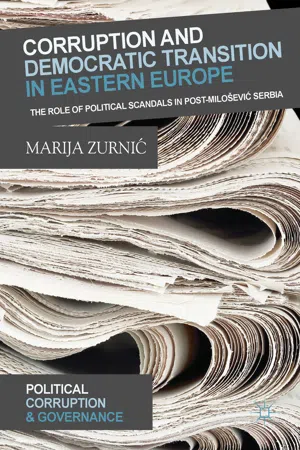
Corruption and Democratic Transition in Eastern Europe
The Role of Political Scandals in Post-Milošević Serbia
- English
- ePUB (mobile friendly)
- Available on iOS & Android
eBook - ePub
Corruption and Democratic Transition in Eastern Europe
The Role of Political Scandals in Post-Milošević Serbia
About this book
Information
© The Author(s) 2019
Marija ZurnićCorruption and Democratic Transition in Eastern EuropePolitical Corruption and Governancehttps://doi.org/10.1007/978-3-319-90101-5_11. Introduction: Political Scandals and Transition in Serbia
This book examines the politicisation of corruption in an Eastern European country undergoing democratic transition. By exploring the nature and dynamics of the anti-corruption discourse in Serbia and the actors involved in it, it aims to identify the political behaviour that is understood as corruption in public debate. The issue of corruption is analysed from the perspective of concept formation, while exploring the potential influence of public debate around corruption on the institutional framework. More specifically, the analysis explores how different understandings of corruption relate to the way corruption is defined in the legal framework. The book restricts its analysis to those elements of corruption that are present in public debate, including the concepts of state, power, property and interest.
The anti-corruption discourse and its politicisation are explored in this book in the context of the democratisation of a post-communist society undergoing transitional reforms, including market liberalisation, privatisation and intensive institution-building. It is generally accepted that post-communist transition is associated with high levels of corruption in terms of both actual incidences and perceptions. There are many explanations for this tendency. Economic reforms are often viewed as generators of structural opportunities for corruption, while the underdeveloped legal and regulatory framework of transitional states and the inefficiency of their judicial systems are also identified as a cause. It is certainly true that countries in transition often experience a large number of scandals, which are revealed by the media and developed in the extra-institutional realm into protracted stories about corruption and in some cases never reach a conclusion in the courts.
The specific political and economic developments of Serbia’s recent past make it a fascinating case study for exploring the politicisation of corruption. The country was in the international media spotlight during the Balkan wars of the 1990s, and for a decade (1992–2001), it was subject to a UN embargo aimed at preventing further regional conflicts. Although Serbia’s economic and diplomatic relations with the international community were severed during its decade of isolation, political developments in Serbia were followed eagerly by the international media. However, since Slobodan Milošević was ousted from power in October 2000, ending Serbia’s international isolation, political developments in the country have drawn significantly less attention, apart from occasional coverage of the territorial dispute over Kosovo.
In the early 2000s, after a decade of isolation and with multiple preconditions being set for the country’s re-integration into international institutions and organisations, the post-Milošević establishment made significant efforts to catch up with developments in the international arena . This concurrence of political and economic circumstances presents a rare opportunity to gain further insight into how a post-communist transitional society reorganised its political, economic and social life according to new rules on the legality and morality of political action introduced as part of transitional processes . As the book will show, corruption controversies cut across the processes of state-building and economic development, constantly challenging the post-Milošević establishment’s political struggle for legitimisation.
The most frequently used instrument in the discursive political struggles was accusations of corruption, that is to say the politics of scandals. Moreover, a variety of issues besides corruption were discussed in the anti-corruption debate, especially matters related to the ongoing transitional process. Over the decade studied in the book, public debate over corruption in Serbia became a platform for ideological contestation between various groups in society whose members voiced their opinions on the nature of corruption and what constituted “proper” political behaviour, putting forward their vision of a desirable community and an ideal state.
In this book, I argue that in the process of post-communist transition, political discourse becomes increasingly contested. Political scandals and corruption—which might be seen as a challenge to political stability and an obstacle to economic development— can offer a path to a more democratic politics. Moreover, unlike the bulk of existing literature on corruption, which argues that political scandals trigger institutional change and improve democratic institutions, this book shows that the corruption scandals analysed here have not been a corrective for the system in Serbia.
As the book argues, the anti-corruption discourse was used by the post-2000 political elites to distance themselves from the previous regime under Milošević . Furthermore, the anti-corruption discourse was used by the new post-Milošević establishment as a tool to introduce systemic economic changes to Serbia, such as market liberalisation and privatisation . Thus, an understanding of corruption based on a strict separation between public and private, which was first introduced discursively by post-Milošević governments, was later institutionalised through a number of anti-corruption legal measures. The change in the conception of corruption in the post-2000 era was not a single event; rather, it is an ongoing process.
The book explores the public debate on corruption which emerged and developed between 2000 and 2012. This period covers the terms of office of four post-Milošević governments: the DOS government (2000–2004), the Koštunica governments (2004–2007, 2007–2008) and the Cvetković government (2008–2012). The book explores how six high-profile corruption scandals affected the political community and made the actors in public debate shift between ideological positions over time. With the aim of aiding better understanding of the current anti-corruption debate in Serbia, the book offers a brief overview of how corruption has been understood in public discourse in the country’s recent history and incorporated into the national legal framework and state policy.
Political Scandals and Corruption
Analysing scandals is highly relevant to the study of corruption owing to the complex relationship between the two concepts. Scandals do not always emerge from a corrupt act, but can have a life of their own. A high incidence of scandals can decrease trust in institutions and politicians and result in political disengagement. Moreover, corruption scandals can empower non-democratic political options or can encourage involvement in corrupt practices by creating a perception in society that “everyone is corrupt”.
The literature written in the early stages of “scandalogy ” analysed political scandals as an extra-institutional phenomenon or an unintended consequence of political processes (Markovits and Silverstein 1988; Doig 1984; Noonan 1987). More recent literature understands scandals from the perspective of communication studies and defines them as mediated events (Entman 2012; Thompson 2000; Tiffen 1999). It is generally accepted that once a scandal has been investigated and those involved prosecuted, the result is long-term institutional changes that prevent the incident from reoccurring. Therefore, it is considered that political scandals often trigger corrective action and thus contribute to the improvement of democratic institutions.
The generic definition of corruption refers to the abuse of power for the purpose of illicit gain, which implies conflict between the public good and private interests . The bulk of academic research on anti-corruption policy assumes that this conflict has been an intrinsic part of the concept of corruption in all societies since ancient times. However, a closer look at the problem of corruption in Eastern Europe’s post-communist countries reveals that the separation between private interests and the public good —as understood in established Western democracies—only became dominant with the transition to parliamentary democracy and the free market economy in the 1990s, and in Serbia as late as the early 2000s. The extensive economic and political transformation including changes to ownership rights and political representation and the emergence of nation states, has significantly affected the way corruption is understood in the post-communist world.
In the policy sphere, a number of conventions aimed at harmonising anti-corruption efforts internationally—such as the UN Convention against Corruption and Council of Europe initiatives —also understand the public–private divide as being at the core of the concept of corruption. Anti-corruption policies transferred to the national level through these instruments focus mainly on strengthening principles of good governance and preventing private interests from harming the public good, or otherwise ensuring the separation of the public and private spheres. The European Union in particular pays special att...
Table of contents
- Cover
- Front Matter
- 1. Introduction: Political Scandals and Transition in Serbia
- 2. Yugoslavia from Kingdom to Socialist Federation: Political Order and Political Corruption
- 3. Milošević’s Rule and Corruption
- 4. Confronting Corruption in Post-Milošević Serbia: Discourse and Institutions
- 5. Money Laundering and Privatisation: The Money in Cyprus Scandal and the Privatisation of Jugoremedija
- 6. State, Interest and Political Corruption: The Bankruptcy of Sartid and the Privatisation of C Market
- 7. Institution-Building and Institutional Corruption: The Port of Belgrade Privatisation and Swine Flu Scandals
- 8. Conclusions: Political Scandals and Political Action
- Back Matter
Trusted by 375,005 students
Access to over 1.5 million titles for a fair monthly price.
Study more efficiently using our study tools.
Frequently asked questions
Yes, you can cancel anytime from the Subscription tab in your account settings on the Perlego website. Your subscription will stay active until the end of your current billing period. Learn how to cancel your subscription
No, books cannot be downloaded as external files, such as PDFs, for use outside of Perlego. However, you can download books within the Perlego app for offline reading on mobile or tablet. Learn how to download books offline
Perlego offers two plans: Essential and Complete
- Essential is ideal for learners and professionals who enjoy exploring a wide range of subjects. Access the Essential Library with 800,000+ trusted titles and best-sellers across business, personal growth, and the humanities. Includes unlimited reading time and Standard Read Aloud voice.
- Complete: Perfect for advanced learners and researchers needing full, unrestricted access. Unlock 1.5M+ books across hundreds of subjects, including academic and specialized titles. The Complete Plan also includes advanced features like Premium Read Aloud and Research Assistant.
We are an online textbook subscription service, where you can get access to an entire online library for less than the price of a single book per month. With over 1.5 million books across 990+ topics, we’ve got you covered! Learn about our mission
Look out for the read-aloud symbol on your next book to see if you can listen to it. The read-aloud tool reads text aloud for you, highlighting the text as it is being read. You can pause it, speed it up and slow it down. Learn more about Read Aloud
Yes! You can use the Perlego app on both iOS and Android devices to read anytime, anywhere — even offline. Perfect for commutes or when you’re on the go.
Please note we cannot support devices running on iOS 13 and Android 7 or earlier. Learn more about using the app
Please note we cannot support devices running on iOS 13 and Android 7 or earlier. Learn more about using the app
Yes, you can access Corruption and Democratic Transition in Eastern Europe by Marija Zurnić in PDF and/or ePUB format, as well as other popular books in Politics & International Relations & European Politics. We have over 1.5 million books available in our catalogue for you to explore.