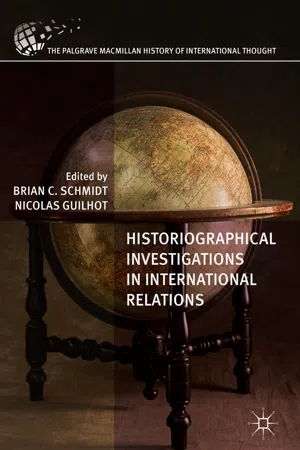
This book critically investigates the historiography of International Relations. For the past fifteen years, the field has witnessed the development of a strong interest in the history of the discipline. The chapters in this edited volume, written by some of the field's preeminent disciplinary historians, all manifest the best of an innovative and exciting generation of scholarship on the history of the discipline of International Relations. One of the objectives of this volume is to take stock of the historical turn. Yet this volume is not simply a stock-taking exercise, as it also intends to identify the limitations and blind spots of the recent historiographical literature. The chapters consider a range of diverse thinkers and examine their impact on understanding various dimensions of the field's history.
eBook - ePub
Historiographical Investigations in International Relations
- English
- ePUB (mobile friendly)
- Available on iOS & Android
eBook - ePub
Historiographical Investigations in International Relations
About this book
Information
© The Author(s) 2019
Brian C. Schmidt and Nicolas Guilhot (eds.)Historiographical Investigations in International RelationsThe Palgrave Macmillan History of International Thoughthttps://doi.org/10.1007/978-3-319-78036-8_11. Introduction
Nicolas Guilhot1
(1)
Centre National de la Recherche Scientifique, Paris, France
Nicolas Guilhot
In an autobiographical lecture given in 1987, the cultural historian Carl Schorske reminisced that when a new and abstract theoretical mood took over the disciplines in the 1950s, turning them away from historical modes of understanding—a process he called “the dehistoricization of academic culture”—intellectual history became the repository for the study of “previously significant thinkers” who had “lost their relevance and stature” in what had been so far their natural disciplinary habitat. The intellectual historian, Schorske claimed, became a “residuary legatee” at the deathbed of the history of philosophy, economic thought, or social theory (Schorske 1987). One could easily add political science and international relations (IR) to the list. Starting in the 1950s, IR theory, especially that being developed in the United States, sought to assert its legitimacy as a social science by shedding entirely its historicist past. Even though historians often played a major role in establishing IR as a specialized academic discipline after World War II (one may think of Herbert Butterfield in the United Kingdom, Jean-Baptiste Duroselle in France, and historically minded German scholars in the United States), the field was caught in the infatuation with general systems theory that took over the social sciences in the 1950s and the 1960s, entirely dispensing with the need for historical knowledge that was previously one of its distinctive features.1 As the disciplinary landscape eventually set around two or three dominant schools or approaches, history had been completely excised from them. The work of historians, legal theorists, economists, geographers, or philosophers who had shed light on the constitution of the modern state system was cast aside, in favor of abstract, parsimonious, and self-sufficient models. To the dismay of an older generation of scholars steeped in a historical understanding of their field, independently of their original specialties, IR became a largely “theoretical” field. Again, these tendencies were most prominent in the United States, which led Stanley Hoffmann (1977) to declare that IR was an American social science.2
More than half a century later, it would seem that the heirs of these lost thinkers are reclaiming their inheritance from the historian legatees. Never have students of IR been so interested in the history of their discipline. As one of the contributors to this volume noted more than 15 years ago, “the study of the history of political thought, as well as the intellectual history of the discipline, is now taken far more seriously, studied more carefully and explicitly, and plays a greater role in shaping the theoretical debate, than in the past” (Bell 2007: 123). Starting with the publication of Brian Schmidt’s seminal The Political Discourse of Anarchy in 1998, a steady and increasingly powerful stream of historical works has indeed developed within the discipline. Early IR theorists have been retrieved from oblivion and their doctrines restored to their original complexity, prior to their reduction to stylized and often misleading vignettes. As the towering and fatherly figure of Hans Morgenthau has been rediscovered, a complex thinker has emerged, whose arguments were deployed in a variety of arenas, from philosophy to international law or even theology because these intellectual fields were still overlapping when the consideration of international affairs was concerned.3 While Morgenthau has certainly received the lion’s share of attention, a number of lesser-known political theorists have been rediscovered, for instance, John Herz or Hans Speier (Sylvest 2008; Zajec 2016; Bessner 2018). Prior to the focus on Morgenthau , a good deal of revisionist scholarship focused on the work of E.H. Carr (Wilson 1998; Jones 1998; Cox 2000). Political realism as an intellectual movement and an ideology has been the focus of exacting historical research that has shed light on its connections to political theory, theology, history, and even, in this volume, aesthetics (Williams 2007; Rengger 2013). Recent research has shown the versatile and ideologically ambivalent nature of the critical charge it leveled against modernity.4 The role émigré scholars played in the establishment of the discipline and the extent of European influences over its early development have attracted extensive scrutiny, and contributed to “question[ing] the usual trajectory of IR as an American discipline,” thus connecting the historiography of the field to international history.5 Thanks to the work of David Long, Brian Schmidt, Duncan Bell, John Hobson, and more recently Robert Vitalis, to name but a few, we know the extent to which IR as a field of study was premised on earlier forms of knowledge organized around imperial and colonial expertise that did not fully subside as decolonization proceeded (Long and Schmidt 2005; Bell 2007; Hobson 2012; Vitalis 2015). The management of imperial relations and of the “color line” was the main focus of the discipline at least until the beginning of the Cold War. Even the trust in the scientific study of international politics that came to define the discipline is now reinscribed within the web of imperial relations (Thakur et al. 2017). The rediscovery of the importance of the legal debates of the 1930s for the development of classical realism has allowed for fruitful engagements between IR and international law (Jütersonke 2010; Koskenniemi 2002). Disciplinary history has also contributed to situate in a more international perspective a field that has been prevailingly defined from the United States’ point of view, as researchers have started to trace the development of IR theory in different national contexts. Next to the overriding narrative of the development of IR theory in the United States, recent works have shed light on the specificity of the English, French, or German cases while at the same time pointing at their interconnectedness (Dunne 1998; Rietzler 2008; Guilhot 2017a, b). Not only have classical thinkers of international affairs been revisited in a more thorough and contextualized fashion: disciplinary historians have shed light on the contribution of intellectual figures who were considered minor or simply outside the boundaries of the discipline. Lesser-known figures such as Edward Mead Earle or Kenneth Thompson have been the subjects of reconsiderations or, simply, consideration, while the legacies of anthropologist Owen Lattimore or sociologist-turned-political scientist Nicholas Spykman have recently been explored in important books (Eckbladh 2011; Rajaee 2013; Rosenboim 2017; Zajec 2016).
While students of IR have never been so interested in history, it is also true that never before have historians been so interested in things international. To no small extent, the reflexive historical turn in IR has been strengthened by a convergence with trends that were taking place among historians. Historians of political thought, in particular, have demonstrated a new interest in the international dimension of political life, recognizing that the history of political thought and political concepts has remained for too long centered on the municipal capacities of the state. Starting in the 1990s, historians of modern political thought rediscovered the international background of the classical doctrines of the state or increasingly recast the problem of political thought in a broader international context , both in terms of the circulation of ideas and in terms of the object of the doctrines themselves (Tuck 1999; Armitage 2013). The impact of international politics—or issues of war and peace—on constitutional doctrine or modern citizenship has been recognized, including outside the absolutist tradition .6 The result, according to David Armitage , was an emergent field, the history of “international thought,” open equally to historians of political thought and “self-critical students of international relations and international law” (Armitage 2013: 2 ).
The historical turn in IR has also matched an international turn in history. Recently, Udi Greenberg’s work on Morgenthau in the context of his exploration of the long-term and international impact of Weimar intellectuals, or Mark Mazower’s analysis of various forms of internationalism, have contributed to extract important figures from the narrow disciplinary contexts in which IR history was confining them (Greenberg 2014; Mazower 2012). This transversal approach to major IR thinkers or concepts has generated fruitful conversation with historians, while also renewing the chronological framework of disciplinary history. The reinscription of IR within a long-term history of international thought meant that IR as an academic discipline represented only a specific episode within a longer evolution of our political concepts, and that a proper understanding of the discipline could be gained only by taking into account this longer history. Torbjørn Knutsen’s A History of International Relations Theory (1997) provides a clear example of this endeavor: Knutsen begins his account of t...
Table of contents
- Cover
- Front Matter
- 1. Introduction
- 2. Writing the World (Remix)
- 3. Aesthetic Realism
- 4. How Should We Approach the History of International Thought?
- 5. Threads and Boundaries: Rethinking the Intellectual History of International Relations
- 6. Internalism Versus Externalism in the Disciplinary History of International Relations
- 7. What’s at Stake in Doing (Critical) IR/IPE Historiography? The Imperative of Critical Historiography
- 8. The English School’s Histories and International Relations
- 9. The Matter with History and Making History Matter
- Back Matter
Trusted by 375,005 students
Access to over 1.5 million titles for a fair monthly price.
Study more efficiently using our study tools.
Frequently asked questions
Yes, you can cancel anytime from the Subscription tab in your account settings on the Perlego website. Your subscription will stay active until the end of your current billing period. Learn how to cancel your subscription
No, books cannot be downloaded as external files, such as PDFs, for use outside of Perlego. However, you can download books within the Perlego app for offline reading on mobile or tablet. Learn how to download books offline
Perlego offers two plans: Essential and Complete
- Essential is ideal for learners and professionals who enjoy exploring a wide range of subjects. Access the Essential Library with 800,000+ trusted titles and best-sellers across business, personal growth, and the humanities. Includes unlimited reading time and Standard Read Aloud voice.
- Complete: Perfect for advanced learners and researchers needing full, unrestricted access. Unlock 1.5M+ books across hundreds of subjects, including academic and specialized titles. The Complete Plan also includes advanced features like Premium Read Aloud and Research Assistant.
We are an online textbook subscription service, where you can get access to an entire online library for less than the price of a single book per month. With over 1.5 million books across 990+ topics, we’ve got you covered! Learn about our mission
Look out for the read-aloud symbol on your next book to see if you can listen to it. The read-aloud tool reads text aloud for you, highlighting the text as it is being read. You can pause it, speed it up and slow it down. Learn more about Read Aloud
Yes! You can use the Perlego app on both iOS and Android devices to read anytime, anywhere — even offline. Perfect for commutes or when you’re on the go.
Please note we cannot support devices running on iOS 13 and Android 7 or earlier. Learn more about using the app
Please note we cannot support devices running on iOS 13 and Android 7 or earlier. Learn more about using the app
Yes, you can access Historiographical Investigations in International Relations by Brian C. Schmidt, Nicolas Guilhot, Brian C. Schmidt,Nicolas Guilhot in PDF and/or ePUB format, as well as other popular books in Politics & International Relations & International Relations. We have over 1.5 million books available in our catalogue for you to explore.