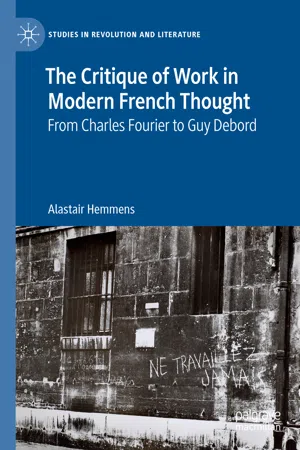
What is work? Why do we do it? Since time immemorial the answer to these questions, from both the left and the right, has been that work is both a natural necessity and, barring exploitation, a social good. One might criticise its management, its compensation and who benefits from it the most, but never work itself, never work as such. In this book, Alastair Hemmens seeks to challenge these received ideas. Drawing on the new 'critique-of-value' school of Marxian critical theory, Hemmens demonstrates that capitalism and its final crisis cannot be properly understood except in terms of the historically specific and socially destructive character of labour. It is from this radical perspective that Hemmens turns to an innovative critical analysis of the rich history of radical French thinkers who, over the past two centuries, have challenged the labour form head on: from the utopian-socialist Charles Fourier, who called for the abolition of the separation between work and play, and Marx's wayward son-in-law, Paul Lafargue, who demanded The Right to Laziness (1880), to the father of Surrealism, André Breton, who inaugurated a 'war on work', and, of course, the French Situationist, Guy Debord, author of the famous graffito, 'never work'. Ultimately, Hemmens considers normative changes in attitudes to work since the 1960s and the future of anti-capitalist social movements today. This book will be a crucial point of reference for contemporary debates about labour and the anti-work tradition in France.
eBook - ePub
The Critique of Work in Modern French Thought
From Charles Fourier to Guy Debord
- English
- ePUB (mobile friendly)
- Available on iOS & Android
eBook - ePub
About this book
Information
© The Author(s) 2019
Alastair HemmensThe Critique of Work in Modern French ThoughtStudies in Revolution and Literaturehttps://doi.org/10.1007/978-3-030-12586-8_11. Marxian Theory and the Critique of Work
Alastair Hemmens1
(1)
Cardiff University, Cardiff, UK
Alastair Hemmens
The critique of work has historically been treated as a marginal topic in discussions of French thought. Although there have been a number of studies of popular resistance to work in the workplace itself,1 analysis of the intellectual history of anti-work discourse in France is fragmentary at best and only very rarely a focus of critical interest. This is an unfortunate state of affairs because France has a singularly rich intellectual tradition of criticising work which stretches at least as far back as the early nineteenth century and which has galvanised some of its most important thinkers and cultural movements. It includes the utopian-socialist Charles Fourier (1772–1837), who called for the abolition of the separation between work and play; Marx’s wayward son-in-law, Paul Lafargue (1842–1911), who called for The Right to Laziness (1880); the father of Surrealism André Breton (1896–1966), who demanded a ‘war on work’; and, of course, the French Situationist Guy Debord (1931–1994), who authored the infamous graffito, ‘never work’; as well as a host of other groups and figures before and since. Nevertheless, although many of these figures are today quite rightly considered to have made major contributions to the development of French thought, the anti-work aspects of their respective intellectual projects, along with the key ideas that drove this dissident tradition as a whole, have not been the subject of a great deal of serious theoretical analysis. It would not be too much of a caricature to say that, just as workers who refuse to obey the beat of the factory drum have often found themselves vilified and marginalised, so too those radical French thinkers who have argued that work might be something quite suspect have, by and large, found this aspect of their writing ignored and dismissed as naïvely utopian and even as reactionary.2
The fact that critiques of work in theory and practice still meet with a great deal of resistance today is not surprising. The political consensus, since at least the nineteenth century, is that work is both a natural necessity and, barring exploitation at least, a social good. There are many who consider it the foundation stone of all human society and even the defining characteristic of human being. The identification of mankind with homo faber , or ‘man the maker’, a being who consciously constructs himself and the world around him through the productive process is foundational to nearly all forms of modern social thought. Work as such has been treated variously in the modern era as a source of social wealth, of identity, of pride, of freedom, social progress, social justice and even as the essence of society or, as Marx puts it in Capital (1867), ‘life itself’.3 Indeed, to the extent that labour has a hold on modern society, this really is the case. Most modern people, from the moment they are born, are destined for a childhood given over to training for competition on the labour market and, if they are one of the ‘lucky winners’, for an adulthood that is spent mostly in the factory, the shop or the office. Even the son of the bourgeois, who, and this is said with no judgement, may never have to work a day in his life, owes his continued existence to the world of work and often has a job all the same. Political and social theory has therefore turned not so much on the critical analysis of work as such but on how best to manage work and distribute its fruits for the greatest social benefit.
In fact, far from criticising it, both sides of the political spectrum have, to a greater or lesser degree, turned work (and very often the ‘Worker’) into a veritable cult of worship. As Anselm Jappe notes, even the more libertarian wings of leftism, such as anarcho-syndicalism, were not entirely free from this fanaticism, as can be seen from this ideology’s celebration of industry.4 This religion of production reached its terrible apogee, of course, in the Soviet gulags and in the ‘negative factories’5 of Nazi concentration camps, where, as the Situationists once noted, the sign above the gates read ‘Work will set you free.’6 At present very few governments, save for rogue states such as North Korea, feel the need to organise anything as systematic as the gulags; contemporary capitalism, as even the briefest glance at today’s newspapers will attest, is quite capable of pulling off the most extreme sacrifices to the labour god without state intervention. It should be recalled that the crude productivist propaganda images of the ‘recuperative modernisation’ regimes of the past,7 so easily mocked by today’s liberals, were only considered necessary because these ‘backward’ peasant populations had not yet fully submitted themselves to an industrial labour discipline that had long ago been internalised in the West in the form of the deepest structures of the modern psyche. In other words, attendance at the church of labour is no less compulsory in the present-day world of Western ‘free markets and democracy’ where we are now supposedly recognised only as citizen-consumers. If anything, as the Orwellian doublespeak of today’s left-wing politicians will attest, the language has only become more insidious. There is no longer a ‘working class’, only ‘working people’ and ‘working families’. There are no ‘unemployed’; there are only ‘job seekers’. As the German social-democrat Friedrich Ebert (1871–1925) once said, in all seriousness, ‘Socialism means working a lot.’8
There are signs, however, that the social consensus that has surrounded work for the past several centuries is in a state of decomposition. Although there have always been pockets of resistance and opposition to work, capitalism thankfully can never evenly develop everywhere and at all times, what we are witnessing today, even in the most developed capitalist countries, seems to be something far more widespread, as a kind of desperation takes hold. The furore in France over the ‘loi travail’, or labour law, which saw a socialist government seek to knock back some of the meagre protections that workers are allotted, has led to huge protests with people marching in the streets holding signs reading ‘work kills’ and, in a call back to Debord, ‘never work’ once more. One might also think of the mainstream success in France of books, such as Bonjour Laziness: Why Hard Work Doesn’t Pay (2004) by Corinne Maier, which suggest ways of resisting corporate discipline in the modern workplace; and of Pierre Carles’ documentary Attention Danger Travail (2003) that follows the movement of French ‘jobseekers’ who proudly say, in a manner that is genuinely brave in the context of the ‘work society’, that they simply want to be left to enjoy their lives living off the dole without the hassle of looking for work that either does not exist or, under the conditions imposed, is hardly worth doing.
Indeed, everywhere one looks, one finds an ever-growing number of proposals from all quarters of society, even business management schools, for dealing with the ‘problem of work’: from well-intentioned calls for basic income, ‘degrowth’ and wages for housewives, to arguments in favour of a better work-life balance, a green economy and, the same refrain that has been sung since the start of the Industrial Revolution, hope that technology will finally liberate us from the ‘natural necessity’ of labour through automation. In Britain and America alone, the past few years have seen a plethora of titles that claim to offer the possibility of a more critical stance towards work.9 Many of these studies, like the social movements taking place in France today, make reference to figures from the history of the French critique of work, albeit sometimes quite superficially, both to find a source of intellectual inspiration from the past for dealing with the problems of the present and to situate themselves within an ongoing history of popular resistance to capitalist exploitation. It is not in the least bit surprising that British and American authors should look to France given our shared history of projecting onto the French either the quality of laziness or of placing greater cultural value on life outside work, depending on one’s point of view. Although, while such projections might have had a certain truth to them in the past thanks to the history of uneven industrial development (with the caveat that laziness, if it means resistance to the modern labour process, can only be a good thing), it could hardly be said to characterise post-war French society, even if a few French workers preserve the dignity of not hastily eating a sandwich at their desk for lunch and still enjoy some social benefits denied to their British and American counterparts.10
These recent developments are first and foremost a reaction to the global financial crisis of 2008 that was itself only an epiphenomenon on the surface of the deeper structural crisis that capitalism has been undergoing since the end of the post-war boom in the early 1970s. Although there are still plenty of paid-up economists who continue to beat the drum of future prosperity, it has become increasingly difficult for even the most partisan of observers to ignore the patent absurdity of the immense productive capability of society and the reality of mass under- and unemployment, working poverty, precariousness and relentless cuts to the arts, education and social services. Even the official figures of unemployment in many Western countries today would have made any post-war government resign in embarrassment.11 At the same time, there is an awareness, even in the higher echelons of power, that we cannot go on as we have been if we want the planet to continue to be a viable habitat, and yet we continue to do so. Mainstream papers in the UK and France are even talking about the plethora of, what David Graeber has described as, ‘bullshit jobs’12 (something of a tautology one might add) and there is a genuine sense of decline of the ‘work society’ as conditions of hyper-competition drive successive national government...
Table of contents
- Cover
- Front Matter
- 1. Marxian Theory and the Critique of Work
- 2. Charles Fourier, Utopian Socialism and Attractive Labour
- 3. Paul Lafargue, Early French Marxism and the Right to Laziness
- 4. André Breton, the Artistic Avant-Garde and Surrealism’s War on Work
- 5. Guy Debord, the Situationist International and the Abolition of Alienated Labour
- 6. The New Spirit of Capitalism and the Critique of Work in France Since May ’68
- 7. News from Nowhere, or an Epoch of Rest
- Back Matter
Trusted by 375,005 students
Access to over 1.5 million titles for a fair monthly price.
Study more efficiently using our study tools.
Frequently asked questions
Yes, you can cancel anytime from the Subscription tab in your account settings on the Perlego website. Your subscription will stay active until the end of your current billing period. Learn how to cancel your subscription
No, books cannot be downloaded as external files, such as PDFs, for use outside of Perlego. However, you can download books within the Perlego app for offline reading on mobile or tablet. Learn how to download books offline
Perlego offers two plans: Essential and Complete
- Essential is ideal for learners and professionals who enjoy exploring a wide range of subjects. Access the Essential Library with 800,000+ trusted titles and best-sellers across business, personal growth, and the humanities. Includes unlimited reading time and Standard Read Aloud voice.
- Complete: Perfect for advanced learners and researchers needing full, unrestricted access. Unlock 1.5M+ books across hundreds of subjects, including academic and specialized titles. The Complete Plan also includes advanced features like Premium Read Aloud and Research Assistant.
We are an online textbook subscription service, where you can get access to an entire online library for less than the price of a single book per month. With over 1.5 million books across 990+ topics, we’ve got you covered! Learn about our mission
Look out for the read-aloud symbol on your next book to see if you can listen to it. The read-aloud tool reads text aloud for you, highlighting the text as it is being read. You can pause it, speed it up and slow it down. Learn more about Read Aloud
Yes! You can use the Perlego app on both iOS and Android devices to read anytime, anywhere — even offline. Perfect for commutes or when you’re on the go.
Please note we cannot support devices running on iOS 13 and Android 7 or earlier. Learn more about using the app
Please note we cannot support devices running on iOS 13 and Android 7 or earlier. Learn more about using the app
Yes, you can access The Critique of Work in Modern French Thought by Alastair Hemmens in PDF and/or ePUB format, as well as other popular books in Literature & European Literary Criticism. We have over 1.5 million books available in our catalogue for you to explore.