eBook - ePub
The Legacy of Second-Wave Feminism in American Politics
- English
- ePUB (mobile friendly)
- Available on iOS & Android
eBook - ePub
The Legacy of Second-Wave Feminism in American Politics
About this book
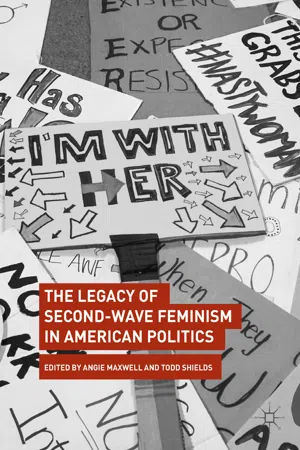
This book chronicles the influence of second wave feminism on everything from electoral politics to LGBTQ rights. The original descriptions of second wave feminism focused on elite, white voices, obscuring the accomplishments of many activists, as third wave feminists rightly criticized. Those limited narratives also prematurely marked the end of the movement, imposing an imaginary timeline on what is a continuous struggle for women's rights. Within the chapters of this volume, scholars provide a more complex description of second wave feminism, in which the sustained efforts of women from many races, classes, sexual orientations, and religious traditions, in the fight for equality have had a long-term impact on American politics. These authors argue that even the "Second Wave" metaphor is incomplete, and should be replaced by a broader, more-inclusive metaphor that accurately depicts the overlapping and extended battle waged by women activists. With the gift of hindsight and theawareness of the limitations of and backlash to this "Second Wave," the time is right to reflect on the feminist cause in America and to chart its path forward.
Information
© The Author(s) 2018
Angie Maxwell and Todd Shields (eds.)The Legacy of Second-Wave Feminism in American Politicshttps://doi.org/10.1007/978-3-319-62117-3_11. Introduction: Toward a New Understanding of Second-Wave Feminism
Angie Maxwell1 and Todd Shields1
(1)
University of Arkansas, Fayetteville, USA
Abstract
In this introductory chapter, Angie Maxwell and Todd Shields claim that the need to mark beginnings and endings of social movements, the over-reliance on popular, yet limited voices, the fact that feminism is not immune to white privilege, and the pain associated with lost battles for women’s rights have all contributed to obscuring the true legacy of the Second-Wave feminist movement. They contend that existing narratives have inordinately focused on the media-appointed “leaders” of the movement, who were almost exclusively white, heterosexual, well-educated women who overshadowed the multi-racial, grassroots cast of hundreds of thousands of women in America and around the globe. While Third-Wave feminists drew attention to these omissions and recovered the history of overshadowed communities, the time has come to reconcile both waves and re-examine the legacy of Second-Wave Feminism in American politics. This reassessment shows that the Second Wave was comprised of a heterogeneous army of women who, though often divided, still significantly influenced economics, theology, political activism, electoral success, attitudes toward homosexuality‚ and support for gay marriage. In fact, in many ways they were so successful that they were blind to the anti-feminist counterattack forming across the country. This introduction highlights the feminist historians, political scientists, gender studies scholars, and economists who are placing women’s activism at the center of our political landscape in their contributing chapters.
The original version of the book was revised: Final corrections have been incorporated. The erratum to this chapter is available at https://doi.org/10.1007/978-3-319-62117-3_11
End AbstractIn her edited collection, Feminist Coalitions: Historical Perspectives on Second-Wave Feminism in the United States, Stephanie Gilmore speaks to the scholarly paralysis that has tempered our understanding of both the accomplishments and the failures, and of the structure and impact, of Second-Wave Feminism. Depicted most often as an offshoot of the Civil Rights Movement , Second-Wave feminists “are suspended in historical—or rather, ahistorical—amber, unable to move or be moved.” 1 Gilmore’s volume and its contributors did much to resurrect this debate. The paralysis, however, is not limited to the way in which the movement is conceived as branching from the larger fight for African-American rights, but also, as Sara M. Evans contends in Chap. 2, to our proclivity to periodization. The need to mark a beginning and an end to what has been a sustained and constant effort for women’s equality—the need even to describe such periods as distinct “waves”—obscures much of the labor. And it obscures the laborers, many of whom remain absent from our narratives. Only popular leaders, or those leaders recognized by the media, present at key events highlighted by this periodization, remain in the public consciousness. Those leaders are almost exclusively privileged, white, and well-educated and function as the feature players overshadowing a multiracial, grassroots cast of hundreds of thousands of women in America and across the globe. And the movement itself, as the passage of a half-century has shown, lost control of the debate over women’s rights as the individual became more powerful than the collective. And so the united front needed to brace against the titanic backlash proved elusive. The consciousness-raising opened women’s eyes to their individual oppression, but not enough saw their own individual experience as part of a systemic and structural oppression for which political, collective, unified action remains the only antidote. Because the conservative backlash was so powerful, because the unity, despite the best efforts‚ was too fragile‚ because of our need to superficially mark beginnings and endings of social movements, because of our over-reliance on popular, yet limited voices, because feminism is not immune to white privilege , and because the losses were so painful for so many activists, we still struggle to understand what it all meant then and what it means for all of us now.
The Second Wave Reconsidered
To be fair, how the movement was portrayed in its time and how it has been remembered have drawn sharp criticism. For example, Charlotte Krolokke and Anne Scott Sorensen argue, “Second Wave feminism has come under attack from other marginalized groups, such as African American women and lesbians, for not including them.” Furthermore, they assert “in the context of the complex power relationships of a postcolonial, but still imperial and capitalist world, [critics of Second-Wave Feminism] questioned what they saw as a predominantly white, middle-class, and heterosexual feminist agenda and raised the issue of a differentiated-identity politics based on the contingent and diversified but no less divisive intersections of gender, class, race/ethnicity, and sexuality.” 2 The tendency, particularly in the initial scholarship on and retelling of the movement to describe a “hegemonic feminism,” which “treats sexism as the ultimate oppression,” 3 disconnected from other bases of prejudice and discrimination, ignores the “double marginalization” of black women, as noted by Nadia E. Brown and her co-authors in Chap. 8 of this volume—not to mention the marginal role to which lesbian activists have been relegated, a historical correction that Claire Bond Potter boldly makes in Chap. 9. Essentialism, Krolokke and Sorensen contend—or “the tendency to assume a unitary notion of women,” not only downplays African-American and Latino activism, but it prioritizes the needs of white women which are falsely assumed to be universal. Even believing in a kind of essential womanhood, promoted, for example, in Robin Morgan’s Sisterhood is Powerful (1970) 4 , is based on “unarticulated premises” 5 of some sort of common understanding of gender. Moreover, it even assumes universal motivation, as Christina E. Bejarano and Valerie Martinez-Ebers demonstrate in Chap. 7 in which they show how Latina women are transforming their leadership within the family into their electoral success as candidates. Such a tendency, Lisa Corrigan warns in Chap. 10 of this collection, threatened to “collapse the Second Wave into whiteness .”
The examples of multiracial activism should have been apparent, even in the cherry-picked media coverage of the public protests and Equal Rights Amendment (ERA) marches, because, as Becky Thompson has shown, women of color not only participated in “white-dominated” feminist groups, but also in “mixed-gendered women’s caucuses” and in “autonomous Black, Latina, Native American, and Asian feminist organizations.” 3 The National Organization of Women (NOW), itself, was a mixed race organization with African American leaders such as attorneys Flo Kennedy and Pauli Murray . 6 Latina activists Aileen Hernandez succeeded Betty Friedan as president. And women of color were more supportive of the movement as a whole, with roughly 2/3 of those polled reporting sympathy to the cause, compared to only 1/3 of white women. 7 Thirty-five percent of the delegates to the 1977 Women’s Convention in Houston with its record-setting attendance were women of color, and roughly 1/5 of the women in attendance were classified as low income. 8
Despite the interracial nature of some women’s organizations, Benita Roth has argued that early activist efforts were divided along racial and ethnic lines, but they existed alongside each other, paving many paths to Houston or “separate roads to Feminism.” 9 Groups such as the Black Women’s Alliance which expanded to become the Third World Women’s Alliance and their journal Triple Jeopardy , “an antisexist, antiracist, anti-imperialist newspaper for women of color” and the fact that it criticized the Miss Black America pageant as putting “black women on the auction block again,” and embraced the global struggles of African American, Native American, and Latina women, 10 gets wiped from historical memory. 11 The whitewashing of the story of Second-Wave Feminism too often also excludes the stories of theological and religious feminists , such as Catholics for the ERA, as pointed to by Laura Foxworth in Chap. 4 and has been characterized as “overly puritanical when it came to sexuality,” an issue addressed by Claire Bond Potter in Chap. 9. Yet, the early histories of the Second Wave, rather than recognizing these distinct roads and analyzing where and how and when and why they intersected with each other, focused on elite white women (often WASPS, despite the fact that most of the white leaders in NOW were actually from the Midwest) 12 and on the more esoteric or philosophical competing types of feminism—liberationists versus socialists versus cultural versus radical feminists, for example. 13 It took the persistent activism of what we now label, Third-Wave Feminism , and the vocal critiques of black feminists in particular, to render the white privilege of our memory of Second-Wave Feminism visible.
The Combahee River Collective’s “A Black Feminist Statement” frames gender and blackness as “interlocking oppressions” 14 that in many ways cannot be separated. Building on this image, Third-Wave Feminism advocates for widespread social justice and champions feminism “grounded in intersectional analysis.” Lesbian and Jewish women have also shined a critical spotlight on whiteness within the activism and coverage of the movement, pointing to the “white woman’s position as both oppressed and oppressor.” 15 Still, as Corrigan summarizes in Chap. 10, “we aren’t even close to producing collective, inclusive histories,” and there are several reasons why.
One of the academic ripple effects of Second-Wave Feminism was a new commitment to and interest in women’s history. Evans contends that the unintended consequence of this scholarly shift was that historians ignored the movement because they were engaged in the tedious work of recovering women’s history. Even as early as 1979 at an academic symposium, writer Audre Lorde insisted that scholars were arrogantly ignoring the voices of “poor women, black and third-world women, and lesbians.” 16 Assessments made by the media and/or on the basis of popular culture resulted in an inaccurate depiction of the Second Wave, crafted from cherry-picked events and focused on activist celebrities. Though these waves have no definitive beginning or end, events such as the 1968 Miss America pageant , as noted by Dorothy Sue Cobble, L...
Table of contents
- Cover
- Front Matter
- 1. Introduction: Toward a New Understanding of Second-Wave Feminism
- 2. Generations Later, Retelling the Story
- 3. Feminism, Anti-Feminism, and The Rise of a New Southern Strategy in the 1970s
- 4. “No More Silence!”: Feminist Activism and Religion in the Second Wave
- 5. Feminist Economics: Second Wave, Tidal Wave, or Barely a Ripple?
- 6. The Gender Gap as a Tool for Women’s Political Empowerment: The Formative Years, 1980–1984
- 7. Latina Mobilization: A Strategy for Increasing the Political Participation of Latino Families
- 8. Black Women Lawmakers and Second-Wave Feminism: An Intersectional Analysis on Generational Cohorts Within Southern State Legislatures from 1990 to 2014
- 9. Not in Conflict, But in Coalition: Imagining Lesbians at the Center of the Second Wave
- 10. Conclusion: Assessing Second-Wave Historiography
- Erratum to: The Legacy of Second-Wave Feminism in American Politics
Trusted by 375,005 students
Access to over 1.5 million titles for a fair monthly price.
Study more efficiently using our study tools.
Frequently asked questions
Yes, you can cancel anytime from the Subscription tab in your account settings on the Perlego website. Your subscription will stay active until the end of your current billing period. Learn how to cancel your subscription
No, books cannot be downloaded as external files, such as PDFs, for use outside of Perlego. However, you can download books within the Perlego app for offline reading on mobile or tablet. Learn how to download books offline
Perlego offers two plans: Essential and Complete
- Essential is ideal for learners and professionals who enjoy exploring a wide range of subjects. Access the Essential Library with 800,000+ trusted titles and best-sellers across business, personal growth, and the humanities. Includes unlimited reading time and Standard Read Aloud voice.
- Complete: Perfect for advanced learners and researchers needing full, unrestricted access. Unlock 1.5M+ books across hundreds of subjects, including academic and specialized titles. The Complete Plan also includes advanced features like Premium Read Aloud and Research Assistant.
We are an online textbook subscription service, where you can get access to an entire online library for less than the price of a single book per month. With over 1.5 million books across 990+ topics, we’ve got you covered! Learn about our mission
Look out for the read-aloud symbol on your next book to see if you can listen to it. The read-aloud tool reads text aloud for you, highlighting the text as it is being read. You can pause it, speed it up and slow it down. Learn more about Read Aloud
Yes! You can use the Perlego app on both iOS and Android devices to read anytime, anywhere — even offline. Perfect for commutes or when you’re on the go.
Please note we cannot support devices running on iOS 13 and Android 7 or earlier. Learn more about using the app
Please note we cannot support devices running on iOS 13 and Android 7 or earlier. Learn more about using the app
Yes, you can access The Legacy of Second-Wave Feminism in American Politics by Angie Maxwell, Todd Shields, Angie Maxwell,Todd Shields in PDF and/or ePUB format, as well as other popular books in Politics & International Relations & Politics. We have over 1.5 million books available in our catalogue for you to explore.