- English
- ePUB (mobile friendly)
- Available on iOS & Android
eBook - ePub
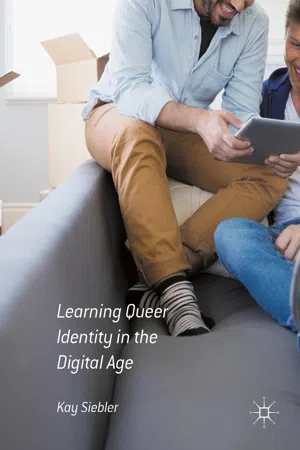
Learning Queer Identity in the Digital Age
About this book
This book explores, through specific analysis of media representations, personal interviews, and historical research, how the digital environment perpetuates harmful and limiting stereotypes of queerness. Siebler argues that heteronormativity has co-opted queer representations, largely in order to sell goods, surgeries, and lifestyles, reinforcing instead of disrupting the masculine and feminine heterosexual binaries through capitalist consumption. Learning Queer Identity in the Digital Age focuses on different identity populations (gay, lesbian, transgender) and examines the theories (queer, feminist, and media theories) in conjunction with contemporary representations of each identity group. In the twenty-first century, social media, dating sites, social activist sites, and videos/films, are primary educators of social identity. For gay, lesbian, bisexual, transgendered, and transsexual peoples, these digital interactions help shape queer identities and communities.
Information
Topic
Scienze socialiSubtopic
Antropologia culturale e sociale© The Editor(s) (if applicable) and The Author(s) 2016
Kay SieblerLearning Queer Identity in the Digital Age10.1057/978-1-137-59950-6_11. Introduction: LGBT Identity and Selling Queer
Kay Siebler1
(1)
Missouri Western State University, St Joseph, Missouri, USA
The trite cliché “We are what we eat” applies directly to the steady stream of images and texts we consume daily via the screens in our lives. Through our phones, computers, tablets, and televisions, we are bingeing our way through a steady diet of information about who we are and what we should be, much of it unhealthy, stereotypical, preying on individual insecurities, and based on product consumption. The negative impact of these images is particularly strong for the queer—gay, lesbian, bisexual, trans—individuals.1 Media theorists and scholars have long argued, beginning with the popularization of television in the 1940s, that our experiences with and consumption of what is fed to us through our screens has a profound effect on how we see/define ourselves and the world. This book applies those theories and philosophies to the digital texts today in a keen analysis of a specific population: lesbian, gay, bisexual, and transgender (LGBT) people. The primary question answered in these chapters is “How and why are representations of queer identity in the digital age shaping who we are as gay, lesbian, bi, trans, queer people?” The answers are vexing in that the digital media, which purports to open up the world with access to all kinds of information and knowledge, ultimately serves to distort and limit in very negative ways how we perceive, embody, perform queer identity. The dynamics of various media shaping our worldview and sense of self is not unique, but typical. The problem, however, is that with the digital age, what we consume is more restrictive than ever.
The Internet and World Wide Web (WWW) emerged in the 1990s and have blossomed into our first go-to source of information, entertainment, and—often—social interaction. With the Internet, people have ready and easy access to the queer community, texts, and images. They can create online personas and personalities that mark them as LGBT. Whereas previously people accessed queer identity, ideas, and texts in a material world/setting, today these interactions can be primarily digital. As a graduate student in the late 1990s, my access to lesbian texts and images was trifold: a feminist activist community, a graduate course in lesbian literature, and lesbian/gay/trans representations in television/film. In the context of the lesbian literature course, I was so disturbed by the retributive and punitive endings of the fiction we read that, for my midterm project, I rewrote the ending to The Well of Loneliness. In my ending, instead of the protagonist offing herself in an act of desperation, grief, and despair, I had her gathering her life around her, facing the future with hope and strength, and walking into the rest of her life with a “fuck you” attitude regarding homophobia. During this time, I was an “out” queer feminist activist living in a liberal Midwestern community, surrounding by feminist friends, politicians, and educators. It was the cusp of the digital age; the Internet and WWW were only just taking shape. Queer community meant physical gatherings. There were few lesbians in the film/television I consumed, although the community radio station had a lesbian DJ who had her own show. Because of the lack of queer images available, I was impatient with Ellen and what I saw as Ellen DeGeneres’ lack of ovaries to come out as lesbian. I was annoyed that people outside the lesbian community seemed resistant to the idea that Rosie O’Donnell could be a lesbian, and I was indignant regarding O’Donnell’s ongoing talk show banter about her crush on Tom Cruise.
Fast forward fifteen years and the digital environment, now part of our everyday lives, has brought us regular access to lesbian, gay, trans characters, people, postings, and groups. Whether it is phoning, texting, posting, commenting, browsing, or watching films and television, the digital environment is our primary access to identity and expression. Today, both Ellen and Rosie are out. Bruce Jenner has transitioned to Caitlyn Jenner with much fanfare and acceptance, most of it positive. Hurrah. Brokeback Mountain and The Kids are Alright were mainstream film sensations—although Brokeback Mountain echoes the tragic ending of The Well of Loneliness. Progress, yes? And yet, when looking closely and critically at the images we consume, when listening to the lived experiences of LGBT people in this digital age, there are problematic themes that emerge: feelings of isolation, stereotypes regarding sex/sexuality/gender that reinforce patriarchal, misogynistic systems of power, and strong connections between queer identity and capitalist consumption with the goal of assimilating to a heterosexual “norm.” These are the issues, problems, and concerns with which this book grapples. Through focus groups, first-person interviews, and media analysis, the chapters in this book examine these complexities with the goal of pushing us all to think more carefully and critically about what we learn through our screens, large and small. The book ends by making a call to teachers across all disciplines and levels of education to teach against the harmful binaries of sex/gender/sexuality. Educators and individuals must work together to think critically and carefully, discuss, and debate the nuances of LGBT representations.
Certainly, the digital age offers hopeful signs of cultural acceptance for LGBT identified people. There are many high schools that have LGBT student groups, as do most college campuses. In June 2015, the US Supreme Court ruled that same-sex marriage was legal in all 50 states. These two examples alone would seem to be a bellwether that North American dominant culture embraces LGBT people. If so, why do many queer-identified young people feel body modifications in the form of gender “reassignment” is necessary, and how are these trends for costly and often dangerous hormone “therapies” and surgeries migrating to children as young as preteen? These are the complicated questions discussed in this book. Online and on our screens, identity issues involving sex, gender, and sexuality are often conflated with rigid stereotypes and limiting binaries instead of being complicated or “queered.” Acceptance is only offered to those who abide by the narrow cultural mandates of sex/gender in the form of heteronormativity. With seemingly unlimited and ready access to a diversity of texts, images, and contacts, an easy assumption would be that young people, especially those traditionally cast out of the dominant culture, would be less restricted and could easily find comrades and community. However, instead of creating more options and ways of being queer in the culture, those of the digital generation seem to be consuming and adopting a very specific narrative of how sex, gender, and sexuality intersect: lesbians need to be sexy porn fantasies or butchy andro boys on their way to a trans identity; gay men are girly femme, domestic divas, or performing the six-pack ab homoerotic sexy ideal; trans people are on their way to surgery/hormones that “correct” the body they were born with to align with their gender. These are the limited, dangerous ways queer people are portrayed in the digital environment.
Yet we tend to look at superficial markers that scroll through or flash onto our screens and herald a new age for LGBT identity. Gay characters—but less often trans and lesbians—are regularly written into Hollywood scripts, sitcoms, and dramas. In addition to these traditional media venues, the Internet has provided a place for LGBT/queer community, representation, and presence in popular culture. More, however, does not necessarily mean better, broader, or more complicated. These texts, the films we see, the websites we visit, the posts we view, the social-networking sites we log into, and the shows we watch are how we learn what it means to be queer, how we see ourselves—or how we perceive others—both within the context of the queer community and in relation to the dominant heteronormative culture. The dominant culture(s) and LGBT communities themselves also use these media sources to define what it means to be LGBT. Rather than “queering” ideas of sex, gender, and sexuality, these portrayals and performances in the digital sphere more often create limited ideas and ideologies of what it means to be LGBT. Contemporary definitions of LGBT are put forth by the capitalist consumerist culture to sell LGBT consumption, relying on marketing versions of uncomplicated sex, gender, and sexuality binaries. Marketers need us to either be male or female; masculine or feminine; and a specific version of gay, lesbian, or trans to sell a product. The sad truth is that we become what we consume; we are what we eat. These reductive images push us to embody not who we are, but what the marketers want us to become.
Coming of age as a queer today is very different from coming of age in the 1970s. In the digital environment, queer and questioning youth turn first to the Internet for information and a sense of what it means to be LGBT. Instead of looking in books, trying to locate bars, or seeking out support groups, the digital world allows queer curious people to access information via phones, tablets, and computers. These media devices, and what we access via our screens, are proliferating across cultures, countries, and socioeconomic classes. Those born of a time where screen-mediated interactions are part of their daily worlds, children who have never known life without a computer screen or phone screen as a primary means of communication and entertainment, are considered children—and now adults—of the digital generation.
As the Internet proliferated across cultures, countries, and socioeconomic classes, visual texts became more prominent. Today, much of what we “read” online are visual texts. These visual texts have an impact in ways very different from written words. Visual images bombard us with what we erroneously convince as the truth or the way things are. As media theorists Meta Carstarphen and Susan Zavoina write, “[W]hat we ‘see’ gives the false allusion of immediate understanding. Because we are so accustomed to being addressed by images, their total impact is sometimes not fully understood” (Carstarphen and Zavoina, p. xv). People peruse websites such as “Dykes Who Look Like Justin Bieber” or pick up the latest People article on Caitlyn Jenner or watch “Modern Family” and chuckle at lesbian/gay characters, believing, perhaps, these portrayals provide a model of gay, trans, or lesbian identities. Visual signs become a shorthand that seems clear and easy to read; these visual signs are imbedded with cultural ideologies and mores that the viewer internalizes without critique (Barthes 1975). The viewer consumes the signs in uncomplicated ways.
For those of us who identify as queer, these images also shape our sense of selves. Because of this power to shape realities, these images we consume embody real political and cultural power. Whether it is a middle-aged, white, heterosexual writing a gay character for a hot new sitcom or a questioning 14-year-old posting “selfies” of himself in drag, these screen-based texts are “read”/consumed by others who unconsciously use them to create a definition of what it means to be LGBT. There is substantial power in creating, producing, and posting these LGBT images. But it is not just LGBT people who are posting themselves on the Internet as a way of making an argument and educating others about what it means to be queer; non-queer writers and producers are creating queer characters in films and reality shows, and marketers are commodifying queerness through advertisements on websites, product placement in films and television, and the peddling of hormones and surgery to transqueers. These power brokers are not interested in a complicated definition of queer identity; they desire the neat stereotypes that will be familiar as a way to sell their show and products.
Not surprisingly, corporations are most interested in preserving heteronormativity and reinscribing stereotypes rather than complicating them. If the corporate/marketing culture can create a stereotype about a group, folks who want to identify with that group will buy to belong. We are consumed by technology that codifies the capitalist assumption that in order to be, we must buy, consuming products to become a specific identity fed to us by the corporations for their benefit (Zizek 1997, The Plague). We are sentenced to and seduced by all the screens we gaze into and often do not question what we see there. In the multiple text-producing media in our digital environment, we have more access to LGBT images than ever before, but these versions of queerness are problematic because they become scripted and stereotypical, even as they purport to be—or at first glance may seem—complex and dynamic.
For people who embody the very identities that are being marketed and consumed, we must critically think and talk through these representations, resisting the stereotypes and assimilation tropes. For those outside the LGBT community, these critical discussions of queer identity are equally important. How we (LGBT people) are represented and presented becomes how we perform our own identities and how we perceive ourselves—as well as how others perceive us (Dyer 1993). The texts we consume—the texts that consume us—teach us who we are supposed to be, creating a pedagogy of queerness that is problematic and fraught with stereotypes and codified binaries within the sex/gender/sexuality systems—a decidedly un-queer phenomena. A careful analysis of digital texts that focuses on LGBT theories, issues, and identity is needed to create a body of vigilant and critical consumers who not only participate in but shape this digital world, queering what has been un-queered by the marketing of LGBT identities.
What is touted as the best part of the phenomenon that is the Internet—easy information access—can also foster lack of diversity or complexity. Whereas people who identify as LGBT in their 50s–60s went to the public library to seek out information on homosexuality or sought places where LGBT gathered—where more complex, deeper, lived realities would be represented—young queers today are more likely to look at social media or video postings on YouTube, Twitter, or Facebook, and use familiar search engines to gather information. Some would argue that there is no difference between going to a meet-up group in a Unitarian church basement and getting online. However, online searches and gender/sex/sexuality representations are narrow and reflect cultural stereotypes in myopic ways very dissimilar to face-to-face community groups. In his book The Googlization of Everything, Siva Vaidhyanathan writes that the Internet search engines are designed to return results that limit rather than open up someone’s worldview (2011). As search engines become more advanced, the more an individual uses them on a single device, the less information—or the more homogenous information—one gets with searches. These search engines, designed to create results that please shoppers by tailoring to previous preferences, serve to restrict what we access, thereby considerably reducing our view of a diverse world.
The ramifications of Vaidhyanathan’s findings in relation to sex, gender, and sexuality mean that the more one searches, the more results reinforcing the same sorts of images, gender manifestations, and culturally codified and acceptable identities appear. Instead of getting a wider range of information, one is getting a short-sighted perspective. The information that is returned is focused on one objective: what can we (the corporate culture) get you to buy? To that end, past searches engender present and future searches, becoming narrower instead of more diverse. As a result, stereotypes of gender, sexuality, and sex become inseparable from a specific type of consumption as a venue for social acceptance.Customization means that Google will deliver more results that fit your known locality, interests, obsessions, fetishes, and points of view. That ‘narrowcasting’ of filtered information could be very efficient. … However, if search results are more customized, you are less likely to stumble on the unexpected, the unknown, the unfamiliar, and the uncomfortable. Your Web search experience will reinforce whatever affiliations, interests, opinions, and biases you already possess (Vaidhyanathan, p. 183)
As early as the late 1970s, John D’Emilio wrote about the connection between sexual orientation (identifying as gay or lesbian) and capitalist consumption. D’Emilio argued that capitalism created the identity of the “homosexual” as a way of codifying heteronormativity because capitalist systems needed a heterosexual nuclear family to function. In capitalism, procreation is needed to produce more workers; (at the time) people who sought out same sex partners would not be able to add to the labor force. This group of people had to be socially discouraged or denied any legitimacy (D’Emilio 1983). Today, of course, some of D’Emilio’s points fall apart in that gay and lesbians do form nuclear family structures and procreate and/or raise children in the context of a nuclear family. This could also be why certain gay/lesbian identities are more accepted: they mirror the ideology of the heterosexual family. If you get married, have/adopt babies, live in the suburbs, work in white-collar professions, are good capitalists and consumers, you can gain cultural acceptance. Gay, lesbian, and trans people may unconsciously feel they need to capitulate and conform to the heterosexual model—from gender performance to lifestyle choices—in order to be accepted and valued. Much of this acceptance and lifestyle choice involves buying products to achieve the middle-class, heteronormative status: the house, the cars, the baby paraphernalia, the clothes, the appliances, the vacations, the phones, the computers, and so on. Through the capitalist system’s “othering” of non-heterosexual people, that queer population strives to become the best heteronormative capitalists they can be in order to be accepted. Consumption is born out of insecurity and the desire to fit in. Instead of breaking out of stereotypes and the statu...
Table of contents
- Cover
- Frontmatter
- 1. Introduction: LGBT Identity and Selling Queer
- 2. Queerness in the Digital Environment
- 3. Virtual Generation Gaps and What Is “Community”
- 4. Lesbian Chic in the Digital World
- 5. The Digital Swish of Gay Identity
- 6. Transgender Transitions: Sex/Gender Binaries in the Digital Age
- 7. Transqueer Representations: Educating Against the Binaries
- Backmatter
Trusted by 375,005 students
Access to over 1.5 million titles for a fair monthly price.
Study more efficiently using our study tools.
Frequently asked questions
Yes, you can cancel anytime from the Subscription tab in your account settings on the Perlego website. Your subscription will stay active until the end of your current billing period. Learn how to cancel your subscription
No, books cannot be downloaded as external files, such as PDFs, for use outside of Perlego. However, you can download books within the Perlego app for offline reading on mobile or tablet. Learn how to download books offline
Perlego offers two plans: Essential and Complete
- Essential is ideal for learners and professionals who enjoy exploring a wide range of subjects. Access the Essential Library with 800,000+ trusted titles and best-sellers across business, personal growth, and the humanities. Includes unlimited reading time and Standard Read Aloud voice.
- Complete: Perfect for advanced learners and researchers needing full, unrestricted access. Unlock 1.5M+ books across hundreds of subjects, including academic and specialized titles. The Complete Plan also includes advanced features like Premium Read Aloud and Research Assistant.
We are an online textbook subscription service, where you can get access to an entire online library for less than the price of a single book per month. With over 1.5 million books across 990+ topics, we’ve got you covered! Learn about our mission
Look out for the read-aloud symbol on your next book to see if you can listen to it. The read-aloud tool reads text aloud for you, highlighting the text as it is being read. You can pause it, speed it up and slow it down. Learn more about Read Aloud
Yes! You can use the Perlego app on both iOS and Android devices to read anytime, anywhere — even offline. Perfect for commutes or when you’re on the go.
Please note we cannot support devices running on iOS 13 and Android 7 or earlier. Learn more about using the app
Please note we cannot support devices running on iOS 13 and Android 7 or earlier. Learn more about using the app
Yes, you can access Learning Queer Identity in the Digital Age by Kay Siebler in PDF and/or ePUB format, as well as other popular books in Scienze sociali & Antropologia culturale e sociale. We have over 1.5 million books available in our catalogue for you to explore.