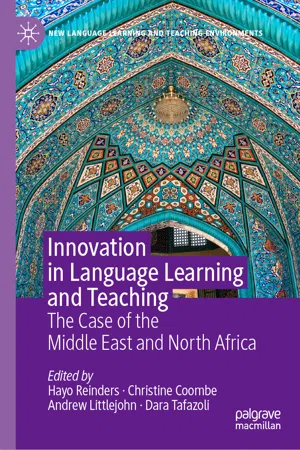
eBook - ePub
Innovation in Language Learning and Teaching
The Case of the Middle East and North Africa
- English
- ePUB (mobile friendly)
- Available on iOS & Android
eBook - ePub
Innovation in Language Learning and Teaching
The Case of the Middle East and North Africa
About this book
Information
Topic
EducationSubtopic
Education General© The Author(s) 2019
H. Reinders et al. (eds.)Innovation in Language Learning and TeachingNew Language Learning and Teaching Environmentshttps://doi.org/10.1007/978-3-030-13413-6_11. Innovation in Language Learning and Teaching: The Case of the MENA
Christine Coombe1 , Hayo Reinders3, 2, Andrew Littlejohn4 and Dara Tafazoli5
(1)
General Studies, Dubai Men’s College, Dubai, United Arab Emirates
(2)
Department of Education, Anaheim University, Anaheim, CA, USA
(3)
School of Liberal Arts, King Mongkut’s University of Technology Thonburi, Thonburi, Thailand
(4)
Sultan Hassanal Bolkiah Institute of Education, Universiti Brunei Darussalam, Brunei, Brunei Darussalam
(5)
Department of English and German Philology, University of Cordoba, Cordoba, Spain
Introduction
The focus of this volume is the study of innovation in English language teaching (ELT) and learning environments in the Middle East and North Africa (MENA). The chapters draw on classroom, administrative and learning experiences from seven of the countries in the region. This chapter begins with the establishment of a definition of innovation and what it means to be innovative in education and ELT. What follows is a description of the current status of English language education in the region and a look at next steps and innovations that are currently being implemented. A brief introduction to the other 12 chapters in this volume rounds out this chapter.
Defining Innovation in Education
In educational contexts worldwide, everyone these days is striving to be innovative in their classrooms as they want their students to be engaged in their own learning. Innovation for many simply means doing what is best for all students, piquing their curiosity about learning and finding ways to keep students interested. For others it means providing them with the tools and knowledge they need to be effective and efficient twenty-first-century learners. A more traditional definition of innovation and how it applies to education has been put forward by the Society of Teaching and Learning in Higher Education (2018, p. 1):
The practice of effective and meaningful teaching can benefit immensely when educators thoughtfully experiment and apply new or different pedagogical approaches, technologies, curricular enhancements, course design and organization and assessments.
In more simplistic terms, innovation can also be defined as “the process of making changes to something established by introducing something new” (O’Sullivan & Dooley, 2009, p. 3). Innovation is about helping organizations grow. In business terms, growth is often measured in terms of turnover and profit, but it can also occur in knowledge, in human experience, and in efficiency and quality. It is these latter concepts that relate innovation to education.
In education today, experts opine that the term ‘innovation’ is an overused one (Alexander, 2017; Darasawang, Reinders, & Waters, 2015; O’Brien, 2013) or a buzzword that implies a big breakthrough. At its core, however, is that innovation is the pairing of tried and tested ideas to yield new results. Two well-known non-educational examples of this premise include the car and Apple technology. In the former, factory assembly lines and cars already existed, but Henry Ford was the person who had the insight to combine the two. In the latter, Steve Jobs sparked a technological revolution by combining easy-to-use mobile technology interfaces with intuitive software (Alexander, 2017). So, to innovate is to look beyond what we are currently doing and develop a novel idea that helps us to do our job in a new way.
Whatever your definition of innovation, it is most probably associated with terms like change, something new and/or something beneficial or successful.
Innovations in Education
For an individual, a nation and mankind to survive and progress in life, innovation is essential. Innovation in education is particularly important because education plays a crucial role in creating a sustainable future (Serdyukov, 2017). The need for educational innovation has become acute as “it is widely believed that countries’ social and economic wellbeing will depend to an ever-greater extent on the quality of their citizens’ education and the emergence of a so called ‘knowledge society’” (p. 5). According to a report by the Organisation for Economic Cooperation and Development, “the pressure to increase equity and improve educational outcomes for students is growing around the world” (Vieluf, Kaplan, Klieme, & Bayer, 2012, p. 3), which in turn increases the pressure on institutions to innovate. Innovation in education is generally understood as “the successful introduction of a new thing or method” (Brewer & Tierney, 2012, p. 5). Brewer and Tierney set out a three-phase innovation plan for education which they feel requires three things: an idea, its implementation, and the outcome that results from the execution of the idea and produces a change.
Key Areas for the Promotion of Educational Innovation
Paniagua (2018) has identified three key areas in the promotion of teaching innovation. The first is the belief that the social and caring nature of learning is the common principle underpinning innovative practice. This means that teachers should allocate the time and resources necessary to allow learners to interact and experiment. The role of the teacher is at the forefront, as is the stakeholders’ need to regard teachers as champions in the promotion of more interactive and caring relationships with students.
The second key area put forward by Paniagua (2018) concerns teachers and their practices. It is critical that teachers review their own practices in order to identify and better align their creative, intuitive and personal capacities with innovative pedagogies.
Having the necessary scaffolding structures in place to make teachers integrate, rather than assimilate, new practices into their repertoire of teaching tools and designs is the third key area.
Yet another area that can be used to promote educational innovation is that of technology. With the emergence of accessible smartphone technology, the Internet and low-cost computers and laptops, there is the possibility of delivering student-centred learning to under-served individuals and communities in a systematic and innovative way. Innovation through the use of technology is a key element of innovation in the MENA, most particularly in the Gulf countries.
These four key factors show how important it is to have the requisite continuous professional development programmes to assist teachers in fostering the skills needed to be innovative as well as the confidence to promote innovation in their classrooms.
Innovation in English Language Teaching
Over the years there have been many changes in the way English language education is designed and delivered in different parts of the world. In ELT, innovation can appear as a new teaching methodology, pedagogical theory, methodological approach, teaching or assessment technique, or learning or instructional tool, and when implemented can lead to better student learning and engagement.
The MENA Context
The MENA is a vast region spanning from the Atlantic coasts of Morocco in the west all the way through the Mediterranean ports of Africa in the Levant into the Red Sea inlets of the Arabian Peninsula and further into the Gulf region (Or, 2017, p. 1). The three most populated countries in the MENA region are Egypt (91 million inhabitants), Algeria (40 million) and Iraq (36 million). Arabic is the official and majority language of all but three of the MENA countries (Israel, Iran and Turkey, which are not always classified as part of the MENA).
Language education policy in the MENA is a complex set of norms, beliefs and practices deeply rooted in the history of the region. Despite the appearance of uniformity, however, the MENA region is marked by economic, religious and linguistic differences (Or, 2017, p. 1). As far as economic differences are concerned, the oil-producing Gulf countries like Saudi Arabia, the United Arab Emirates and Kuwait are among the richest countries in the world, while other MENA countries are some of the poorest with limited resources available for education. While the majority of the MENA countries are Muslim, different religious, ethnic and linguistic minorities contribute to the complexity of the region (Or, 2017, p. 2). From the linguistic perspective, countless Arabic dialects are spoken in different parts of the region.
Despite these differences, the MENA region has taken great strides in education. According to the World Bank Group (WBG, 2014), who have been heavily engaged in education reform for the past decade, the region has quadrupled the average level of schooling since 1960, halved illiteracy rates since 1980 and achieved almost complete gender parity for primary education.
Innovation in English Language Teaching in the MENA
A great many innovative teaching, learning and assessment practices have emerged over the last two decades in the MENA. The following sub-sections describe a small sampling of the many innovations in the Gulf region and the rest of the MENA.
The Gulf Region
The Arabian Peninsula, and especially the Gulf area, consists of countries whose economies have relied on oil production for the last 50 years. These countries are Bahrain, the Kingdom of Saudi Arabia (KSA), Kuwait, Oman, Qatar and the UAE. All are ex-colonies of the British Empire, except for KSA, and English has therefore played an important role in their educational systems. These countries have invested a lot in education and sent many of their citizens abroad to study at well-known universities in various English-speaking countries. They have also invested in the domestic development of education, especially English language education, as English is both a lingua franca and the language of business. Many expatriate teachers from different countries have been teaching EFL in the Gulf countries for many years, as there are a great number of universities that are English medium only and few of the local population go into tertiary teaching as a career.
Most tertiary-level education in the Gulf is government funded and free for all nationals of those countries. Education is also predominantly segregated. Classroom sizes are relatively small and range from 15 to 30 students. Classrooms at university level are highly technological environments, with most campuses wireless, and English language teachers are encouraged to use as much technology in the classroom as possible. Classrooms are equipped with projectors and/or smartboards and in many tertiary-level institutions both teachers and students are provided with laptops or iPads to use in class throughout their education. In an attempt to further the use of technology in the classroom, universities are moving away from traditional textbooks to a greater use of e-books, with courses now fully accessed on learning management systems such as Moodle and Blackboard, among others. The use of educational technology is prevalent in all the educational vision statements of the Gulf countries (Bahrain 2030, KSA Vision 2030, Kuwait Vision 2035, Oman Vision 2040 and UAE 2020), as is the concept of being more innovative in instruction.
Among the many innovations in ELT in recent years, the most frequently cited are in the areas of technology, assessment and pedagogy. Alshahrani and Ally’s (2017) co-edited volume on transforming education in the Gulf region focuses on emerging learning technologies and innovations in pedagogy for t...
Table of contents
- Cover
- Front Matter
- 1. Innovation in Language Learning and Teaching: The Case of the MENA
- 2. Refugees from MENA Learning Languages: Progress, Principles and Proposals
- 3. Plugging the Gap: Supporting Primary School Teachers to Create Culturally Appropriate English Language Teaching (ELT) Materials
- 4. Task-Based Learning and Teaching in Egypt
- 5. Innovation in Writing Instruction: Towards Nurturing Confident, Motivated and Academically Honest L2 Writers
- 6. Innovation in Reading in the United Arab Emirates
- 7. Reading for Science: Anatomy as a Metaphor for a Holistic College-Wide Innovation
- 8. Towards English for Academic Purposes Curriculum Reform: Linguistic, Educational or Political Considerations?
- 9. The Evolution of a Research Paper Course
- 10. Developing Communication Skills Through Participation in Course-Based Undergraduate Research Experiences
- 11. Preparing for a Digital Future: CALL Teacher Education in Iran
- 12. Online Language Teacher Education for a Challenging Innovation: Towards Critical Language Pedagogy for Iran
- 13. Telecollaboration Among Qatari and US Undergraduates in a Multicultural Course: Opportunities and Obstacles
- Back Matter
Trusted by 375,005 students
Access to over 1.5 million titles for a fair monthly price.
Study more efficiently using our study tools.
Frequently asked questions
Yes, you can cancel anytime from the Subscription tab in your account settings on the Perlego website. Your subscription will stay active until the end of your current billing period. Learn how to cancel your subscription
No, books cannot be downloaded as external files, such as PDFs, for use outside of Perlego. However, you can download books within the Perlego app for offline reading on mobile or tablet. Learn how to download books offline
Perlego offers two plans: Essential and Complete
- Essential is ideal for learners and professionals who enjoy exploring a wide range of subjects. Access the Essential Library with 800,000+ trusted titles and best-sellers across business, personal growth, and the humanities. Includes unlimited reading time and Standard Read Aloud voice.
- Complete: Perfect for advanced learners and researchers needing full, unrestricted access. Unlock 1.5M+ books across hundreds of subjects, including academic and specialized titles. The Complete Plan also includes advanced features like Premium Read Aloud and Research Assistant.
We are an online textbook subscription service, where you can get access to an entire online library for less than the price of a single book per month. With over 1.5 million books across 990+ topics, we’ve got you covered! Learn about our mission
Look out for the read-aloud symbol on your next book to see if you can listen to it. The read-aloud tool reads text aloud for you, highlighting the text as it is being read. You can pause it, speed it up and slow it down. Learn more about Read Aloud
Yes! You can use the Perlego app on both iOS and Android devices to read anytime, anywhere — even offline. Perfect for commutes or when you’re on the go.
Please note we cannot support devices running on iOS 13 and Android 7 or earlier. Learn more about using the app
Please note we cannot support devices running on iOS 13 and Android 7 or earlier. Learn more about using the app
Yes, you can access Innovation in Language Learning and Teaching by Hayo Reinders, Christine Coombe, Andrew Littlejohn, Dara Tafazoli, Hayo Reinders,Christine Coombe,Andrew Littlejohn,Dara Tafazoli in PDF and/or ePUB format, as well as other popular books in Education & Education General. We have over 1.5 million books available in our catalogue for you to explore.