The stock-in-trade of the news media is what American philosopher Charles Peirce called “those awkward chunks of phenomenon called ‘events’” (Peirce, 1992, p. 186). In order for an occurrence to become a news event, it has to be transformed into a human interest story, a selectively constructed narrative designed to attract audiences whose attention is being solicited by multiple other stimuli in real space and cyberspace. The process of transforming happenings into news narratives or events is what Stiegler (2009, p. 100) calls selective “événementialisation” (event-ization). The neologism refers to the “exteriorization, deterritorialization” and transformation of banal occurrences or happenings into news events and, once in a while, into “mediatized meta-events” (Christensen & Christensen, 2013, p. 232). At another level, évenémentialisation or eventization is the result of human interest in the novel, the unusual, the unprecedented, the eccentric, and the incomprehensible. It is “a philosophy of the event, of discontinuity … An event of the World, but also an event of life” (Baudrillard & Guillaume, 2008, p. 5). Elsewhere, Baudrillard (1990) noted that the world is “subject to a veritable bombardment of ‘superconductive’ events … untimely intercontinental whirlwinds … In earlier times, an event was something that happened—now it is something that is designed to happen … it occurs as a reflection of pre-existing media defined forms” (p. 41, 46). The censorious terrorist attack of January 7, 2015 was a pre-designed event that fit pre-existing media frames of terrorism, and instantly transformed the irreverent, parochial, anti-clerical, leftist-wing Charlie Hebdo into the subject of global news and controversy, the secular martyr of freedom of expression. After the Charlie Hebdo terrorist attack of January 7, 2015, the French political and media establishments engaged in acts of selective évenémentialisation (event-ization) of the tragic occurrence. They created a master narrative of the attack as an assault on France and its abstract, post-Revolutionary founding myth, secular republicanism, and collective memory. According to this master narrative, the terrorists had attacked the identitarian hallmarks of “Frenchness” and French exceptionalism—French citizenship shorn of all foreign ethno-national, religious, cultural, and identitarian appurtenances.
Je Suis Charlie: The Charlie Hebdo Terrorist Attack and Global Collective Memory
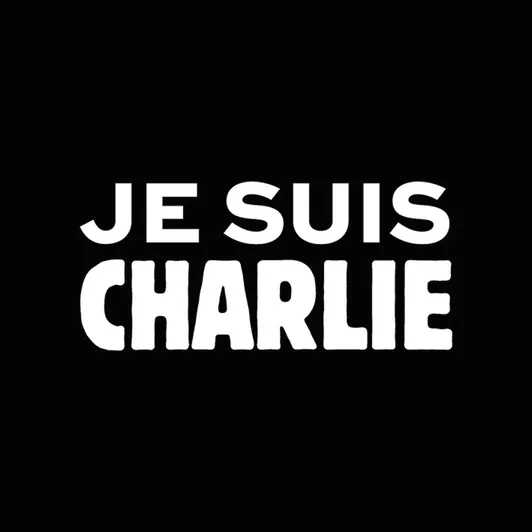
One of the outcomes of the Charlie Hebdo terrorist attack was the creation of an instantaneous imagined or pseudo global collective present. This ephemeral collective present is triggered by unprecedented calamitous or catastrophic events that stop people in their tracks, trigger their survival instinct, and move them to act, jointly with others, in the spur of the moment, to assuage the pressing psychological angst provoked by the unprecedented event. Mass trauma is often the trigger and the cement of the fleeting collective present, which ultimately passes into collective memory, which Halbwachs (1992) called “the cult of the past.” The collective present is a modern phenomenon facilitated by the interconnected online media of global communication. One of the first occurrences of the collective present—and it is always expressed in present tense—occurred in 1962 when President John Kennedy stood in front of the immense monstrosity of the Berlin Wall, symbol of the Cold War, and the suppression of human freedom and proclaimed: “Ich bin ein Berliner!” That resounding statement of personal involvement in the pain and suffering of the people of Berlin has passed into the collective memory of Germany. In 2001, the day after the terrorist attacks of September 11, French journalist Jean-Marie Colombani wrote a memorable editorial entitled: Nous sommes tous Américains! (We are all Americans) (Colombani, 2001) in Le Monde, one of the newspapers of record in France. That remarkable statement and the sentiments it aroused are now part of French collective memory. The collective present was also evident during the Charlie Hebdo affair. The most remarkable and most enduring “voice” of the Charlie Hebdo controversy was the pithy but memorable French expression, Je Suis Charlie (I am Charlie). In effect, on the day of the Charlie Hebdo terrorist attack, a stunned Joachim Roncin, artistic director for Paris-based Stylist magazine, used the font of Charlie Hebdo’s masthead to create the simple but viscerally arresting, black-and-white-colored “Je Suis Charlie” visual slogan (see Fig. 1.1). It was an individual’s visceral, first-person, psychological expression of lack of fear and solidarity with the victims of the attack. It was also Roncin’s individual tribute to the Charlie Hebdo journalists and caricaturists who had been instantly transformed into “martyrs of freedom of expression.” Roncin posted the slogan on Twitter, the contemporary locus of psychological outpouring, and it quickly struck a primordial emotional chord. Je Suis Charlie became one of the most popular hashtags of the Internet age. Its Twitter hashtag was used 2.1 million times on the day of the attack and more than six million times the following week (Bogart, 2015; Dearden, 2016). “Je Suis Charlie” instantly went viral and became the visual slogan of instantaneous, global resistance against terrorism, and censorship. Je Suis Charlie also stood for support for the human right of freedom of expression in general, and the right to satire in particular. A master narrative of the Charlie Hebdo terrorist attack soon emerged from the historical and politico-cultural “neuroanatomies” of French collective memory: France was the victim of a terrorist attack that was as existential as any crisis the nation had faced in the darkest hours of its 200-year post-Revolutionary history. Je Suis Charlie quickly became the embodiment of national psycho-social catharsis and global solidarity. In France, Quebec, and elsewhere, Je Suis Charlie reaffirmed the sacred right/rite to blaspheme and to offend religion that was an acquis (gain) of the Revolution of 1789.
Fig. 1.1
Roncin’s Je Suis Charlie slogan
The trauma of the Charlie Hebdo affair had inspired individual and collective solidarities around the world as a means of dealing with atrocities that had hitherto been unthinkable.
“Republican” Rallies for Charlie Hebdo and for Freedom of Expression
Stiegler’s neologism “eventization” also refers to situations where influential international entities and centers of power focus on a specific phenomenon, reify it, present it anew, memorialize it, and instrumentalize it by putting it on the global news agenda for political and ideological purposes. French media and governmental “eventization” and instrumentalization of the Charlie Hebdo terrorist attack was aimed at using national collective memory as a defense mechanism designed to attenuate the shock of this unprecedented occurrence, and ensure collective catharsis. “Eventization” or transformation of the Charlie Hebdo terrorist attack into a global event took the form of a series of unprecedented, government-sponsored, nationwide rallies, which the media called, “Marches républicaines pour Charlie Hebdo et pour la liberté d’expression” (Republican rallies for Charlie Hebdo and for freedom of expression). The word “republican” is a particularistic deployment of the term to contrast France’s contemporary republican form of government with the French Divine right monarchy that was overthrown during the revolution of 1789.
The Charlie Hebdo rally in Paris, France, was one of the most spectacular eventmentalizations of the first quarter of the twenty-first century. The optics were as spectacular as they were unprecedented: French President, François Hollande, marching arm-in-arm with the heads of state and government of 50 different countries on the streets of Paris on January 11, 2015. Taking part in this very French tradition, in a city that had witnessed many historic rallies from time immemorial, were German Chancellor, Angela Merkel, British Prime Minister, David Cameron, Israeli Prime Minister, Benjamin Netanyahu, Palestinian President, Mahmoud Abbas, Prime Minister Ahmet Davutoğlu of Turkey, King Abdallah and Queen Raina of Jordan, and the President of Mali, Boubacar Keïta, to name a few (See Fig. 1.2). President Obama was conspicuously absent from the event, but he sent United States Attorney General, Eric Holder, to represent him. These politicians, who projected an image of resolute defiance, were surrounded by a sea of 1.5 million people holding signs that defiantly proclaimed: Je Suis Charlie. Others held an assortment of symbols of the graphic, artistic, writing, and journalistic crafts. Je Suis Charlie also became the global cry of solidarity with Charlie Hebdo and the values of freedom of expression the newspaper had come to symbolize. Not since the liberation of Paris from Nazi German occupation in 1945 had the city of Paris seen such a huge crowd. The international march in Paris was part of a series of marches républicaines pour Charlie Hebdo et pour la liberté d’expression” (marches républicaines for Charlie Hebdo and for freedom of expression). The marches républicaines were collective memory phenomena that echoed the overthrow of the French monarchy and the establishment of a republican system of government in France. These rallies took place in Paris and around the country on January 10 and 11, 2015, to denounce terrorism and show solidarity with Charlie Hebdo. Je Suis Charlie, had been developed on the spur of the moment by French graphic designer, Joachim Roncin, after the terrorist attack at the editorial offices of the notorious French satirical newspaper, Charlie Hebdo, left 12 people dead, including several cartoonists whose work had made them cultural “institutions.” Je Suis Charlie became the rallying cry, the symbol of advocacy for freedom of speech and of the press, including the right to satirize. The slogan became one of the most popular news hashtags in Twitter history.
Fig. 1.2
President François Hollande of France and 50 world leaders at Parisian Charlie Hebdo Rally, January 11, 2015 (Getty)
The aim of this global, popular solidarity rally was not so much to support the content of Charlie Hebdo, but to condemn terrorism, and ostensibly defend the human right of freedom of expression—including the right to satirize—as well as to stand up for the legitimacy of the journalistic paradigm, the craft of discursive construction and re-presentation of reality in the form of news, commentary, cartoons, and caricatures. The irony of this march was that President Hollande had been the subject of some of the most caustic, scatological cartoons of Charlie Hebdo. Je Suis Charlie was the slogan for freedom of literal and symbolic expression, a transnational and transcultural metonym for jailed, censored, exiled, and murdered journalists around the world. It was also a symbol of resistance to the purest and most extreme form of censorship—murder of journalists. It was a counter-narrative to “propaganda of the deed” killing media workers to “send a message” to their colleagues, and to the world. Je Suis Charlie became the fastest and most globalized French expression since the tripartite motto, liberté, egalité, fraternité, emerged during the French Revolution of 1789. Not all French opinion leaders and thinkers were in favor of the massive Charlie Hebdo rallies. Sociologist and political scientist, Todd (2015), wrote a very critical book entitled Who Is Charlie?: Xenophobia and the New Middle Class, in which he called the Je Suis Charlie rallies a gross irrational jingoistic over-reaction. He said that many people had interpreted the expression “Je Suis Charlie” as a nationalistic, identitarian slogan that meant “Je Suis Français” (p. 2). Todd added that: “What France, a country undergoing a metaphysical crisis, is most sorely lacking is a minimal ability to reflect serenely about what people can get out of religion” (p. 173).
Nevertheless, thanks to the media, information and communication technologies, the French master-narrative of Charlie Hebdo as the secular martyr of liberty and freedom of expression, the Charlie Hebdo affair ...
Table of contents
Cover
Front Matter
1. Introduction: The Charlie Hebdo Affair as a Global “Meta-Media Event”
Part I. Theoretical and Historical Approaches
Part II. The Charlie Hebdo Affair: Case Studies in Journalism and Comparative Establishmentalities
Back Matter
Trusted by 375,005 students
Access to over 1.5 million titles for a fair monthly price.
Study more efficiently using our study tools.
Frequently asked questions
Yes, you can cancel anytime from the Subscription tab in your account settings on the Perlego website. Your subscription will stay active until the end of your current billing period. Learn how to cancel your subscription
No, books cannot be downloaded as external files, such as PDFs, for use outside of Perlego. However, you can download books within the Perlego app for offline reading on mobile or tablet. Learn how to download books offline
Perlego offers two plans: Essential and Complete
Essential is ideal for learners and professionals who enjoy exploring a wide range of subjects. Access the Essential Library with 800,000+ trusted titles and best-sellers across business, personal growth, and the humanities. Includes unlimited reading time and Standard Read Aloud voice.
Complete: Perfect for advanced learners and researchers needing full, unrestricted access. Unlock 1.5M+ books across hundreds of subjects, including academic and specialized titles. The Complete Plan also includes advanced features like Premium Read Aloud and Research Assistant.
Both plans are available with monthly, semester, or annual billing cycles.
We are an online textbook subscription service, where you can get access to an entire online library for less than the price of a single book per month. With over 1.5 million books across 990+ topics, we’ve got you covered! Learn about our mission
Look out for the read-aloud symbol on your next book to see if you can listen to it. The read-aloud tool reads text aloud for you, highlighting the text as it is being read. You can pause it, speed it up and slow it down. Learn more about Read Aloud
Yes! You can use the Perlego app on both iOS and Android devices to read anytime, anywhere — even offline. Perfect for commutes or when you’re on the go. Please note we cannot support devices running on iOS 13 and Android 7 or earlier. Learn more about using the app
Yes, you can access The Charlie Hebdo Affair and Comparative Journalistic Cultures by Lyombe Eko in PDF and/or ePUB format, as well as other popular books in Social Sciences & Journalism. We have over 1.5 million books available in our catalogue for you to explore.