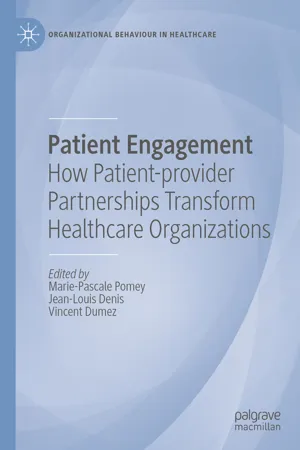
Patient-oriented approaches to healthcare management have been brought to the fore in recent years, yet this book underlines how even further change is needed in order to fully mobilise the experiential knowledge of patients, and ultimately improve our healthcare systems. With contributions from scholars and patients across the globe, this collection brings together a comprehensive overview of major achievements in patient engagement, analysing political, organizational and clinical contexts. By understanding the concept of care partnership, the authors explore how this patient revolution could transform, improve and innovate the ways in which care services are organized and delivered. Looking closely at the role of new technologies, this timely book will undoubtedly be of use to patients, managers and professionals within the healthcare industry, as well as those researching health policy and organization.
eBook - ePub
Patient Engagement
How Patient-provider Partnerships Transform Healthcare Organizations
- English
- ePUB (mobile friendly)
- Available on iOS & Android
eBook - ePub
Patient Engagement
How Patient-provider Partnerships Transform Healthcare Organizations
About this book
Information
© The Author(s) 2019
M.-P. Pomey et al. (eds.)Patient EngagementOrganizational Behaviour in Healthcarehttps://doi.org/10.1007/978-3-030-14101-1_11. Introduction
Marie-Pascale Pomey1 , Nathalie Clavel1 and Jean-Louis Denis1
(1)
School of Public Health, University of Montreal, Montreal, QC, Canada
Keywords
Patient revolutionBreakthrough innovationPatient knowledgeBuilt between 1940 and 1970, healthcare systems were structured around acute and highly specialized care provided by health facilities. Now, and over the last 30 years, needs have considerably changed due to the significantly increased prevalence of chronic diseases, which are currently the leading cause of morbidity and mortality in western countries (Jeon et al. 2009; Beaglehole et al. 2011). Patients, in the vast majority of cases, do not recover from their illness and face a number of chronic health conditions that coexist with acute events. This trend is expected to worsen in the coming years in all countries of the Organisation for Economic Co-operation and Development (OECD 2013). In addition, these epidemiological mutations result from changes in lifestyles, enhanced self-management from patients, increased accessibility to healthcare professionals and better continuity and coordination of care and services (Tinetti et al. 2012; Grady and Gough 2014; Clarke et al. 2017). In order to respond to emerging challenges, one promising avenue for improving population health and the quality of health care and services is to engage patients and their relatives at all levels of the health system (clinical, organizational and strategic) (Coulter 2012; Carman et al. 2013; Richards et al. 2013; Pomey et al. 2015b).
Moreover, in 2013, a few months apart from each other, an editorial in Health Affairs mentioned “The Blockbuster Drug’ Of Patient Engagement” (Dentzer 2013), followed by one in the BMJ which stated: “Let the patient revolution begin” (Richards et al. 2013). In the first editorial, reference was made to the fact that “the emerging evidence is that patients who are actively involved in their health and health care achieve better health outcomes, and have lower health costs, than those who aren’t” (Dentzer 2013). It was also written that patient participation could better meet the triple AIM goal proposed by the Institute of Health Improvement in the USA (IHI 2018), offering to simultaneously improve “the patient experience of care (including quality and satisfaction); […] the health of populations; and […] the per capita cost of health care” as well as “the conditions for the healthcare workforce to find joy and meaning in their work and in doing so, improving the experience of providing care” (Sikka et al. 2015). As for the BMJ, the editorial highlighted: “[The] corruption in the mission of healthcare requires urgent correction. How better to do this than to enlist the help of those whom the system is supposed to serve—patients? Far more than clinicians, patients understand the realities of their condition, the impact of disease and its treatment on their lives, and how services could be better designed to help them” (Richards et al. 2013).
In fact, over the last 20 years, paternalistic approaches of health care have gradually given way to patient-oriented approaches that consider differences, values and experiences of patients (Stewart et al. 2000; Karazivan et al. 2015). Around the world, healthcare organizations, institutions and universities are doubling their efforts to involve patients and make their participation increasingly active, using different modalities of engagement (Karazivan et al. 2015) and various means of motivation (Flora 2008). However, recent initiatives such as shared decision-making (Legare and Witteman 2013) and some therapeutic education approaches (Foster et al. 2007) maintain the healthcare provider’s monopoly when determining the course and outcomes of treatment. The prospect of care partnership goes one step further by considering the patient as a full member of the care team, whose status is based on care expertise (Karazivan et al. 2015). This generates a rupture and emancipates the “oriented approach”. The Patient Partnership perspective suggests considering the patient as a healthcare provider, an equally valued member, a partner of the healthcare team (Karazivan et al. 2015; Pomey et al. 2015b). When dealing with a chronic disease, which generally cannot be completely cured, the patient’s life experience with the disease becomes a rich source of knowledge, essential for decision-making (Pomey et al. 2015b). Current models, such as that of Carman et al., suggest a continuum of patient engagement going from informing the patient to partnering with the patient (Carman et al. 2013). Patient engagement can also happen at different levels of healthcare systems: policy or systemic level, healthcare organizations level and clinical care/direct patient care level (Carman et al. 2013; Pomey et al. 2015b).
In this context, the objectives of this monograph are to show if the ongoing patient revolution (Richards et al. 2013), based on patient knowledge, has contributed to transform, improve or innovate the ways in which care services are organized and delivered as well as the culture and practices of healthcare professionals regarding direct patient care.
The monograph will illustrate—through six countries, a Canadian province, and a European patient organization (EURORDIS)—the different forms of patient engagement that have been put in place at different levels of the healthcare system by way of specific experiences. In particular, it will highlight the methods behind successful patient engagement and ways to measure the impact of patient engagement in various dimensions and at different levels of the healthcare system, including challenges that are encountered and possible improvements to strengthen patient engagement in the future. Each chapter takes into consideration the patients’ point of view and was co-signed by patients. The first country explored is one of Canada province, Québec, where, in 2010, thanks to the leadership of a patient hired by a medical school, the “Montréal Model” enabled the simultaneous roll out of patient engagement within the health system, training, research and communities. This movement spread across the entire Canadian province through the care and services partnership feature in the Health Minister’s 2015–2020 Strategic Plan (Ministry of Health and Social Services 2017) and the promulgation of a reference framework for the partnership approach between users, their families and health and social services stakeholders (Ministry of Health and Social Services 2018).
The French model illustrates the strategic role of patient organizations, which, starting in 2015, began organizing to counterbalance different players in the health system. On the one hand, what started as the defence of patients’ rights and therapeutic education for patients, patient involvement is now progressively evolving towards a greater share of partnerships between professionals and patients and, on the other hand, a greater share of voice for patients and patient partners. Over the years, this model has gradually imposed the presence of users at almost all levels of the system: national, regional and within health facilities. However, the movement still suffers from weak clinical presence and low visibility among the general public. In the United Kingdom, there is a substantial history of user movements in both service and research. Moreover, initially, the movement of patient engagement is mainly structured around research and this chapter presents how, in Northwest London, the Collaboration for Applied Health Research and Care (CLAHRC NWL), started in 2009, helped structure patient engagement in care. Thanks to this programme, which focused on patients’ needs and benefits to patient outcomes, it was possible to involve patients, carers and service users at all levels of governance. Through testimonials, it is possible to realize the impact that these initiatives have had on people and on how to design the health system. In Sweden, the notions of co-care and self-care have a long history and substantial investment in the context of health promotion and wellness programmes. However, in the context of care, the widening gaps between needs and supply as well as between cost and affordability need to engage and support citizens, patients and health workers to carry out more effective self-care and co-care. This chap...
Table of contents
- Cover
- Front Matter
- 1. Introduction
- 2. From Medical Paternalism to Care Partnerships: A Logical Evolution Over Several Decades
- 3. The Participation of Patients and Relatives in Quebec’s Health System: The Montréal Model
- 4. Implementing Patient and Carer Participation in Self-Care and Co-Care in Sweden: Policy, Practice and the Future of Person-Centred Care
- 5. Patient and Family Engagement in the United States: A Social Movement from Patient to Advocate to Partner
- 6. Connections: The Power of Learning Together to Improve Healthcare in the United Kingdom
- 7. Partnering with Patients for Change and Improvement: An Australian Perspective
- 8. The Engagement Conundrum of French Users
- 9. Expert by Experience: Valuing Patient Engagement in Healthcare
- 10. Discussion and Conclusion
- 11. Future Directions for Patient Knowledge: A Citizen-Patient Reflection
- Back Matter
Trusted by 375,005 students
Access to over 1.5 million titles for a fair monthly price.
Study more efficiently using our study tools.
Frequently asked questions
Yes, you can cancel anytime from the Subscription tab in your account settings on the Perlego website. Your subscription will stay active until the end of your current billing period. Learn how to cancel your subscription
No, books cannot be downloaded as external files, such as PDFs, for use outside of Perlego. However, you can download books within the Perlego app for offline reading on mobile or tablet. Learn how to download books offline
Perlego offers two plans: Essential and Complete
- Essential is ideal for learners and professionals who enjoy exploring a wide range of subjects. Access the Essential Library with 800,000+ trusted titles and best-sellers across business, personal growth, and the humanities. Includes unlimited reading time and Standard Read Aloud voice.
- Complete: Perfect for advanced learners and researchers needing full, unrestricted access. Unlock 1.5M+ books across hundreds of subjects, including academic and specialized titles. The Complete Plan also includes advanced features like Premium Read Aloud and Research Assistant.
We are an online textbook subscription service, where you can get access to an entire online library for less than the price of a single book per month. With over 1.5 million books across 990+ topics, we’ve got you covered! Learn about our mission
Look out for the read-aloud symbol on your next book to see if you can listen to it. The read-aloud tool reads text aloud for you, highlighting the text as it is being read. You can pause it, speed it up and slow it down. Learn more about Read Aloud
Yes! You can use the Perlego app on both iOS and Android devices to read anytime, anywhere — even offline. Perfect for commutes or when you’re on the go.
Please note we cannot support devices running on iOS 13 and Android 7 or earlier. Learn more about using the app
Please note we cannot support devices running on iOS 13 and Android 7 or earlier. Learn more about using the app
Yes, you can access Patient Engagement by Marie-Pascale Pomey, Jean-Louis Denis, Vincent Dumez, Marie-Pascale Pomey,Jean-Louis Denis,Vincent Dumez in PDF and/or ePUB format, as well as other popular books in Business & Management. We have over 1.5 million books available in our catalogue for you to explore.