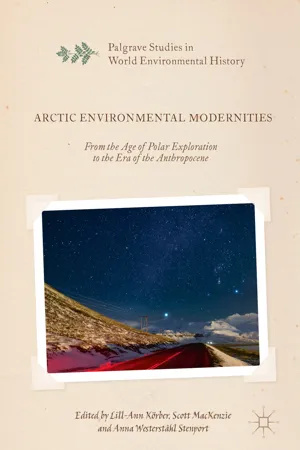
This book offers a diverse and groundbreaking account of the intersections between modernities and environments in the circumpolar global North, foregrounding the Arctic as a critical space of modernity, where the past, present, and future of the planet's environmental and political systems are projected and imagined. Investigating the Arctic region as a privileged site of modernity, this book articulates the globally significant, but often overlooked, junctures between environmentalism and sustainability, indigenous epistemologies and scientific rhetoric, and decolonization strategies and governmentality. With international expertise made easily accessible, readers can observe and understand the rise and conflicted status of Arctic modernities, from the nineteenth century polar explorer era to the present day of anthropogenic climate change.
eBook - ePub
Arctic Environmental Modernities
From the Age of Polar Exploration to the Era of the Anthropocene
- English
- ePUB (mobile friendly)
- Available on iOS & Android
eBook - ePub
Arctic Environmental Modernities
From the Age of Polar Exploration to the Era of the Anthropocene
About this book
Information
© The Author(s) 2017
L.-A. Körber et al. (eds.)Arctic Environmental ModernitiesPalgrave Studies in World Environmental Historyhttps://doi.org/10.1007/978-3-319-39116-8_11. Introduction: Arctic Modernities, Environmental Politics, and the Era of the Anthropocene
Lill-Ann Körber1 , Scott MacKenzie2 and Anna Westerståhl Stenport3
(1)
Department of Linguistics and Scandinavian Studies, University of Oslo, Oslo, Norway
(2)
Department of Film and Media, Queen’s University, Kingston, ON, Canada
(3)
School of Modern Languages, Georgia Institute of Technology, Atlanta, GA, USA
Since its “discovery,” the Arctic has held a longstanding significance as a critical and exceptional space of modernity. It has been utilized and imagined as a location where the past, present, and future of the planet’s environmental and geopolitical systems are played out. These imaginations and projections have hit a crescendo in recent years, catalyzed by anthropogenic climate change, accelerating resource extraction, mass tourism, and a heightened global awareness and activism regarding environmental change, Indigenous rights, and nature preservation. Arctic Environmental Modernities critically investigates the exceptional status of Arctic environmental discourses and practices by foregrounding the diversity, hybridity, and multiplicity of Arctic modernities, and by nuancing differentiations between sublime “nature,” cultural and vernacular landscapes and cityscapes, and social practices. To this end, the book addresses the rise and conflicted status of Arctic modernities from nineteenth-century European exploration of the Arctic to the present day. Arctic Environmental Modernities provides a framework for examining the continuing role of the explorer mythology in accounts of Arctic modernities, while foregrounding methodologies that contest such a monolithic historiography.
Arctic Exploration and Modernity
Arctic exploration and its relationship to questions of modernity, in this context, must be seen through a specific frame: that of the European and North American explorers who went there and then either left or died there, with the goal of “expanding” territorial holdings in the name of the nation state. The Arctic explorer myth assumes that there is no “staying,” yet the generations of offspring that emerge from the era of exploration tell another story, as does the environmental impact of continuous exploration in the global circumpolar North. The book examines the history of Arctic exploration to question the construction of this myth and the counter-narratives that have been used to challenge its centrality to discourses of European modernity.
European modernity, pace Marshall Berman and Eric Hobsbawm, begins in 1789 (Hobsbawm 1962; Berman 1988). This period of political and industrial revolutions meant the start of an era in need of ever greater supplies of fossil fuels (including oil from whaling in the Arctic), and the results are seen in today’s baseline of disproportionate environmental effects in the far North. There is a direct genealogy from industrialization and its social formations to the two interrelated challenges facing the Arctic presently: climate change (warming environments) and the continuous drive for resource extraction (with multifarious environmental impacts). Most European assumptions of Arctic modernity arguably begin nearly a century after the emergence of the Enlightenment in continental Europe, as European and North American exploration of the polar regions and the colonization of the North accelerated in the mid-to-late 1800s. This era of polar exploration can be understood as an attempt to mobilize Western technology and the global expansion of territorial holdings, by which the colonial practices of nation states (from cartography to whaling) were further sanctioned. More contemporary accounts of Arctic modernities place nature and the environment back at the center of discourses of modernity, especially in relation to fossil fuel and rare earth mineral resource extraction, the politics governing marine life and fishing, climate change, pollution, Indigenous rights, and the ideological belief systems that underpin questions of geopolitical sovereignty (Bravo and Triscott 2011; Dodds and Nuttall 2015; Kjeldaas and Ryall 2015). Arctic Environmental Modernities investigates how a study of the Arctic region as a privileged site of modernity articulates globally significant but often overlooked intersections between environmentalism and sustainability, Indigenous epistemologies and representational practices, decolonization strategies, and governmentality (especially in the Nordic and Canadian welfare states). The book offers a pan-Arctic scope. Most of the constituent nation states are addressed in historical and contemporary frames. Attention is also paid to the distinct political, judicial, cultural, colonial, and sociological aspects of these Arctic states. For instance, the book avoids totalizing Scandinavia as a homogeneous region, and foregrounds discrete political and cultural formations with contrasting histories; this is especially important, as one of the main arguments put forth in this book is that the Arctic itself is in no way homogeneous. Contrasting discourses are evident in a range of representational practices in the arts, cinema, ethnography, and literature, as well as in corporate, government, NGO, and scientific documentation. These varied and conflicting discourses are critical to understanding how theories of modernity are articulated, implemented, and occasionally rejected in the Arctic regions and beyond.
Arctic Environmental Modernities additionally examines narratives of Arctic counter-modernities that complicate political, social, and discursive assumptions of European and Western models. For example, as many of the chapters in this book demonstrate, the Arctic region has functioned as a space to project Euro-American modernity and modernization ideologies, while simultaneously challenging these paradigms from within, constructing location-specific concepts of modernity. Furthermore, “the Arctic” was conceived as a space where ideas of a nostalgic past, or utopian or dystopian futures, could be put to the test. The book therefore builds on notions of “alternative modernities” (Gaonkar 2001) and “multiple modernities” (Eisenstadt 2000) as well as on approaches that recognize Indigenous or vernacular cosmopolitanisms (Bhabha 1996; Werner 2006; Forte 2010). Shmuel Eisenstadt affirms that “modernity and Westernization are not identical,” but that we in the twenty-first century are facing a “multiplicity of continually evolving modernities” (Eisenstadt 2000: 2f). Dilip Parameshwar Gaonkar also argues that “modernity today is global and multiple and no longer has a governing center of master narratives to accompany it,” especially at “a time when non-Western people everywhere begin to engage critically their own hybrid modernities” (Gaonkar 2001: 14). Following these lines of thought, Arctic Environmental Modernities is therefore dedicated to an exploration of the ways in which such approaches pertain to pluralist conceptualizations of the Arctic. Indeed, the need for counter-modernities is cogently argued for by Edward Said: “what does need to be remembered is that narratives of emancipation and enlightenment in their strongest form were also narratives of integration and not separation, the stories of people who had been excluded from the main group but who were now fighting for a place in it” (Said 1994: xxvi). This book also analyzes gendered constructions of “the Arctic,” complicating the region as a bastion for the discursive construction of heteronormative masculinities as ruling over nature (see Bloom 1993; Hill 2008; MacKenzie and Stenport 2013). The Arctic has continuously been an arena for the performance of conflicted narratives about masculine heroism, supposedly anchored through recourse to normative male rationality and beliefs in technological progress. Foregrounding alternative Arctic modernities, which question colonial, gendered, capitalist, and racialized power structures, is thus central to the book’s argument.
Arctic Environments
Arctic Environmental Modernities thereby draws upon a diverse array of definitions of “the Arctic” beginning in the late 1800s and the era of polar exploration, which are often in conflict with one another (see Ryall et al. 2010). For instance, the concept of the Anthropocene, increasingly promulgated through the media and factions of the scientific community during the last decade, has substantial bearing on the politics of representing the Arctic in the twenty-first century. First developed by ecologist Eugene F. Stoermer in the 1980s, and refined by atmospheric chemist Paul Crutzen, the Anthropocene addresses the vastly accelerated rate of climate change brought on by humans: “our species’ whole recorded history has taken place in the geological period called the Holocene—the brief interval stretching back 10,000 years. But our collective actions have brought us into uncharted territories. A growing number of scientists think we have entered a new geological epoch that needs a new name—the Anthropocene” (www.theanthropocene.info; see also Robin 2013). While the notion of the Anthropocene is contested (see, for instance, Malm and Hornborg 2014 and Chernilo 2016), both in terms of when it began and whether it exists, we mobilize the term as a means by which to frame the environmental modernity that is the de facto Arctic. That includes the vast ecological, ideological, and political changes that have emerged since the Industrial Revolution. The Anthropocene allows for tracing the confluences between industrialization, resource extraction, advanced capitalism, and neoliberalism to understand these developments as not discrete and unrelated phenomena. Therefore, many of the book’s chapters implicitly and explicitly engage with the Anthropocene in the Arctic context, addressing local and global implications of environmental change and environmentalist thought.
Arctic Environmental Modernities demonstrates how various definitions of the Arctic are always ideological, mobilized by various actors to their own ends. The consequences of ongoing enviro-spatial shifts in the Arctic can seem paradoxical: we encounter simultaneous processes of regionalization, localization, Indigenization, globalization, and nationalization. The plethora of competing definitions is a constitutive part of Arctic environmental modernities, reflecting different perceptions of what environments are in relation to the human and social cultures and ideologies that shape them, and by which environments simultaneously inform assumptions of modernity—in the Arctic and elsewhere. To this end, many different notions of the Arctic are mobilized in the book, foregrounding the contested nature of its constitution, its environmental implications, and how it is always discursively constructed.
Most contemporary definitions of the Arctic are “environmental,” originating in supposedly empirical, observable, and quantifiable parameters of the natural world: climate (the 10 °C July isotherm); vegetation (the tree line); marine boundary (temperature and saline quotient of ocean water); and cartographic (the Arctic Circle at 66° 32' north) in ways that roughly account for the northernmost areas of the eight Arctic Council nation states: USA (Alaska), Canada, Denmark (Greenland), Iceland, Norway, Sweden, Finland, and Russia. These positivist parameters, which map onto the geopolitical priorities of sovereign states, are not as empirically stable as one might first assume. As the Arctic is a negotiated region consisting of environments, cultures, histories, practices, and modernities—permeated by geopolitical tensions—the definition offered by the Arctic Council working group Arctic Monitoring and Assessment Programme (AMAP) offers a contrasting account, tied to questions of sovereignty and ideology that are also shaped by specific environments. AMAP’s definition indeed foregrounds the region’s constructed constitution: “AMAP has established a circumpolar region as a focus for its assessment activities that includes both High Arctic and sub-Arctic regions.” This “established” assessment area reflects key components of AMAP’s charge to monitor pollutants, assess evidence and impact of climate change, and promote socio-economic development. These aspects are key to understanding the environmental modernities that have shaped and continue to impact the region, and the understanding of it in other parts of the world. AMAP’s assessment protocol thus effectively constitutes “the Arctic” as based on “collaborations with relevant groups,” with a primary purpose being to “answer the needs of policy-makers” (AMAP 1997). This conceptualization of “the Arctic” in effect promotes regional environmental, policy, and socio-economic factors as constitutive—which is clear from the Arctic Council’s activities—while foregrounding their discursive and negotiated status. AMAP, like all definitions, is not without its problems; see Wormbs and Sörlin, in this volume, for a critical appraisal of the limitations of the AMAP definition.
The Inuit Circumpolar Council (ICC), in contrast, defines the Arctic by way of the international solidarity that exists between Inuit Indigenous peoples: “to thrive in their circumpolar homeland, Inuit had the vision to realize they must speak with a united voice on issues of common concern and combine their energies and talents towards protecting and promoting their way of life” (ICC). The ICC does not address the transnational and bilateral relationships between states; instead, it envisions a shared and interconnected space that needs to be defended through, among other things: “strengthen[ing] unity among Inuit of the circumpolar region; [and] promot[ing] Inuit rights and interests on an international level” (ICC).
The Arctic has repeatedly ...
Table of contents
- Cover
- Front Matter
- 1. Introduction: Arctic Modernities, Environmental Politics, and the Era of the Anthropocene
- 2. The Disappearing Arctic? Scientific Narrative, Environmental Crisis, and the Ghosts of Colonial History
- 3. Petro-images of the Arctic and Statoil’s Visual Imaginary
- 4. Arctic Urbanization: Modernity Without Cities
- 5. Cod Society: The Technopolitics of Modern Greenland
- 6. Re-reading Knut Hamsun in Collaboration with Place in Lule Sámi Nordlándda
- 7. The Polar Hero’s Progress: Fridtjof Nansen, Spirituality, and Environmental History
- 8. Heritage, Conservation, and the Geopolitics of Svalbard: Writing the History of Arctic Environments
- 9. Toxic Blubber and Seal Skin Bikinis, or: How Green Is Greenland? Ecology in Contemporary Film and Art
- 10. The Negative Space in the National Imagination: Russia and the Arctic
- 11. Invisible Landscapes: Extreme Oil and the Arctic in Experimental Film and Activist Art Practices
- 12. Icelandic Futures: Arctic Dreams and Geographies of Crisis
- 13. Feminist and Environmentalist Public Governance in the Arctic
- 14. The Greenlandic Reconciliation Commission: Ethnonationalism, Arctic Resources, and Post-Colonial Identity
- 15. Arctic Futures: Agency and Assessing Assessments
- Back Matter
Trusted by 375,005 students
Access to over 1.5 million titles for a fair monthly price.
Study more efficiently using our study tools.
Frequently asked questions
Yes, you can cancel anytime from the Subscription tab in your account settings on the Perlego website. Your subscription will stay active until the end of your current billing period. Learn how to cancel your subscription
No, books cannot be downloaded as external files, such as PDFs, for use outside of Perlego. However, you can download books within the Perlego app for offline reading on mobile or tablet. Learn how to download books offline
Perlego offers two plans: Essential and Complete
- Essential is ideal for learners and professionals who enjoy exploring a wide range of subjects. Access the Essential Library with 800,000+ trusted titles and best-sellers across business, personal growth, and the humanities. Includes unlimited reading time and Standard Read Aloud voice.
- Complete: Perfect for advanced learners and researchers needing full, unrestricted access. Unlock 1.5M+ books across hundreds of subjects, including academic and specialized titles. The Complete Plan also includes advanced features like Premium Read Aloud and Research Assistant.
We are an online textbook subscription service, where you can get access to an entire online library for less than the price of a single book per month. With over 1.5 million books across 990+ topics, we’ve got you covered! Learn about our mission
Look out for the read-aloud symbol on your next book to see if you can listen to it. The read-aloud tool reads text aloud for you, highlighting the text as it is being read. You can pause it, speed it up and slow it down. Learn more about Read Aloud
Yes! You can use the Perlego app on both iOS and Android devices to read anytime, anywhere — even offline. Perfect for commutes or when you’re on the go.
Please note we cannot support devices running on iOS 13 and Android 7 or earlier. Learn more about using the app
Please note we cannot support devices running on iOS 13 and Android 7 or earlier. Learn more about using the app
Yes, you can access Arctic Environmental Modernities by Lill-Ann Körber, Scott MacKenzie, Anna Westerståhl Stenport, Lill-Ann Körber,Scott MacKenzie,Anna Westerståhl Stenport in PDF and/or ePUB format, as well as other popular books in History & Social History. We have over 1.5 million books available in our catalogue for you to explore.