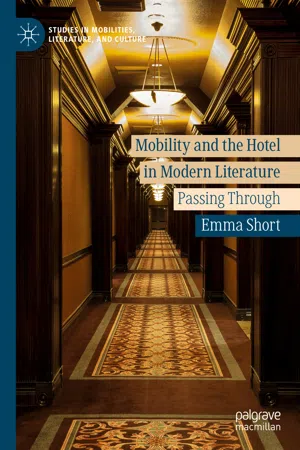
This book considers the complex ways in which the hotel functions to express the shifting experiences of modernity in the works of such authors as Anthony Trollope, Wilkie Collins, Arnold Bennett, H.G. Wells, and Elizabeth Bowen. The text contributes to the critical debates on nineteenth- and twentieth-century literature concerning space, movement, and mobility, arguing that the hotel reconfigures boundaries of modernist, middlebrow, and popular fiction. Drawing on a range of interdisciplinary theoretical and analytical perspectives, the book provides a critical and cultural history of the hotel in British literature, charting its changing nature and usage from the mid-nineteenth century up until the interwar period.
- English
- ePUB (mobile friendly)
- Available on iOS & Android
eBook - ePub
About this book
Information
© The Author(s) 2019
Emma ShortMobility and the Hotel in Modern LiteratureStudies in Mobilities, Literature, and Culturehttps://doi.org/10.1007/978-3-030-22129-4_11. Introduction: Modern Mobilities in the Hotel
Emma Short1
(1)
Durham University, Durham, UK
Among the proliferation of spaces of mobility in nineteenth- and early-twentieth-century literature, the hotel stands out as one of the most complex, contradictory, and compelling. Characterised by impermanence in the constant coming and going of its guests and yet underpinned by the routine and order of the work of the hotel staff, it is a space that at once exemplifies the flux and chaos of modernity in the early twentieth century, as well as the rationalisation of space that was taking place during the same period. It encapsulates what Tim Cresswell refers to as the ‘tension between a spatializing ordering principle seen by many to be central to modernity, and sense of fluidity and mobility emphasized by others’ (2006, p. 16). From the Ormond Hotel in James Joyce’s Ulysses (1922) to the eponymous Grand Babylon Hotel in Arnold Bennett’s 1902 novel, the hotel features heavily across the literatures of this period and offers crucial insight into the shifting tensions and ideologies of modernity. This book, the first account of the hotel in British fiction, interrogates this tension through a consideration of the diverse ways in which the hotel functions in early-twentieth-century literature. The hotel offers itself as the ideal literary setting, enabling authors to bring disparate characters together, and often acting as a microcosm of society as a whole. All of this is thanks to the mobility by which the hotel is necessarily characterised and defined.
In order to fully interrogate the relationship between the hotel and mobility, or indeed, to understand the hotel as a space of mobility, it is first necessary to clarify what we mean when we refer to mobility. For while the two terms are often conflated or used seemingly interchangeably, it is crucial to recognise that mobility does not simply equate to movement. Indeed, mobility is more than movement—as Cresswell argues, movement might well be better understood as ‘abstracted mobility (mobility abstracted from contexts of power)’ (2006, p. 2). Where movement represents the basic act of getting from one destination to another, mobility is always implicated in relations and practices of power. Mobility is, as Cresswell summarises, ‘socially produced motion’ (2006, p. 3). Following Cresswell, mobility is defined by Emma Bond as ‘movement that carries meaning’ (2018, p. 4), and similarly, by Peter Adey, as ‘movement imbued with meaning’ (2010, p. 33). Adey’s use of the word ‘imbued’ here, however, suggests a definition that is attuned to the complexity of the connection between mobility and meaning, implying as it does a context in which meaning is conferred upon movement. This is key, as according to Adey, ‘the way [mobility] is given meaning is dependent upon the context in which it occurs and who decides upon the significance it is given’ (2010, p. 37). The immediate context of the mobilities discussed in this book is, of course, the hotel, but just as important, if not more so, is the wider context of modernity, or more specifically, of British society and culture in the nineteenth and early twentieth centuries.
The hotel encourages, enables, and engenders a reconsideration of mobilities in western modernity, of how and why they are produced, and by whom or by what they come to be imbued with meaning. Mobilities have, of course, always existed, but they arguably come into sharper focus in that period of flux and flow in the nineteenth and early twentieth centuries that is widely defined as modernity. As Cresswell argues, ‘mobility is central to what it is to be modern’, and indeed the links between mobility and modernity are manifold. They are to be found, for example, in that aforementioned ‘tension between a spatialized ordering principle […] and sense of fluidity and mobility’ that frequently underpins understandings of modernity (2006, p. 16). On a more fundamental level, these connections can be detected in the relationship to time and space that is so intrinsic to both mobility and modernity. In his seminal work on modernity, Marshall Berman defines it, for example, as ‘a mode of vital experience—experience’, first and foremost, ‘of space and time’ (2010 [1982], p. 15). Building upon Berman’s understanding of modernity, David Harvey argues that it is a period that can be further characterised by the development of ‘time-space compression’, a phenomenon of capitalist societies that involves a ‘speed-up in the pace of life, while so overcoming spatial barriers that the world sometimes seems to collapse inwards upon us’ (1990, p. 240). And mobility is, of course, central to these debates. As Cresswell maintains, ‘[m]oving people and objects are agents in the production of time and space’, and he points out that this understanding of time-space compression is ‘[p]erhaps the most well-known formulation of this […]—the effective shrinking of the globe by ever-increasing mobility at speed enabled by innovations in transportation and communications technology’ (2006, p. 4). With the growth of the hotel so deeply bound up in the development of new technologies of transport such as the railway, this space is located at the nexus of these changing perceptions of time and space in this period.
The hotel is, then, a truly modern space. The inherent transience of the hotel existence encapsulates the spirit of Zygmunt Bauman’s definition of modernity as ‘an obsessive march forwards’, a march which ‘must go on because any place of arrival is but a temporary station’ (1991, p. 10). By its very nature, the hotel is just such a ‘temporary station’, and again, Bauman’s interpretation of modernity is saturated with notions of mobility, with the image of modernity’s ‘march forwards’ conjuring up a decidedly bodily mobility at that. Mobility is always, as Bond argues, necessarily ‘an embodied mode of movement, […] one that is imbued with a range of meanings for both the mobile subject and for the people and places that are encountered through that movement’ (2018, pp. 2–3). The body is that which enables our mobility—it is, as Elizabeth Grosz points out, ‘the very condition of our access to and conception of space’ (1994, p. 91)—but, equally, it is also that which is ‘brought into being’ through mobility (Merleau-Ponty 2002 [1948], p. 117). For Maurice Merleau-Ponty, mobility engenders an unparalleled knowledge and awareness of one’s body, and he argues:
The mobile body, the way in which the body moves through space (and time), thus lies at the heart of phenomenological approaches to embodiment that form the theoretical backbone of this book.By considering the body in movement, we can see better how it inhabits space (and, moreover, time) because movement is not limited to submitting passively to space and time, it actively assumes them, it takes them up in their basic significance which is obscured in the commonplace of established situations. (2002 [1948], p. 117)
To consider the hotel as a space of mobility is to consider first and foremost the ways in which embodied subjects move through that space. It is through the body that we, as subjects, locate ourselves in and interact with the space surrounding us. Indeed, the very materiality of the body dictates that we cannot avoid interacting, at least in some way, with our location. Sara Ahmed locates the body as ‘[t]he starting point for orientation […] the point from which the world unfolds’ (2006, p. 8). Edward Casey argues similarly that ‘to be embodied is ipso facto to assume a particular perspective and position; it is to have not just a point of view but a place in which we are situated’ (2000, p. 182). Crucially, the places through which we move have a significant effect on us as embodied subjects. As Ahmed suggests, ‘bodies do not dwell in spaces that are exterior but rather are shaped by their dwellings and take shape by dwelling’ (2006, p. 8). Grosz’s theory of corporeal inscription might enable a fuller understanding of the nature of these effects, and what lies behind them. Maintaining that the surface of the body is constantly inscribed and re-inscribed by, among other things clothes, diet, make-up and surroundings, Grosz suggests that it is ‘through exercise and habitual patterns of movement, through negotiating its environment whether this be rural or urban […] [that] the body is more or less marked, constituted as appropriate, or, as the case may be, an inappropriate body for its cultural requirements’ (1994, p. 142). We are, in other words, constructed and re-constructed by our environments, by the spaces through which we move; the navigation of uneven rural terrain results, for example, in the strengthening of certain muscles, while the negotiation of flat, urban streets produces a markedly different body. Such effects are not just evident at a purely muscular level—in cities, the body engages with and is influenced by countless cultural elements in a wide range of media. As Grosz acknowledges, the city has become ‘the place where the body is representationally reexplored, transformed, contested, reinscribed’ (1995, p. 108). Shifting the discussion indoors to the domestic environment, Iris Marion Young observes that the interior of one’s home, and the distribution of one’s possessions throughout, inscribes the body in a similar way, suggesting that it is not merely the presence of personal belongings in the home, ‘but their arrangement in space in a way that supports the body habits and routines of those who dwell there’ (2005, p. 139). For Young, subjectivity is constructed and sustained by the unique individual pathways created in the home. Through arguments such as these, the importance of space and place in the construction and constitution of the embodied subject is made strikingly apparent.
It is, however, important to recognise here the mutually constitutive nature of the relationship between the body and space, and to thereby acknowledge the ways in which bodies themselves continually construct and reinscribe the environments they inhabit. Commenting on the capacity of the walker to challenge and physically alter the landscape of the city, Michel de Certeau suggests that
In highlighting the radical potential inherent in the act of walking, de Certeau here rescues the embodied subject from the role of passive entity or blank surface insc...if it is true that a spatial order organizes an ensemble of possibilities (e.g., by a place in which one can move) and interdictions (e.g., by a wall that prevents one from going further), then the walker actualizes some of these possibilities. In that way, he makes them exist as well as emerge. But he also moves them about and he invents others, since the crossing, drifting away, or improvisation of walking privilege, transform or abandon spatial elements. (1984, p. 98)
Table of contents
- Cover
- Front Matter
- 1. Introduction: Modern Mobilities in the Hotel
- 2. Along the Corridor: Charting the Hotel Narrative
- 3. Anticipation and Stagnation in the Lobby
- 4. ‘The Intolerable Impudence of the Public Gaze’: The Public Rooms of the Hotel
- 5. Space, Movement, and Inhabitation: Transgression in the Hotel Bedroom
- 6. ‘The Bowels of the Hotel’: The Laundry, Kitchen, and Back Areas
- 7. Afterword
- Back Matter
Trusted by 375,005 students
Access to over 1.5 million titles for a fair monthly price.
Study more efficiently using our study tools.
Frequently asked questions
Yes, you can cancel anytime from the Subscription tab in your account settings on the Perlego website. Your subscription will stay active until the end of your current billing period. Learn how to cancel your subscription
No, books cannot be downloaded as external files, such as PDFs, for use outside of Perlego. However, you can download books within the Perlego app for offline reading on mobile or tablet. Learn how to download books offline
Perlego offers two plans: Essential and Complete
- Essential is ideal for learners and professionals who enjoy exploring a wide range of subjects. Access the Essential Library with 800,000+ trusted titles and best-sellers across business, personal growth, and the humanities. Includes unlimited reading time and Standard Read Aloud voice.
- Complete: Perfect for advanced learners and researchers needing full, unrestricted access. Unlock 1.5M+ books across hundreds of subjects, including academic and specialized titles. The Complete Plan also includes advanced features like Premium Read Aloud and Research Assistant.
We are an online textbook subscription service, where you can get access to an entire online library for less than the price of a single book per month. With over 1.5 million books across 990+ topics, we’ve got you covered! Learn about our mission
Look out for the read-aloud symbol on your next book to see if you can listen to it. The read-aloud tool reads text aloud for you, highlighting the text as it is being read. You can pause it, speed it up and slow it down. Learn more about Read Aloud
Yes! You can use the Perlego app on both iOS and Android devices to read anytime, anywhere — even offline. Perfect for commutes or when you’re on the go.
Please note we cannot support devices running on iOS 13 and Android 7 or earlier. Learn more about using the app
Please note we cannot support devices running on iOS 13 and Android 7 or earlier. Learn more about using the app
Yes, you can access Mobility and the Hotel in Modern Literature by Emma Short in PDF and/or ePUB format, as well as other popular books in Literature & Literary Criticism Theory. We have over 1.5 million books available in our catalogue for you to explore.