eBook - ePub
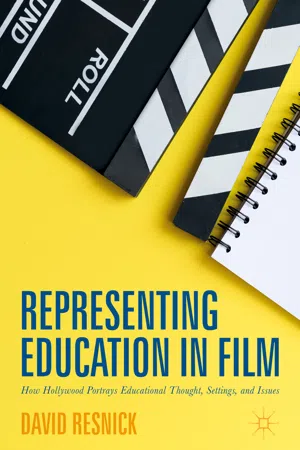
Representing Education in Film
How Hollywood Portrays Educational Thought, Settings, and Issues
- English
- ePUB (mobile friendly)
- Available on iOS & Android
eBook - ePub
Representing Education in Film
How Hollywood Portrays Educational Thought, Settings, and Issues
About this book
This book presents an incisive analysis of how fundamental issues in education are portrayed in film. Focusing on recent films, the author draws on a wide range of educational thinkers and fields of research to examine issues not discussed before. Resnick challenges our assumptions and enriches our general knowledge on critical issues like funding for arts education, what we mean by successful civic education, and the educational value of sports. This project, which includes topics such as the gender gap in civic education, religious education, and what animated films have to say about human education, can serve as a "viewer's guide" to selected educational issues in film and may spur the intelligent use of films in public debate.
Information
Topic
EducationSubtopic
Film & Video© The Author(s) 2018
David ResnickRepresenting Education in Filmhttps://doi.org/10.1057/978-1-137-59929-2_11. Introduction
David Resnick1
(1)
School of Education, Bar Ilan University, Ramat Gan, Israel
The purpose of this book is to help people interested in education enrich their thinking by taking a serious look at selected Hollywood films. I take a broad view of education in a variety of settings, including informal education—like sports and the arts—as well as educational issues which are sometimes not “taught” at all, like the civic education students absorb from the political life of their schools. Some of the educational issues I explore are “philosophical,” for which animated film s are a particularly rich source of material. Even when some of the films are school-based, I do not focus on classroom or instructional issues, topics thoroughly covered by other books in the field (Dalton 2017).
Why Movies?
Movies are a powerful source of what Lindblom and Cohen (1979) call “ordinary knowledge ,” the knowledge people use to make most of their everyday life decisions. Some movies educate us about things we have never experienced first-hand, like war, outer space, and vampires.1 Closer to this project, some movies flesh out educational topics people have already had experience with, like school politics and sports coaches. Other movies may provide “knowledge ” on educational topics few have experienced directly. For example, most of the American public has never attended—or even visited—a private school , other than in the movies. This situation is probably true for many of those who shape education policy , like state legislators. For most of them, as for most of us, Mona Lisa Smile might be their only experience of a private women’s college and Saved! of a fundamentalist Christian high school.
Thus, an in-depth analysis of educational issues portrayed in the movies is a window onto some aspects of our “ordinary knowledge ” about education. This analysis can help us challenge our assumptions, thereby enlarging and enriching the public debate on important issues like funding for arts education, what we mean by successful civic education , and the educational value of sports. Indeed, this book aspires to be a “viewer’s guide” to selected educational issues in film. It may even spur the intelligent use of films in public debate, both inside and outside academia.
To Watch First or Read First, That Is the Question
As a guide, I aim to help readers after their own viewing of the films. Obviously, my interpretation of the films is mine. The best way to form your own opinion is to watch the entire film before reading what I have to say. Fortunately, all the films are available online. You may find it helpful to use an online transcription of the screenplay. (Beware: some online screenplays do not match the final filmed version; see Note 1.) Likewise, after reading my discussion of a particular scene, watch that scene again. Finally, watch the film again in its entirety after reading my analysis.Much of the full thinking-through of the import of [my] ordered observations is left to the reader … the function of the highest sort of guide or teacher [is] focusing his readers’ gaze and drawing them back from wandering confusion, but leaving to them the challenge, and the satisfaction, of completing the interpretive thought … Sometimes, one is also led to disagree . (Pangle 1980 p. xiv)
These films do deserve careful, repeated watching. Provocative ideas may be found in a single line of dialogue or the reaction on an actor’s face to a line someone speaks. These gems are easily overlooked if you watch only to get “the message” of the movie. You may have only 90 minutes to watch each film, but the screenwriters spent months fashioning each and every line. One example of what a close watching can yield is the look on Jesse Owens’ face in Race (1:52:00) in response to blatant anti-Semitism —and what the background music in that scene adds to its meaning. (For the full context of this scene, see Chap. 4, “Sports Coach as Educator.”)
This kind of close, interpretive viewing is what changes a movie into a film, especially once we appreciate how much time and effort went into creating it. As the goal of the book is for films to be springboards for thinking about educational issues, how high your thoughts soar depends largely on your own viewing and thinking.
Spoiler alert: I try to avoid spoilers, but sometimes there is no way around including them in the text.The best way to avoid spoilers is for you to watch the movie before reading what I have to say.
Tip of the Iceberg
Because this book deals with so many different fields of educational endeavor, I cannot claim to have mastered all of the films, the educational material, or the scholarly literature in each domain. For example, this is not a comprehensive guide to movies about arts education, nor arts education itself, let alone the scholarly material on the arts. The topic of each chapter could fill a book. Rather, my project is to provide enough relevant information as the basis for a thoughtful discussion. If my analysis is on-target, it should enable you to be a more intelligent viewer of future films on the same topic, testing my interpretations against future examples of the same genre (e.g. coach movies).
I have sometimes relied on just one or two educational thinkers on each topic, fully aware that there are many additional thinkers and schools of educational thought. If you are reading this book as part of a course, I rely on your instructor to enrich each topic with additional schools of thought and points of view. Thus, each chapter is the tip of an iceberg. There are also additional topics not dealt with in this book for which there are films worthy of viewing and study, such as:
- Mentoring— The Color of Money
- Professional education — The Doctor , An Officer and a Gentleman , The Paper Chase
- School rituals and community values : proms and graduations— In & Out , Mean Girls , Saved!, She’s All That
- Character education — Mean Girls , Renaissance Man
Hollywood and the Happy Ending
This is a study of how educational issues are portrayed in film. Bear in mind that the presentation of the issues is very much subject to the exigencies of the commercial Hollywood film format: a time deadline to keep the action moving, generally stock presentation of characters (heroes and villains ), and a happy ending.2 There is a huge literature on Hollywood film conventions and genres you may consult, if interested.3 In general, no one makes movies about smooth-running schools, or almost any other stable human endeavor. No crisis, no movie.
Are Movies Themselves Educative?
Everyone agrees on the power of the media to shape ideas and attitudes. Moviemakers—especially the scriptwriters—promote the values they believe in via the heroes and denigrate the values they oppose via the villains . In 1993, even before the internet became mainstream, Richard Rorty (p. xvi) asserted that “the novel, the movie and the TV program have, gradually but steadily, replaced the sermon and the treatise as the principal vehicles of moral change and progress.” Zootopia is an outstanding example of a movie which does not take place in an educational setting at all, yet has a clear agenda to shape the values of its (young) audience. See a more detailed discussion of this topic at the end of Chap. 7, Civic Education.
A Word on Methodology
I try to see every film which has an educational dimension—domestic and foreign, independent and Hollywood . Still, I usually limit my analysis to Hollywood movies for three reasons.
- They have the largest American audience, hence the largest impact on “ordinary knowledge .”
- The Hollywood...
Table of contents
- Cover
- Front Matter
- Part I. Defining the Domain: Methodology and Rationale
- Part II. A Movie Close-up on Educational Themes
- Back Matter
Trusted by 375,005 students
Access to over 1.5 million titles for a fair monthly price.
Study more efficiently using our study tools.
Frequently asked questions
Yes, you can cancel anytime from the Subscription tab in your account settings on the Perlego website. Your subscription will stay active until the end of your current billing period. Learn how to cancel your subscription
No, books cannot be downloaded as external files, such as PDFs, for use outside of Perlego. However, you can download books within the Perlego app for offline reading on mobile or tablet. Learn how to download books offline
Perlego offers two plans: Essential and Complete
- Essential is ideal for learners and professionals who enjoy exploring a wide range of subjects. Access the Essential Library with 800,000+ trusted titles and best-sellers across business, personal growth, and the humanities. Includes unlimited reading time and Standard Read Aloud voice.
- Complete: Perfect for advanced learners and researchers needing full, unrestricted access. Unlock 1.5M+ books across hundreds of subjects, including academic and specialized titles. The Complete Plan also includes advanced features like Premium Read Aloud and Research Assistant.
We are an online textbook subscription service, where you can get access to an entire online library for less than the price of a single book per month. With over 1.5 million books across 990+ topics, we’ve got you covered! Learn about our mission
Look out for the read-aloud symbol on your next book to see if you can listen to it. The read-aloud tool reads text aloud for you, highlighting the text as it is being read. You can pause it, speed it up and slow it down. Learn more about Read Aloud
Yes! You can use the Perlego app on both iOS and Android devices to read anytime, anywhere — even offline. Perfect for commutes or when you’re on the go.
Please note we cannot support devices running on iOS 13 and Android 7 or earlier. Learn more about using the app
Please note we cannot support devices running on iOS 13 and Android 7 or earlier. Learn more about using the app
Yes, you can access Representing Education in Film by David Resnick in PDF and/or ePUB format, as well as other popular books in Education & Film & Video. We have over 1.5 million books available in our catalogue for you to explore.