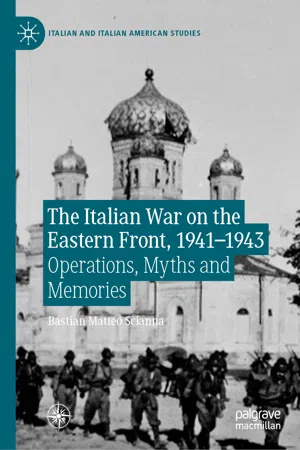
eBook - ePub
The Italian War on the Eastern Front, 1941–1943
Operations, Myths and Memories
- English
- ePUB (mobile friendly)
- Available on iOS & Android
eBook - ePub
The Italian War on the Eastern Front, 1941–1943
Operations, Myths and Memories
About this book
The Italian Army's participation in Hitler's war against the Soviet Union has remained unrecognized and understudied. Bastian Matteo Scianna offers a wide-ranging, in-depth corrective. Mining Italian, German and Russian sources, he examines the history of the Italian campaign in the East between 1941 and 1943, as well as how the campaign was remembered and memorialized in the domestic and international arena during the Cold War. Linking operational military history with memory studies, this book revises our understanding of the Italian Army in the Second World War.
Information
© The Author(s) 2019
B. M. SciannaThe Italian War on the Eastern Front, 1941–1943Italian and Italian American Studieshttps://doi.org/10.1007/978-3-030-26524-3_11. Introduction
Bastian Matteo Scianna1
(1)
University of Potsdam, Potsdam, Brandenburg, Germany
‘Cowards’, ‘clowns’, ‘useless soldiers’, and ‘treacherous allies’—the Second World War has bequeathed many stereotypes and enduring myths about the Italians. Mussolini’s regime had a central role as Nazi Germany’s closest diplomatic ally, and its fortunes during the war also influenced the Axis’s overall position. Yet, as the noted historian MacGregor Knox observed: “despite a fifty years’ undergrowth of memoirs and popular accounts, Fascist Italy at war remains poorly understood.”1 This holds particularly true for one key piece in the puzzle: the Italian Army (Regio Esercito). Most myths are linked to the armed forces and the campaigns that it fought. But while the operations in North Africa have attracted notable attention, another vital theatre for the Italian Army, the Eastern Front, has thus far been almost completely neglected. This happened notwithstanding the fact that over one-third of Italian combat losses between 1940 and 1943 were suffered on Russian soil and five times more soldiers (229,000) fought on the Don in 1942–1943 than at the battle of El Alamein—the coinciding turning point in the North African desert. Collective memory in Italy has focused on the winter retreat (la ritirata dal Don) and largely portrayed the Italian soldiers as victims. This has meant that the previous operations have been seen as prelude to the inevitable catastrophe of a supposedly inept military machine. In principle, three topoi emerged from the campaign in Russia, each with diverging interpretations that often depended on political views. First was the question of military performance, second, the Italian soldiers as victims (of their poor materiel and bad leadership, their government, their German ally and the Soviets) and third, whether the Italians had been brava gente (decent people) or ruthless Fascist occupiers. The Italian involvement in the war against the Soviet Union is, then, an important element of understanding the country’s general role during the Second World War and the contested memories after 1945.
While cultural histories on collective memory analyse a constructed reality and public narratives, they often show little interest in the actual operations or in the armed forces as organisation. And yet events are never commemorated without myths and different layers of memories. Thus, reality—in a hermeneutic sense of what really happened—and the myths fashioned about an event often (or rather always) diverge, and notably influence the narrative and memory. The new school of military history as a study of mentality, cultural and everyday history has widened the hitherto narrow field, but has left operational aspects neglected. At the same time, operational military histories often did not investigate the memory of battles and campaigns or remained restricted to a single nation. A truly modern military history has to include several methodological strands, taking political, operational and cultural aspects into proper account without excluding the actual fighting.2 This first step, analysing the military and its operations, is fundamental to drawing wider assessments of Italy’s role in the Second World War. Yet, particularly the operational history of the Italian Army has been under-researched.
The myths about Italian military incompetence are closely linked to the difficulties of assessing military effectiveness. In the Second World War, one benchmark was arguably the ability to wage combined arms manoeuvre warfare (with infantry, artillery, armour and aircraft) on the divisional and corps levels. This included the capability to command, control, supply and maintain these forces in the field. Military effectiveness has further to be subdivided into the political, strategic, operational and tactical levels, and has been defined as “process by which armed forces convert resources into fighting power. A fully effective military is one that derives maximum combat power from the resources physically and politically available. Effectiveness thus incorporates some notion of efficiency.”3 In his seminal work, Martin van Creveld had additionally highlighted the importance of combat motivation and morale for an army’s ‘fighting power’.4 On the other hand, the contributions from political science to this field have been vast—and are unfortunately often neglected by historians. Stephen Biddle has argued that modern material and sound finances alone are not sufficient for an army to be effective. His ‘modern system’ theory of force employment emphasised doctrine, tactical education for combined arms cooperation and the importance of force exposure reduction over sheer numbers and technology.5 Other scholars have hinted at the importance of national cultures in explaining the military as an organisation and in understanding combat outcomes.6
Added to this, military effectiveness has to be considered as a relative benchmark: that is, one to be seen in comparison to other armies and taking proper account of situational and structural factors, such as weather or materiel (lest we forget the enemy). The metrics for measuring effectiveness are both difficult to establish and hotly disputed.7 Defeat is certainly an indicator, but no one would claim that German defeat in two world wars means that her army was ineffective. Cohen and Gooch have pointed to the complexity of military failure, and shifted the analytical focus from seeing individual commanders as sole culprits to organisational flaws.8 They also criticised often-unsubstantiated theories about collective incompetence, institutional failure and uncritical military minds caught in their rigid doctrinal thinking.9 They thus argued against understanding institutions as a static concept and preferred to analyse armed forces as organisations, i.e. how they work in practice.10
Any serious examination of a given army must analyse its planning for war, organisational culture, battlefield performance and learning processes. Indeed, poor civilian-military relations, restrictions on training, hyper-centralisation, duplication in command chains and lack of international contacts will hamper hypothetical capabilities and may take decades to be overcome.11 Therefore, military adaptability was and remains a key virtue for armies: even if cynics argue that the military always prepares for the last war, we also know that predictions are always difficult. Unpredictability and peacetime dividends add to the problem of military readiness,12 which increases the need to instil armed forces with capability for critical self-assessment in peacetime and to stimulate a culture of change and adaptation with realistic training to prepare for the fog of war.13 According to John Nagl, “military organisations often demonstrate remarkable resistance to doctrinal change as a result of their organisational cultures. Organisational learning, when it does occur, tends to happen only in the wake of a particularly unpleasant or unproductive event.”14 Outside threats and defeat on the battlefield clearly are such unpleasant events,15 which still require a framework for effective reorganisation. Yet, other outside influences, e.g. within alliances, can have positive effects by channelling innovation to less developed armed forces. Thus, an army’s combat performance depends as much on pre-war training as on time, context, enemy, materiel, strategic goals and policies and the nature of operations.
The second wider theme of this study is memory, which includes aspects of how myths16 and narratives are formed and contested. The main issues will be the interrelation between discourses and how some narratives prevailed and influenced memories, and the deviation of an organisational memory (e.g. the military’s) from public discourses and the dominant collective memory. In the following, memory will be understood as contested and dynamic process of remembering and interpreting the past in order to provide identity. Memory will be seen as an active ‘recollection’ and search for meaning, e.g. in public political discourses to evoke images and narratives of the past for the present—or else to mute certain aspects.17
In order to explain why even military defeats are glorified, one needs to understand the political significance of myths about redemption and resurgence. Political myths have always held a central place for nation-building purposes, including in the Italian case.18 Likewise, war has always played an important role for founding myths and memories of nations.19 All these battle myths revolve around several recurring topoi: the few against the many (David versus Goliath), volunteerism, youth, elitism, hostile terrain, heroic sacrifice, refusal to surrender in hopeless situations and the association of a stronghold with a sacred home soil. These myths are often based on false official statements that set the tone for the ‘glorious defeat’ narrative and can be altered to suit...
Table of contents
- Cover
- Front Matter
- 1. Introduction
- 2. Historiography: Past Problems and Recent Trends
- 3. The Italian Army Before the Second World War (1861–1940)
- 4. The guerra fascista—10 June 1940–25 July 1943
- 5. The Italian Operations on the Eastern Front (1941)
- 6. The Italian Operations on the Eastern Front (1942)
- 7. The Battle on the Don, 11 December 1942–31 December 1943
- 8. The Italian Combat Performance: ‘Chicken Led by Donkeys’?
- 9. Narratives About Victimhood: Evil Germans, Good Italian Occupiers and Evil Soviets?
- 10. Shaping the Myths: Memoirs, the Army and the Alpini
- 11. Contested Memories During the Cold War
- 12. Conclusion
- Back Matter
Trusted by 375,005 students
Access to over 1.5 million titles for a fair monthly price.
Study more efficiently using our study tools.
Frequently asked questions
Yes, you can cancel anytime from the Subscription tab in your account settings on the Perlego website. Your subscription will stay active until the end of your current billing period. Learn how to cancel your subscription
No, books cannot be downloaded as external files, such as PDFs, for use outside of Perlego. However, you can download books within the Perlego app for offline reading on mobile or tablet. Learn how to download books offline
Perlego offers two plans: Essential and Complete
- Essential is ideal for learners and professionals who enjoy exploring a wide range of subjects. Access the Essential Library with 800,000+ trusted titles and best-sellers across business, personal growth, and the humanities. Includes unlimited reading time and Standard Read Aloud voice.
- Complete: Perfect for advanced learners and researchers needing full, unrestricted access. Unlock 1.5M+ books across hundreds of subjects, including academic and specialized titles. The Complete Plan also includes advanced features like Premium Read Aloud and Research Assistant.
We are an online textbook subscription service, where you can get access to an entire online library for less than the price of a single book per month. With over 1.5 million books across 990+ topics, we’ve got you covered! Learn about our mission
Look out for the read-aloud symbol on your next book to see if you can listen to it. The read-aloud tool reads text aloud for you, highlighting the text as it is being read. You can pause it, speed it up and slow it down. Learn more about Read Aloud
Yes! You can use the Perlego app on both iOS and Android devices to read anytime, anywhere — even offline. Perfect for commutes or when you’re on the go.
Please note we cannot support devices running on iOS 13 and Android 7 or earlier. Learn more about using the app
Please note we cannot support devices running on iOS 13 and Android 7 or earlier. Learn more about using the app
Yes, you can access The Italian War on the Eastern Front, 1941–1943 by Bastian Matteo Scianna in PDF and/or ePUB format, as well as other popular books in History & Eastern European History. We have over 1.5 million books available in our catalogue for you to explore.