eBook - ePub
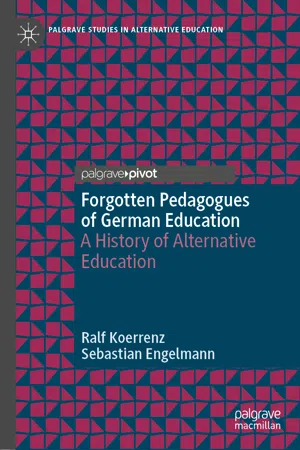
Forgotten Pedagogues of German Education
A History of Alternative Education
- English
- ePUB (mobile friendly)
- Available on iOS & Android
eBook - ePub
Forgotten Pedagogues of German Education
A History of Alternative Education
About this book
This book introduces six pedagogues from the German context to an English-speaking audience, and demonstrates their significant contribution to the field of alternative education. First and foremost, the authors emphasise the importance of understanding the history of education, to realise that in fact what we understand as 'normal' today is by no means the only course history could have taken. The quest for alternative ways of schooling goes back to the late eighteenth century, where educational thinkers advocated various approaches in the face of rapid societal change. The chosen six thinkers are not well known in the English-speaking scientific community, and some are even infrequently cited in the German context. In offering an historic and systematic introduction to concepts that can frame Alternative Education in different ways, this book allows the reader to critically reevaluate present forms of education by using the past as a mirror.
Information
Topic
EducationSubtopic
Education General© The Author(s) 2019
R. Koerrenz, S. EngelmannForgotten Pedagogues of German EducationPalgrave Studies in Alternative Educationhttps://doi.org/10.1007/978-3-030-29570-7_11. Introduction
Ralf Koerrenz1 and Sebastian Engelmann2
(1)
Institute for Bildung and Culture, Friedrich Schiller University Jena, Jena, Germany
(2)
Institute for Education, Eberhard Karls University Tübingen, Tübingen, Germany
Abstract
As humans we all tend to forget things—scientific disciplines do the same. In this book we argue that the history of pedagogical thought and action can often best be characterized by forgetting, a collective amnesia that leaves out, renders invisible or even annihilates ideas from the past. More and more texts and documents are forgotten, some of them for good. The introduction discusses methodological questions of writing a history of “forgotten” concepts. It offers an overview of the approach used in this book. Furthermore, it introduces the six cases of the book and situates them in the field of education.
Keywords
HistoryAlternative educationForgettingDisciplinary amnesiaMethods1.1 Disciplinary Amnesia—An Introduction
Sometimes, we tend to forget things—not only where we left our glasses, whether we locked the door properly or if the stove is still turned on. Sometimes, we forget names of old friends, places we have been, the impression of a beautiful sunrise during our last vacation. We forget these things even though they were important to us in the past. In this book we argue that the history of pedagogical thought and action can often best be characterized by forgetting, a collective amnesia that leaves out, renders invisible or even annihilates ideas from the past. More and more texts and documents are forgotten, some of them for good. However, without a collective historical memory, education as a practice and Human Science Pedagogy as a scientific reflection of this practice become blind to its failures—and also to the success and learning experiences of educational programs throughout time and space. Without thinking about the ideas we might have forgotten along our way, there is the constant fear—which in itself is not a problem—of disrespecting important tradition or even discussing findings as ‘new’ even though they were already presented by other scholars.
Educators have always thought about learning, diversity, how to construct a system for schooling and about the relation between teacher and student—those are time-transcendent problems of Human Science Pedagogy. We are—metaphorically speaking—standing on the shoulders of others. We are evaluating our past through a lens, a perspective that is co-constructed by them and ourselves. This lens sometimes seems to be blurred, even scratched; it is only partially reflecting the light. Some thinkers of education—as Palmer puts it (Palmer 2001)—seem to be founding figures of educational thought. They are stylized as they become idols, their creed is used for disciplinary identification and even for justification of action. This is especially the case of New Education or Progressive Education in the English-speaking world. Instead of referring to the various processes of knowledge transfer, the communal practice of educational thinking and the often-shared projects that were put in practice all around the globe, the narratives mostly focus on just one or two authors.
This is especially the case for the meta-narrative of Progressive Education. In comparison to the German discussion, where texts by John Dewey were translated years after his success in the United States, this educator seems to be the almost heroic founding figure of an entirely new strand of discussion. One person—one man—is mentioned when Progressive Education is discussed: John Dewey. Dewey’s democratic idea for a social, just and community-based education—as outlined in his epoch-making work Democracy and Education: An Introduction to the Philosophy of Education published in 1916—is still influential today. It is still influencing the scholarly discussion. In addition to a large quantity of papers (e.g. Apple and Teitelbaum 2001) various monographs were published, summing up the intellectual development of Dewey’s thought and his connection to various other strands of discussion (e.g. Oelkers 2009) or discussing certain aspects such as problem-based learning or civic education in Dewey’s work anew (cf. Konrad and Knoll 2018). John Dewey definitively was and still is influential for the discussion of Progressive, New or Alternative Education in Europe and all over the world (cf. Biesta and Miedema 1996). He influenced thinkers such as Decroly, Ferriere and Blonksy (cf. Koerrenz, Blichmann and Engelmann 2017). Nevertheless, there is more than Dewey—and Dewey himself might have become more of an “empty signifier” as political theorist Ernesto Laclau puts it. One might even argue that Dewey is not read anymore but his ideas are perpetuated and utilized, when educators want to frame their educational models as democratic, progressive or “alternative”. Contrary to this general understanding of Dewey as a “democratic” thinker, Knoll points out, that Dewey’s concept offers a deliberative and cooperative understanding of democracy that does not put emphasis on democratic decision making by voting or even relies on institutionalized party democracy (cf. Knoll 2018). This understanding of democracy must be understood as more radical than is often displayed in educational concepts. So, there might be more to the history of education than what is mediated by introductions, established discourse and carried out in a language-specific, geographically-located and culturized context.
Often enough, educators and educational theorists do not see the mesh of culture that they are wrapped in. Therefore, sometimes we all forget the most important part of concepts, their critical moments, that can be understood as the real alternative part of them. Certainly, alternative pedagogical concepts are mostly critical concepts. They are part of a larger field called critical pedagogies that consider the societal, political, cultural and economic factors that influence all kinds of educational practices (cf. Kirylo 2013). Critical pedagogies, as well as Alternative Education, want to provide a different way of thinking about education. According to Austro-Marxist psychoanalyst and educational thinker Siegfried Bernfeld, education is always conservative. Bernfeld argues that education is always influenced by the thoughts, ideas and ideals of a specific time: We are only teaching to conserve our values and our mode of life. You cannot change a society by education; education adjusts the society to the dominant values of its own time and perpetuates the conservative stance of its time. That’s it. On the contrary, Alternative Education wants to teach and educate for a change; it hopes for a better, a different future that is also put forward by education.
This insight is part of the argument that is going to be put forward in the next chapters: Sometimes we do not only forget because we struggle to remember everything, but because certain modes of thought, alternative modes that challenge conservative thinking and established orders, are neglected and ignored. Forgetting and selective commemoration of concepts and ideas—we argue—is one of the most interesting parts of disciplining the discipline, educating the Human Science Pedagogy themselves. To stick to one example, one has to keep in mind that Dewey was not the only thinker when talking about Alternative Education. Even though he is perceived as the most important figure of democratic and alternative education, this perception is constructed by certain practices that must be pointed out to better understand both commemoration and forgetting. On the one hand, the Alternative Education movement is composed of manifold thinkers and activists. It is a heterogenous group that is hard to grasp. It’s even harder to represent this highly diverse group by only referring to only one thinker.1 On the other hand, there might be a possibility to integrate various ideas on education into Alternative Education by finding the aspect of the concepts that unites them.
1.2 Alternating Alternatives and the Identity of Human Science Pedagogy
Recent publications offered such a systematic understanding of Alternative Education to integrate marginalized, forgotten or even outlawed concepts. According to Koerrenz, Blichmann and Engelmann the “alternative” in Alternative Education can be understood in two ways. Firstly, the term “alternative” refers to a difference, “an alternative is alternate to something else” (Koerrenz et al. 2017, p. 6). Alternative approaches to education try to offer an alternative to an established concept. They are in this first sense different to the established education and the established, standardized talk about education. Secondly, alternative is always understood in a normative way. There is no alternative set of educational practices that does not understood itself as better, more helpful, more humane, more effective, more whatsoever. So, the second understanding of alternative is to be a better education than the established one. Therefore, we understand alternative education as a different option that offers a better education than the established one. Admittedly, this understanding is very broad. Especially in the discussion about Alternative, Progressive and New Education as brand names, it is more or less neglected. The discussion about the systematic core of Alternative Education (and its various national variations) is a very recent one. Link argues that Alternative Education is a bewildering object of research. This object of research is—according to Link—historically situated at the beginning of the twentieth century. On the one hand, it must be understood as a reaction to moments of crisis during the confusions at the beginning of the twentieth century; especially economical change, war, militarization, starting globalization and the “fall of virtue”. On the other hand, it must be understood as a set of pedagogical practices, didactical arrangements and methodological models that are oriented towards the learner, aimed at initiating reform processes in schools (Link 2017, p. 25). However, Link explicitly points out the historical context of Alternative Education; the beginning of the twentieth century. If one follows this understanding of Alternative Education, there simply is no Alternative Education nowadays. Additionally, there can be no Alternative Education before the beginning of the twentieth century. According to Matthes, Schütze and Koerrenz, however, understanding Alternative Education as different and better education that criticizes the established education helps to point out the alternative elements in educational thought throughout earlier periods of educational thought (cf. Matthes and Schütze 2017; Koerrenz 2005). However, this systematic understanding must consider the specific circumstances in which educational thought is situated—it is not without history; on the contrary, it offers a more complex understanding of the various strands of discussion and lines of thought that are more or less coherent across the ages. Thus, it opens up the narrowed understanding of the “canonical texts” of educational sciences in general, and more specifically Alternative Education. According to Gorak (2013) and Oelkers (1994), establishing a canon of texts that serves as the normative foundation for everything from this point on is an impossible task. Talking about the “classics” nowadays seems to be an almost ignorant position that does not consider the variety of positions and voices in the discussion. It does not support the voices that were neglected for various reasons, too many and sometimes too repellent to name them all.2 Since postmodern thinkers, poststructuralist theorists and deconstructionists started their critical work on texts, it is no longer possible to talk about “the classics” of a discipline in a self-assured way. There simply is no such thing as a time-transcending quality of texts that talk about education—even though male scholars such as Hans-Georg Gadamer argued for this quality. Even though at some universities, in seminars and talks, scholars talk about “classics”, this talk is cheap and part of a certain culture of dominance, that does not consider its own situatedness. All kinds of texts—even the texts of John Dewey—were written in a specific context, from a specific point of view and with a specific intention. According to feminist scholars such as Donna Haraway, knowledge is always situated, it is produced and dominated by societal power relations. The feminist critique of the canon offers insights into t...
Table of contents
- Cover
- Front Matter
- 1. Introduction
- 2. Joachim Heinrich Campe and the Pedagogical Anthropology of the Child
- 3. Bernhard Heinrich Blasche and the Romantic Concept of Nature Education
- 4. Helene Lange, Emancipation and Education for All
- 5. Heinrich Scharrelmann and the Art of Storytelling
- 6. Bernhard Hell and the Protestant School Community
- 7. Gertrud Bäumer, Deconstructing Gender and Discussing Social Work
- Back Matter
Trusted by 375,005 students
Access to over 1.5 million titles for a fair monthly price.
Study more efficiently using our study tools.
Frequently asked questions
Yes, you can cancel anytime from the Subscription tab in your account settings on the Perlego website. Your subscription will stay active until the end of your current billing period. Learn how to cancel your subscription
No, books cannot be downloaded as external files, such as PDFs, for use outside of Perlego. However, you can download books within the Perlego app for offline reading on mobile or tablet. Learn how to download books offline
Perlego offers two plans: Essential and Complete
- Essential is ideal for learners and professionals who enjoy exploring a wide range of subjects. Access the Essential Library with 800,000+ trusted titles and best-sellers across business, personal growth, and the humanities. Includes unlimited reading time and Standard Read Aloud voice.
- Complete: Perfect for advanced learners and researchers needing full, unrestricted access. Unlock 1.5M+ books across hundreds of subjects, including academic and specialized titles. The Complete Plan also includes advanced features like Premium Read Aloud and Research Assistant.
We are an online textbook subscription service, where you can get access to an entire online library for less than the price of a single book per month. With over 1.5 million books across 990+ topics, we’ve got you covered! Learn about our mission
Look out for the read-aloud symbol on your next book to see if you can listen to it. The read-aloud tool reads text aloud for you, highlighting the text as it is being read. You can pause it, speed it up and slow it down. Learn more about Read Aloud
Yes! You can use the Perlego app on both iOS and Android devices to read anytime, anywhere — even offline. Perfect for commutes or when you’re on the go.
Please note we cannot support devices running on iOS 13 and Android 7 or earlier. Learn more about using the app
Please note we cannot support devices running on iOS 13 and Android 7 or earlier. Learn more about using the app
Yes, you can access Forgotten Pedagogues of German Education by Ralf Koerrenz,Sebastian Engelmann in PDF and/or ePUB format, as well as other popular books in Education & Education General. We have over 1.5 million books available in our catalogue for you to explore.