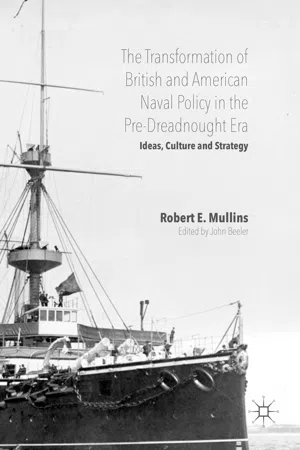
This volume examines the transformation of British and US naval policy from 1870 to 1889, which resulted in the British Naval Defence Act (1889), the construction of the first modern US battleships, and began the naval arms race which culminated in World War One. In examining the development of strategic thinking in the Royal and US Navies, it overturns conventional wisdom regarding genesis of the Naval Defence Act and the US Navy's about-face from a defensive to an offensive strategic orientation. It pays particular attention to activities of the key individuals in both countries' navies, who were instrumental in transforming their respective services' organizational culture. This study will be of interest not only to historians but to political scientists, sociologists, and others working in the fields of international relations, strategic studies, policy analysis, and military learning, adaptation and innovation. It is also essential reading for those interested in the naval arms race during this period.
eBook - ePub
The Transformation of British and American Naval Policy in the Pre-Dreadnought Era
Ideas, Culture and Strategy
- English
- ePUB (mobile friendly)
- Available on iOS & Android
eBook - ePub
The Transformation of British and American Naval Policy in the Pre-Dreadnought Era
Ideas, Culture and Strategy
About this book
Information
Overview
© The Author(s) 2016
Robert E. Mullins and John Beeler (eds.)The Transformation of British and American Naval Policy in the Pre-Dreadnought Era10.1007/978-3-319-32037-3_11. Introduction
Robert E. Mullins1 and John Beeler2
(1)
Chevy Chase, Maryland, USA
(2)
University of Alabama, Tuscaloosa, Alabama, USA
The emergence of modern sea power in Britain and the United States can be traced to decisions made in 1889, when both countries embarked on rapid and sustained naval expansion that continued throughout the pre-dreadnought (1889–1906) and dreadnought (1906–14) eras, into World War I. The British Naval Defence Act, enacted in May 1889, authorized the construction of ten battleships, forty-two cruisers of various types, and eighteen torpedo-gunboats at the cost of £21.5 million. This constituted the largest British warship-building program of the nineteenth century. It was deemed necessary in order to modernize the fleet—the Royal Sovereign class capital ships built under its terms were the prototypical “pre-dreadnought” battleships—and was intended to deter other countries from following suit. In December 1889, a similar proposal to modernize the American fleet was circulated in Washington, following the enunciation of a new strategic posture that envisioned an offensive naval force of capital ships as the means of hemispheric defense. The result was an unparalleled transformation of naval power on both sides of the Atlantic, due not only to maturing naval technologies and the emergence of the pre-dreadnought battleship, but also the pervasive influence of strategic ideas and their impact upon the peacetime naval policies of Britain and the United States.
This work examines the decisions of 1889 in light of those strategic ideas, and from cultural and organizational perspectives that combine archival sources with modern historical techniques and social science methodologies and applies them to the study of naval policy formulation. Prior accounts of these decisions typically measure their historical significance in terms of the naval construction that ensued. This study focuses instead upon the shaping influence of strategic ideas and how they were inspired, institutionalized, and finally implemented in the policies enacted in 1889. That strategic ideas shared among naval officers were decisive in this instance is the underlying tenet of the cultural approach to historical naval analysis, which in turn highlights the impact of organizational cultures upon the strategic and force structure choices of military institutions.
The pre-dreadnought era has garnered less historical attention than the subsequent period, characterized by HMS Dreadnought and the Anglo-German naval race that immediately preceded World War I, but it has nonetheless been the subject of a substantial body of scholarly literature. Much of it, however, focuses on technology, naval architecture, and naval construction, leaving policy decisions such as those of 1889 essentially untouched or only briefly mentioned. Indeed, that the period between 1889 and the appearance of HMS Dreadnought is known as the “pre-dreadnought era”—using a ship design to characterize an era—speaks volumes of its treatment in modern naval historiography. Typical of the scholarship is an overarching emphasis upon the technical aspects of warship building, as evidenced by design histories by David K. Brown, Norman Friedman, and others. 1 These technocentric histories, while excellent for their detailed descriptions of the ship design and building processes, typically give short shrift to the substantive rationales behind key policy choices. “The problem,” observes one prominent naval historian with respect to design histories in general, “is that we need to address warships and their development as a historical problem, and we need to address it with respect to organization, to personality, [and] to technology ….” 2 Yet this approach remains to be applied to the decisions of 1889.
The tendency to consign the policy formulation process, especially in peacetime, to a conceptual “black box” is further encouraged by longstanding tendencies in naval historiography, more specifically, the limits of what can be termed the “policy-and-operations” perspective ordinarily employed to analyze naval policy formulation. 3 At its worst, this perspective oversimplifies the complex realities of developing policy, strategy, and doctrine in navies, a characteristic that becomes more pronounced when studying peacetime administration, during which organizational decisions are often reflective of the ideas and experiences of service professionals. “Naval officers,” writes David Alan Rosenberg, “acquire their experience and understanding of naval strategy and operations, and later apply it in decision making positions, within the unique organizational structure of the navy.” 4 Failure to take this phenomenon into consideration means that peacetime policy decisions are often treated as if they had been made under wartime conditions, when external factors such as foreign navies and threat perceptions generally assume priority in the decision-making process. In failing to distinguish between these different policymaking environments, many core naval histories are misinformed (and misinforming) as to the major shaping influences behind policy choice and implementation.
Nowhere is this tendency more apparent than in most existing accounts of the decisions of 1889. Conventional wisdom regarding the Naval Defence Act rests on the work of Arthur Jacob Marder, who as a pioneer in the field of modern, scholarly naval history popularized the policy-and-operations perspective in his landmark studies of British naval policy. 5 Failing fully to consider the shaping influence of organizational, political, and economic factors in peacetime policy deliberations, Marder framed his account of the Naval Defence Act around three conceptual pillars: external provocations, threat perceptions, and civilian intervention. On this basis, he concluded that the Act was spurred by a combination of these external factors, with particular emphasis upon a feared Franco-Russian naval combination that he argued was ultimately responsible for the new course in Admiralty policy. 6
Somewhat less problematic are what amount to hagiographies of US naval officer Alfred Thayer Mahan, which together form the basis of conventional wisdom about his centrality to the origins of strategic reconfiguration in United States naval policy. 7 Yet these too overlook additional, critical internal factors in favor of an oversimplified image of how American naval policy was transformed in the late 1880s. That historian Jon Tetsuro Sumida elected not to challenge this image but instead perpetuated it in his assessment of the celebrated naval theorist and his writings—Inventing Grand Strategy and Teaching Command (1997)—testifies to the extent to which the strategic discourse that prompted the revolution in American naval affairs remains obscured by the literary attainments of its most famous participant. 8
Naval historiography has broadened in the last twenty-five years to examine policy formulation from an organizational perspective, based on the appreciation that navies are complex organizations, with sophisticated ideas, structures, and processes which combine to affect how naval officers and administrators think about and prepare for war within the larger context of policy formulation. “Navies,” in the words of Sumida and Rosenberg, should be “… understood as institutions whose manifold dimensions, variations in major characteristics, and potential for radical reformation need to be taken into consideration when investigating the … motives underlying the behavior of naval decision makers.” 9 To accomplish this task, the historical discipline has recently embraced new analytical techniques and research methodologies borrowed from the social sciences, especially those that can be used to sort out complex issues in naval technology, personnel, administration, and finance. 10
A number of naval historians have produced studies that focus chiefly upon internal factors and the organizational perspective. Sumida has written extensively on the formulation of British naval policy between 1889 and 1914, with a particular emphasis upon the interaction of internal factors and their impact upon the key policy choices made during the John Fisher era (1904–10). 11 Nicholas Lambert has followed a similar research agenda in his studies of the same period, while John Beeler has applied an organizational perspective to an investigation of mid-Victorian British naval policy. 12 Andrew Gordon’s superb analysis of British naval command highlights cultural factors that affected the operational performance of the Grand Fleet at the Battle of Jutland. 13 More recently, C. I. Hamilton’s study of British naval policymaking in the nineteenth and early twentieth centuries, Shawn Grimes’ examination of Admiralty war-planning 1887–1918, Nicholas Black’s work on World War I-era British naval staff, Stephen Cobb’s exploration of Royal Navy efforts to employ armed merchant cruisers to interdict enemy trade 1885–1914, and Matthew Seligmann’s investigation of the service’s plans for trade protection have all moved decisively beyond the policy-and-operations approach to take into consideration cultural and organizational factors in the formulation of naval policy. 14 Because of their analytical roots in the organizational perspective, these studies are marked by an emphasis on the pervasive influence of strategic ideas and professional arguments thereon, and their impact in shaping the content and process of naval policy formulation. Yet, as one naval historian has warned, it is simply not enough to identify which idea(s) mattered most in the policymaking process: “[i]n order to explain the history of naval strategy, we must move behind the ideas to consider where they came from and how they were translated from theory into practice.” 15 Understanding key policy choices is thus dependent upon a study of strategic ideas and, more importantly, the organization in which these ideas are inspired, institutionalized, and finally implemented in policy frameworks.
Implicit to assessing the impact of strategic ideas is the concept of organizational culture, which this study adopts from the social sciences to link strategic ideas with the environment in which they evolve into preferences within the professional mindset of British and American naval officers. Having originated in organizational theory, the concept of organizational culture has in recent years attracted the attention of political scientists and historians, many of whom have incorporated it in their analyses to explain certain aspects of military behavior. 16 Although frequently categorized in this literature as “service culture,” or “military culture,” organizational culture is employed in this study as encompassing a set of attitudes, beliefs, and other common habits of thought shared among naval officers serving as the intellectual basis for their conceptions as to the roles and missions of the service. For evidence of such culture and its impact upon naval decision-making, this work relies on departmental records, official and private communications, journal articles, newspaper submissions, and personal memoirs, as well as the private papers of senior officers, in order to provide answers to the following questions about the decisions of 1889:
- To w...
Table of contents
- Cover
- Frontmatter
- 1. Overview
- 2. The Struggle for Control of British Naval Policy, 1870–1889
- 3. Strategic Reconfiguration in the United States, 1873–1889
- 4. Conclusion
- Backmatter
Trusted by 375,005 students
Access to over 1.5 million titles for a fair monthly price.
Study more efficiently using our study tools.
Frequently asked questions
Yes, you can cancel anytime from the Subscription tab in your account settings on the Perlego website. Your subscription will stay active until the end of your current billing period. Learn how to cancel your subscription
No, books cannot be downloaded as external files, such as PDFs, for use outside of Perlego. However, you can download books within the Perlego app for offline reading on mobile or tablet. Learn how to download books offline
Perlego offers two plans: Essential and Complete
- Essential is ideal for learners and professionals who enjoy exploring a wide range of subjects. Access the Essential Library with 800,000+ trusted titles and best-sellers across business, personal growth, and the humanities. Includes unlimited reading time and Standard Read Aloud voice.
- Complete: Perfect for advanced learners and researchers needing full, unrestricted access. Unlock 1.5M+ books across hundreds of subjects, including academic and specialized titles. The Complete Plan also includes advanced features like Premium Read Aloud and Research Assistant.
We are an online textbook subscription service, where you can get access to an entire online library for less than the price of a single book per month. With over 1.5 million books across 990+ topics, we’ve got you covered! Learn about our mission
Look out for the read-aloud symbol on your next book to see if you can listen to it. The read-aloud tool reads text aloud for you, highlighting the text as it is being read. You can pause it, speed it up and slow it down. Learn more about Read Aloud
Yes! You can use the Perlego app on both iOS and Android devices to read anytime, anywhere — even offline. Perfect for commutes or when you’re on the go.
Please note we cannot support devices running on iOS 13 and Android 7 or earlier. Learn more about using the app
Please note we cannot support devices running on iOS 13 and Android 7 or earlier. Learn more about using the app
Yes, you can access The Transformation of British and American Naval Policy in the Pre-Dreadnought Era by Robert E. Mullins, John Beeler, Robert E. Mullins,John Beeler in PDF and/or ePUB format, as well as other popular books in History & British History. We have over 1.5 million books available in our catalogue for you to explore.