eBook - ePub
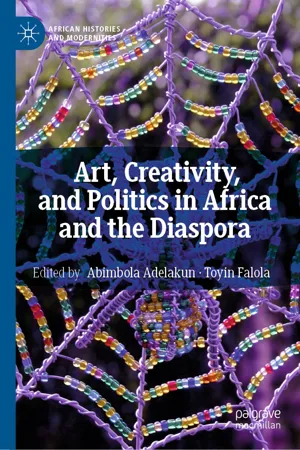
Art, Creativity, and Politics in Africa and the Diaspora
- English
- ePUB (mobile friendly)
- Available on iOS & Android
eBook - ePub
Art, Creativity, and Politics in Africa and the Diaspora
About this book
This book explores the politics of artistic creativity, examining how black artists in Africa and the diaspora create art as a procedure of self-making. Essays cross continents to uncover the efflorescence of black culture in national and global contexts and in literature, film, performance, music, and visual art. Contributors place the concerns of black artists and their works within national and transnational conversations on anti-black racism, xenophobia, ethnocentrism, migration, resettlement, resistance, and transnational feminisms. Does art by the subaltern fulfill the liberatory potential that critics have ascribed to it? What other possibilities does political art offer? Together, these essays sort through the aesthetics of daily life to build a thesis that reflects the desire of black artists and cultures to remake themselves and their world.
Information
Topic
HistoriaSubtopic
Historia africana© The Author(s) 2018
Abimbola Adelakun and Toyin Falola (eds.)Art, Creativity, and Politics in Africa and the DiasporaAfrican Histories and Modernitieshttps://doi.org/10.1007/978-3-319-91310-0_11. Introduction
Abimbola Adelakun1 and Toyin Falola1
(1)
University of Texas at Austin, Austin, TX, USA
Abimbola Adelakun (Corresponding author)
Toyin Falola
Questions have always been posed on the relationship between creativity and politics: Is art perpetually called upon to be a site of personal and cultural politics? Why is the social and political liberation of black subjects still being hinged on art expressivity? Through the decades, black artists and black productions in Africa(n) diasporas have been made, seen, and interpreted through a somewhat inflexible category of politics. 1 Does art by the marginalized, the subaltern, the excluded, the forgotten, the dominated, fulfill the liberatory potentials critics ascribed to it? What other possibilities do political art fulfill that transcends the politics? Beyond art as a symbolic system or creative strategies constructed towards fashioning, expressing, or supporting a political agenda , what about the goal of art and its creative processes as means of personal fulfillment or individual aggrandizement?
Contributors to the discourse have played around Murray Edelman’s contention that, “art is the fountainhead from which political discourse, beliefs about politics, and consequent action ultimately spring.” 2 This is evident in many ways, particularly, the ways art production s have been called upon to fulfill statist politics. Art production was part of the symbolic means of communicating the legitimacy of Obas’ power and majesty by objectifying social fulfillment and embodying social memory in ancient Benin empires. 3 In seventeenth century, Japan art was part of the system of social stratification and power legitimacy by the state and political elite. 4 Artistic productions were also integral to the imperial reign of notorious figures such as Adolf Hitler and Benito Mussolini, who considered the “soft power” of art as a persuasive medium that could complement the brutal and aggressive force of militarism. 5
Art is, therefore, innately political; it innovatively synchronizes life into abstractive, embodied, and visceral forms to both create and share meanings, values, beliefs , and political ethics . 6 Art gives us a perceptible image or sets of images to perceive evocative messages sourced from the social and cultural milieu in which the artist is embedded and which forms the stock from which the transactions of political, cultural, and social identity issues are produced. As Judith Butler once noted, the processing of seeing images is itself never shorn of preemptive sociopolitical biases. When the field of vision is tainted by the schema of identity politics , the processes of viewing the end product is always steeped in the ideological impurities of the context that produces these images. 7 Arts, its producers, consumers, interpreters, and the regulators, are all, therefore, subject to politics. 8 As the meanings we take away from art are subjective, we, within the vast universe of broad meanings artistic production offers, take away an array of connected ideas that encapsulate a reality that we relate to, or which relates to us. While we can, therefore, agree with Edelman that politics is a production of art, we would also assert that art, especially, when it takes on a pedagogical mission, is produced by the politics against which it wages its ideological wars. Indeed, art generates the ideas of heroism, virtue, nobility, and cultural fantasies that we have come to suppose are intrinsic to human moral and cultural essence. These ideas are crucial to political rituals; they grant us a shorthand way of grasping complex materials. However, politics also pushes us to intuit the artistic images with which we discourse with the world to evoke, to provoke, to conscientize, to resist, and to conjure ideal images of the world while we condemn the insalubrious aspects of the real.
Art, therefore, produces politics and politics produce art; both are interlocked in a conjugal embrace of mutually reproducing images through which we understand our world, interpret them, compartmentalize broad and complex human experiences into relatable paradigms, stage our agency and assert the terms of our humanity within the context of our social temporality. Through art , we create and re-create realities of our worlds, revise existing beliefs and assumptions to answer to ongoing anxieties, panic, aspirations, and desires of the audience . Art, therefore, is not merely adjunct to politics neither is it a stream from which political actions and processes flow. The creative processes of art, the poetics, the expansiveness of meanings that spring from artistic innovation are all an integral and interwoven aspect of the political milieu of the artist and his/her audience . Art and its inevitable political interpretation, contrary to assumption, are not floating signifiers per se, they are floated signifiers discharged from a politically imbued imagination , filtered through embodied politics, and dispensed into an ethically charged space thus making the entire chain of artistic production a densely and politically overlayered one.
This book, Art, Creativity, and Politics in Africa and the Diaspora, a product of an extensive dialogue on the politics of artistic creativity , examines how black artists in Africa and the African diaspora create art as part of the procedures of self-making in their respective universes. We consider that art , whenever it is re-interpreted against the conditions of the present, stimulates ideas, rejuvenates rational stances, reinforces and upturns definitive perceptions, and poses new ways of seeing. Critics, in investigating creativity in art, have, therefore, tried to expand their analyses beyond the definition, aesthetics , practices of production, and the immediate visceral impacts of art, to considering other ethics of creativity such as how the conditions that contribute to creative process also engenders the possibilities of its efficacy or not. 9 Art, Creativity, and Politics in Africa and the Diaspora goes ahead to investigate the political aesthetics of art and the creativity of black artists and culture that spans across spaces and places. By weaving together chapters and analyses from various regions such as North America, North Africa , West Africa, Latin America , and the Caribbean , Art, Creativity, and Politics in Africa and the Diaspora examines the efflorescence of black culture and creativity in both national and global contexts.
Art, Creativity, and Politics in Africa and the Diaspora emerged out of inquiring the politics of black creativity in the twenty first century. Already, anthropologist, Stuart MacLean, urges an understanding of creativity that transcends the mere implication of a facility to solve problems, one that is calibrated to the demands of global capital. Instead, creativity should be considered regarding its force to impel a rethink of both the syncopation of the human imagination and the making of the material universe. By mapping an “experimental, multiagentive, and pluralistic vision of creativity,” MacLean offers a critical means of escape from the constrictive ideas of creativity. He conceives creativity as a timeless conception of the universe that does not merely replicate originary or cosmogonic models of action but a relational process of interacting actions between non-individuated humans and non-humans. 10 In this collection, the essays go further to explore creativity as an outcome of the contentious yet “intangible chemistry” between art producers, their cultural milieu, and the reactive ways the latter impugns on the consciousness to stimulate art production . The writers focus on identity politics , social, and cultural changes going on in black cultures in African Diasporas (with its evolving meanings), 11 migration , transnationalism, multiple belongings, and consciousness. These forces, we acknowledge, are no mere backdrops to artistic production just as art is not reducible to a foil to politics. Both art and politics are self-constituting and mutually influencing, thus making political culture integral to art and the creative instinct of black cultures .
This collection is necessitated by the imperatives of investigating black culture in an era of increasing globalization , migration , the flux of identities, and inc...
Table of contents
- Cover
- Front Matter
- 1. Introduction
- 2. Rewriting Algeria: Transcultural Kinship and Anticolonial Revolution in Kateb Yacine’s L’Homme aux sandales de caoutchouc
- 3. Revolution and Revolt: Identitarian Space, Magic, and the Land in Decolonial Latin American and African Writing
- 4. Family Politics: Negotiating the Family Unit as a Creative Force in Chigozie Obioma’s The Fishermen and Ben Okri’s The Famished Road
- 5. Auteuring Nollywood: Rethinking the Movie Director and the Idea of Creativity in the Nigerian Film Industry
- 6. Nollywood in Rio: An Exploration of Brazilian Audience Perception of Nigerian Cinema
- 7. Re-producing Self, Community, and ‘Naija’ in Nigerian Diaspora Films: Soul Sisters in the United States and Man on the Ground in South Africa
- 8. “A Single Story”: African Women as Staged in US Theater
- 9. Silêncio: Black Bodies, Black Characters, and the Black Political Persona in the Work of the Teatro Negro Group Cia dos Comuns
- 10. New Orleans: America’s Creative Crescent
- 11. The Hashtag as Archive: Internet Memes and Nigeria’s Social Media Election
- 12. Black Creativity in Jamaica and Its Global Influences, 1930–1987
- 13. Ethics and Aesthetic Creativity: A Critical Reflection on the Moral Purpose of African Art
- 14. From Saartjie to Queen Bey: Black Female Artists and the Global Cultural Industry
- Back Matter
Trusted by 375,005 students
Access to over 1.5 million titles for a fair monthly price.
Study more efficiently using our study tools.
Frequently asked questions
Yes, you can cancel anytime from the Subscription tab in your account settings on the Perlego website. Your subscription will stay active until the end of your current billing period. Learn how to cancel your subscription
No, books cannot be downloaded as external files, such as PDFs, for use outside of Perlego. However, you can download books within the Perlego app for offline reading on mobile or tablet. Learn how to download books offline
Perlego offers two plans: Essential and Complete
- Essential is ideal for learners and professionals who enjoy exploring a wide range of subjects. Access the Essential Library with 800,000+ trusted titles and best-sellers across business, personal growth, and the humanities. Includes unlimited reading time and Standard Read Aloud voice.
- Complete: Perfect for advanced learners and researchers needing full, unrestricted access. Unlock 1.5M+ books across hundreds of subjects, including academic and specialized titles. The Complete Plan also includes advanced features like Premium Read Aloud and Research Assistant.
We are an online textbook subscription service, where you can get access to an entire online library for less than the price of a single book per month. With over 1.5 million books across 990+ topics, we’ve got you covered! Learn about our mission
Look out for the read-aloud symbol on your next book to see if you can listen to it. The read-aloud tool reads text aloud for you, highlighting the text as it is being read. You can pause it, speed it up and slow it down. Learn more about Read Aloud
Yes! You can use the Perlego app on both iOS and Android devices to read anytime, anywhere — even offline. Perfect for commutes or when you’re on the go.
Please note we cannot support devices running on iOS 13 and Android 7 or earlier. Learn more about using the app
Please note we cannot support devices running on iOS 13 and Android 7 or earlier. Learn more about using the app
Yes, you can access Art, Creativity, and Politics in Africa and the Diaspora by Abimbola Adelakun, Toyin Falola, Abimbola Adelakun,Toyin Falola in PDF and/or ePUB format, as well as other popular books in Historia & Historia africana. We have over 1.5 million books available in our catalogue for you to explore.