eBook - ePub
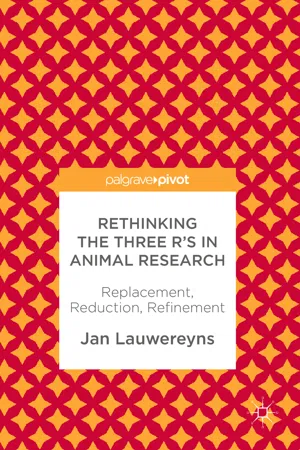
Rethinking the Three R's in Animal Research
Replacement, Reduction, Refinement
- English
- ePUB (mobile friendly)
- Available on iOS & Android
eBook - ePub
About this book
This work challenges the current reliance on "The Three R's" or Replacement, Reduction and Refinement which direct most animal research in the behavioral sciences. The author argues that these principles that were developed in the 1950's to guide the use of animals in research studies are outdated. He suggests that the notions of refinement and reduction are often ill-defined and can be useful only in cases where replacement is impossible.
Information
© The Author(s) 2018
Jan LauwereynsRethinking the Three R's in Animal Researchhttps://doi.org/10.1007/978-3-319-89300-6_11. Introduction
Abstract
Anyone involved in animal research knows the three R’s—Replacement, Reduction, and Refinement. Russell and Burch introduced these groundbreaking principles more than sixty years ago; now, it is time for a reassessment with the aim of improving the ways in which we conduct animal research. The opening chapter lays out the basic premise and perspectives of the book, with brief previews of the chapters.
Keywords
Animal researchAnimal ethicsGuiding principlesI think we can do better in many areas of life. Here, in this short book, I concentrate on the room for improvement in animal research. I am writing this small book of critique for you, dear animal investor (that is what I will call you: animal investor). An animal investor may be any person (or human being, Homo sapiens ) who is actively concerned with animal research—whether it be as a practitioner, a policymaker, or an advocate (for or against). This book provides new ideas and proposals based on the so-called three R’s—Replacement, Reduction, and Refinement—which were first formulated by W.M.S. (“Bill”) Russell and R.L. (“Rex”) Burch in their classic text, The Principles of Humane Experimental Technique (1959/1992). My objective in this book is simple: I aim to explain how we can improve the ethics of animal research. Thus, I offer a scholarly work of thought before action. (The action would have to be joint action, and will happen only if you agree.)
1.1 Building on the Legacy of Russell and Burch (1959/1992)
You do not have to have read Russell and Burch to be able to join the discussion. Most animal investors have not read Russell and Burch. In fact, the book is out of print (1992 reprints are available for roughly 300 US dollars—a price I found too steep, even though I can promise you I am really interested in the topic). An online version exists (courtesy of ALTWEB, “the global clearinghouse for information on alternatives to animal testing”), which should technically be regarded as “accessible”; however, practically, it is difficult to read and requires many clicks. I eventually managed to read many sections of it (diligently, forcing myself, while preparing for this book), but I strongly believe animal investors can benefit from the book without having to read it. Russell and Burch’s classic has served its purpose: it created a legacy. The three R’s have entered the mainstream in the practice and policymaking regarding animal research. Yet, the mainstream did not absorb the original definitions. Instead, if we take a closer look at how the three R’s are being interpreted and applied, we quickly find that the concepts have morphed significantly in their real-world afterlife.
Most animal investors have not read Russell and Burch (1959/1992), but very many of us can name the three R’s. In doing so, we understand them intuitively, in our own ways, often without actually defining them. Here, I aim to rethink the three R’s by pointing out some issues with the original definitions, as well as with some of the later interpretations and applications. The book is structured with four movements to develop a critical assessment of the validity of the three R’s as guiding principles for animal research. To go straight to the core of the argument, I pull Replacement into the foreground as the one principle that requires full priority; in fact, it may be the only purely ethical principle among the three R’s. (When emphasizing the priority of Replacement, I use a revised definition that is broader than the original.) Reduction and Refinement, on the other hand, may have more to do with balancing the economics and quality of science than with ethics. I argue that, if Replacement fails, the proper ethical course of action is to rely on collective decision-making. Only through agreement can we make an ethically valid (utilitarian) case for the need of animal research.
1.2 Four Movements to the Argument
The first movement, which takes place in Chapter 2, considers the historical background and achievements of the work by Russell and Burch (1959/1992). I carefully examine the original definitions of the three R’s, noting how the principles have come to occupy a central position that is broadly accepted by all interested parties. I describe the aims and rationale offered by Russell and Burch, situating these in the context of the late 1950s. I argue that the principles are products of their time, completely in line with the then-prevailing knowledge about and attitudes toward animals in society. A particular point of interest is the concept of “humanity” as applied in the formulation of the three R’s. This is contrasted with more recent ideas about “speciesism” and the moral status of nonhuman animals. Today, the majority of people believe that animals deserve some amount of protection. This seems to imply a cost that weighs in opposition to potential benefits, such as those promised by science. As a case study, I focus on the use of nonhuman primates in basic neuroscience research, from the 1960s to the present. This historical analysis illustrates how the changing context implies a changing perspective on the ethical validity of research. Yet, the three R’s fail as guidelines to translate the changes in context to commensurate changes in conduct. We must analyze this dysfunction of the three R’s.
Chapter 3 presents the second movement in the argument, focusing on a micro-macro analysis of animal research. Viewed at the microscopic level of each individual laboratory, it may appear that researchers work in accordance with the three R’s, choosing the appropriate animal model, aiming to get the smallest sample size needed for any experiment, and continuing to improve the techniques and knowledge extraction. However, turning to the macroscopic level of the entire field, we find mismatches between the individual intentions and overall outcomes. This chapter offers an analysis inspired by the groundbreaking work of Thomas C. Schelling and others on emergent patterns of macro-behavior as a function of micro-motives. Here, I anticipate that the key challenge will be to shift from agency at the microscopic level to agency at the macroscopic level. Such a shift would enable researchers to address, among other things, the key scientific problem of sample size. Following the micro-macro analysis, I offer my revised definitions of the three R’s as principles toward reasonable experimental inquiry, to be orchestrated by the research community.
Chapter 4, home to the third movement in the argument, presents the use of monkeys in research as a particular area of controversy, with a critique of typical arguments offered in public debate. I note the weaknesses of retrospective thinking, the erroneous appeal to necessity, and the unfounded bias against working with human volunteers and rodents. The issues are examined more specifically via three scientific paradigms to illustrate the impasse with the three R’s as guiding principles. One paradigm regards work on the development of a neural control system for robotic arm movement. As a second paradigm, I discuss work on the topic of perceptual decision-making with rats as a putative replacement for research with nonhuman primates. A third paradigm focuses on the topic of the cognitive mechanisms underlying cocaine addiction and relapse in nonhuman primates. The three paradigms allow us to reflect on the resistance by individual researchers, using their limited perspective to put forth misguided claims of irreplaceability of their preferred animal model.
Drawing on the analyses of the previous chapters, I construct an integrative view in Chapter 5, with clear and realistic proposals for the policymaking with respect to the use of animals in research. The aim is to come to a straightforward, internally coherent approach to the use of animals in research, which represents an upgrade of the three R’s. Replacement comes first, as an inherently ethical principle. When Replacement is not possible, the use of animals should be carefully managed on the basis of collective decision-making—that is, at the level of research communities, universities, and funding agencies, but not at the level of individual researchers. This proposal is strengthened through a discussion in terms of opportunity costs (the alternative opportunities that are given up when engaging in a given research project); these are precisely the type of costs that often remain out of consideration when individual researchers design their research projects as autonomous agents, vulnerable to conflicts of interest. I argue that collective decision-making is necessary to ensure that we invest our time, money, and effort in the most optimal way.
The proposal essentially comes down to a macroscopic approach to managing research—an effort in line with recent calls for open science and mega-science, analogous to the Large Hadron Collider and the Human Genome Project. Collective decision-making enables communities to engage in particular animal research projects that seem crucial for important research progress that cannot be obtained through alternative means. Detailed suggestions are made on how to organize the macroscopic approach, through extant research communities and institutes, thinking with the concepts of open science and big science.
1.3 Full Disclosure
At the outset of this scholarly work, I want to note a few particularities about the position from which I write (or about “my voice,” to use a poetical concept). Writing about ethics, I find, requires more than the usual level of attention to the personal dimension, including who I am, where I am coming from, what I know from experience, what I feel, my potential biases, and my prejudices. Thus, relevant information to know about the present writer may include the following.
I am an atheist. I do not adhere to any systematic moral philosophy. Furthermore, I find myself continuously grappling with the concepts of welfare, freedom, and virtue (to name the three approaches to justice, as listed by Sandel, 2009)—thinking I would like all three, but I do not always know what they are or how they line up (or not).
I value science very highly and believe that a knowledge-based society is necessary for welfare, freedom, and virtue.
I think democracy is generally the appropriate form of society. It tends to promote welfare, freedom, and virtue. This is a somewhat shaky thought because democratic processes can occasionally produce adverse effects. An infamous example is Nazi Germany, where the people put Hitler in power. Thus, we must watch over democracy with our own critical devices, speaking up when we note problems; in this vein is my current writing.
I value many forms of life and being (and even inorganic objects) very highly. However, I also have weaknesses: I find myself...
Table of contents
- Cover
- Front Matter
- 1. Introduction
- 2. Concept Fatigue with the Three R’s
- 3. A Mismatch Between Micro-motives and Macro-behavior
- 4. The Monkey Question
- 5. Toward Reasonable Experimental Inquiry
- Back Matter
Trusted by 375,005 students
Access to over 1.5 million titles for a fair monthly price.
Study more efficiently using our study tools.
Frequently asked questions
Yes, you can cancel anytime from the Subscription tab in your account settings on the Perlego website. Your subscription will stay active until the end of your current billing period. Learn how to cancel your subscription
No, books cannot be downloaded as external files, such as PDFs, for use outside of Perlego. However, you can download books within the Perlego app for offline reading on mobile or tablet. Learn how to download books offline
Perlego offers two plans: Essential and Complete
- Essential is ideal for learners and professionals who enjoy exploring a wide range of subjects. Access the Essential Library with 800,000+ trusted titles and best-sellers across business, personal growth, and the humanities. Includes unlimited reading time and Standard Read Aloud voice.
- Complete: Perfect for advanced learners and researchers needing full, unrestricted access. Unlock 1.5M+ books across hundreds of subjects, including academic and specialized titles. The Complete Plan also includes advanced features like Premium Read Aloud and Research Assistant.
We are an online textbook subscription service, where you can get access to an entire online library for less than the price of a single book per month. With over 1.5 million books across 990+ topics, we’ve got you covered! Learn about our mission
Look out for the read-aloud symbol on your next book to see if you can listen to it. The read-aloud tool reads text aloud for you, highlighting the text as it is being read. You can pause it, speed it up and slow it down. Learn more about Read Aloud
Yes! You can use the Perlego app on both iOS and Android devices to read anytime, anywhere — even offline. Perfect for commutes or when you’re on the go.
Please note we cannot support devices running on iOS 13 and Android 7 or earlier. Learn more about using the app
Please note we cannot support devices running on iOS 13 and Android 7 or earlier. Learn more about using the app
Yes, you can access Rethinking the Three R's in Animal Research by Jan Lauwereyns in PDF and/or ePUB format, as well as other popular books in Psychology & Cognitive Psychology & Cognition. We have over 1.5 million books available in our catalogue for you to explore.