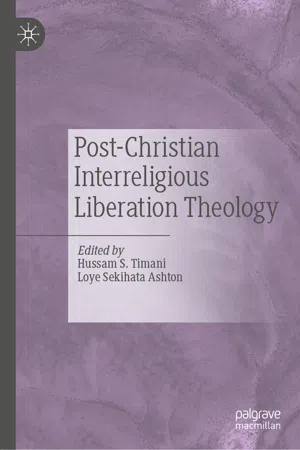
This book explores the ideals of liberation theology from the perspectives of major religious traditions, including Islam, Christianity, Judaism, Buddhism, and the neo-Vedanta and Advaita Hindu traditions. The goal of this volume is not to explain the Christian liberation theology tradition and then assess whether the non-Christian liberation theologies meet the Christian standards. Rather, authors use comparative/interreligious methodologies to offer new insights on liberation theology and begin a dialogue on how to build interreligious liberation theologies. The goal is to make liberation theology more inclusive of religious diversity beyond traditional Christian categories.
eBook - ePub
Post-Christian Interreligious Liberation Theology
- English
- ePUB (mobile friendly)
- Available on iOS & Android
eBook - ePub
Post-Christian Interreligious Liberation Theology
About this book
Information
Topic
Theology & ReligionSubtopic
Christian Theology© The Author(s) 2019
H. S. Timani, L. S. Ashton (eds.)Post-Christian Interreligious Liberation Theology https://doi.org/10.1007/978-3-030-27308-8_11. Introduction
Hussam S. Timani1 and Loye Sekihata Ashton2
(1)
Christopher Newport University, Newport News, VA, USA
(2)
Aoyama Gakuin University, Tokyo, Japan
Hussam S. Timani (Corresponding author)
Loye Sekihata Ashton
This volume explores the ideals of liberation theology from the perspectives of major religious traditions, in particular Islam, Christianity, Judaism, Buddhism, and the neo-Vedanta and Advaita Hindu traditions. Renewed attention to liberation theology with an emphasis on its comparative dimensions is essential and timely. Globalization has created a sharp divide between developed, wealthy nations and the underdeveloped, nonindustrial societies. In the last three decades, there has been an increase in social and economic inequalities between the global north and the global south. Even within nations, not only the middle class has disappeared but also a sharp increase in disparities between the rich and poor has been on the rise. The current age of globalization not only created a wedge between the rich and the poor but it has also led to a sharp increase in the number of the oppressed and the deprived. The age of globalization witnessed the largest mass migration of refugees since World War II. This mass migration from the global south to the global north has created a great divide between the migrants who are seeking safety, economic opportunities, and political freedom in the global north and citizens of host nations. Many come from Muslim nations, these refugees were met with waves of anti-Muslim, anti-immigration rhetoric, not only at the street level but also from top officials who exert political and financial power. The unprecedented rise of populism in the global north and the widespread anti-immigrant, anti-Muslim slogans in the host nations have legitimized and sanctified the stigmatization and criminalization of people seeking shelter from wars and genocides. In this age of increased diversity and proximity between people of different religious and ethnic backgrounds, there is an urgent need for a greater understanding of the other. This project attempts to lay the ground for this understanding.
The literature on liberation theology has been mostly Christian with the exception of a handful of recent works on non-Christian liberation theologies.1 A volume on the interplay between Christian and non-Christian (or interreligious) liberation theology is yet to be written. This volume fills that gap. The goal of this volume is not to explain the Christian liberation theology tradition and then assess whether the non-Christian liberation theologies meet the Christian standards. The goal from our comparative/interreligious methodology is to offer new insights on liberation theology and begin a dialogue on how to build interreligious liberation theologies.
What we are trying to do is to expand the religious concepts of symbolic engagement traditionally used in liberation theology (e.g., “salvation,” “liberation,” “oppression,” “sin,” “injustice,” “oikonomia,” “dignity,” “poverty,” etc.) to contexts and applications outside of Christianity. As such, we want to make liberation theology more inclusive of a religious diversity beyond traditional Christian categories. Given that the political oppression by the economically privileged against the economically marginalized is a global phenomenon, it stands to reason that every religious tradition on the planet will be a stakeholder in advocating theologically for a “preferential option of the poor.” And by theologically we mean to define the term “theology” as an interdisciplinary effort of intentionally critical intellectual reflection by thinkers and justice workers including those from different faith traditions on religious symbols and ideas and how they function to guide the daily life of practitioners of faith. By bringing together these theological scholars and practitioners to reflect in dialogue with one another about how they understand liberation symbols, we are creating opportunities of intersectional exchange that will challenge each individual to rethink how those categories function in their home faith traditions. We are also likely to discover that the core justice issues of economic and political oppression so eloquently identified in the traditional Roman Catholic Latin American liberation theology of the 1970s and 1980s will also have to undergo expansion to include additional foci of contemporary global conflict and oppression. To name but a few, these would include: human rights and dignity with respect to sexual identity and gender equity; environmental justice and climate change; mass migrations and immigration policies; increasingly authoritarian governance models and the retreat of liberal democracies; the eclipse of personal privacy and civil rights in the wake of security threats and religious violence; and the rise of the ethical challenges generated by exponential technology, particularly genetic bioengineering, cloning, automation and robotics, and synthetic digital super intelligence. If, in the end, we find ourselves moving more toward a “post-Christian liberation theology” where one faith tradition no longer holds all of the hermeneutical cards with respect to the need for political activism to alleviate the oppression of the global poor and politically marginalized, then that is fine with us. Our goal is to nurture and cultivate a creative and socially engaged plethora of theologies of interreligious liberation.
While there are already texts that survey the trajectories of liberation theology within the religions of the world as well as those that conceptualize liberation as the meeting place of interreligious dialogue, the distinctive contribution of our volume will be its decentering of Christian liberation theology. This volume gives voice to non-Christian liberation theologies but in comparative perspective with and in relation to Christian liberation theologies. The few books written about liberation theology within the religions begin with the assumption that liberation theology emerged in a Christian context, therefore, all liberation theologies have to be assessed against the Christian yardstick. For example, in the introduction to a volume on liberation theology titled The Hope of Liberation in World Religions, Miguel A. De La Torre, the volume editor, uses Christian terms to define the concept of liberation theology. He writes that liberation is “salvation … [and] to be ‘saved’ … is to be liberated.”2 He adds: “The purpose of the book … is to explore how the theological concepts defined as liberation theology, which to some degree was initially … a Catholic phenomenon, might be manifested within other world faith traditions.”3 The purpose of De La Torre’s volume, therefore, is to show that liberation theologies in the religions of the world are liberative only because they are a manifestation of Christian liberation theology. In an edited volume entitled Pluralism and Oppression: Theology in World Perspective, Jon Sobrino stresses that in the world today “there needs to be a variety of [liberation] theologies since there is variety in our world” and that “not every theology must replicate the liberation theology of Latin America.”4 Our volume is doing exactly that: constructing a variety of interreligious liberation theologies that are not replicate at all of Christian or Latin American liberation theology.
This volume introduces a host of liberation theologies with which some readers, especially in the global north, may be unfamiliar. Since its inception in the 1960s by Catholic priests and theologians, liberation theology has been dominantly Christian. To many scholars, intellectuals, and practitioners in the global north, liberation theology is synonymous with Christian theology. Our volume shatters this perception, as it calls attention to the liberation theologies in other traditions but in conversation with Christian liberation theology. For example, the chapters by Hussam S. Timani, Shadaab Rahemtulla, and Laura Alexander, respectively, familiarize the reader with the emerging Islamic liberation theology as these authors make new scholarly and theoretical interventions into this literature. Timani, for example, introduces a liberation theology based on the Islamic concept of God’s oneness (tawhid) and the Christian doctrine of the Trinity to construct ethical, universal criteria that face the challenges of globalization. Rahemtulla argues that a key challenge of the Muslim liberation theologian is to articulate a radical understanding of Islam that accents the specificity of the Muslim faith and its own distinctive liberative themes. Taking the writings of the pioneering Muslim liberation theologian Farid Esack as a case study, and his centring of the Exodus as a paradigm of liberation in particular, he shows how the epistemic dominance of Christianity can inadvertently manifest itself in Islamic discourse. Alexander argues for human rights conception that allows Christian and Muslim liberation thinkers and practitioners to incorporate human rights into liberation theologies and practices of solidarity as a fundamental aspect of what it means for people to be “liberated,” while retaining theologically grounded conceptions of liberation as both other and more than simply the upholding of rights.
James E. Bo...
Table of contents
- Cover
- Front Matter
- 1. Introduction
- 2. Confessing Tawhid and the Trinity: Towards a Christian–Muslim Theology of Liberation
- 3. The Politics of Paradigms: Liberation and Difference in Islam and Christianity
- 4. Human Rights as “Law of Nations” in Conversation with Contemporary Christian and Islamic Liberation Theologies
- 5. Fixing a God’s Mess: Jewish Tikkun Olam and Interreligious Action
- 6. “Work Is Worship” Swami Vivekananda’s Philosophy of Seva and Its Contribution to the Gandhian Ethos
- 7. “Looking Upon All Beings as One’s Self”: Insights from Advaita Hinduism for Racial Justice Within Christian Theology and Liberative Praxis
- 8. Envisioning a Dharmic Society: Retelling a Traditional Buddhist Tale
- 9. Decolonizing and Indigenizing Liberation Theology
- 10. Mississippi’s Voices Against Extremism Project: A Case Study in Inclusive Interfaith Leadership
- 11. Afterword
- Back Matter
Trusted by 375,005 students
Access to over 1.5 million titles for a fair monthly price.
Study more efficiently using our study tools.
Frequently asked questions
Yes, you can cancel anytime from the Subscription tab in your account settings on the Perlego website. Your subscription will stay active until the end of your current billing period. Learn how to cancel your subscription
No, books cannot be downloaded as external files, such as PDFs, for use outside of Perlego. However, you can download books within the Perlego app for offline reading on mobile or tablet. Learn how to download books offline
Perlego offers two plans: Essential and Complete
- Essential is ideal for learners and professionals who enjoy exploring a wide range of subjects. Access the Essential Library with 800,000+ trusted titles and best-sellers across business, personal growth, and the humanities. Includes unlimited reading time and Standard Read Aloud voice.
- Complete: Perfect for advanced learners and researchers needing full, unrestricted access. Unlock 1.5M+ books across hundreds of subjects, including academic and specialized titles. The Complete Plan also includes advanced features like Premium Read Aloud and Research Assistant.
We are an online textbook subscription service, where you can get access to an entire online library for less than the price of a single book per month. With over 1.5 million books across 990+ topics, we’ve got you covered! Learn about our mission
Look out for the read-aloud symbol on your next book to see if you can listen to it. The read-aloud tool reads text aloud for you, highlighting the text as it is being read. You can pause it, speed it up and slow it down. Learn more about Read Aloud
Yes! You can use the Perlego app on both iOS and Android devices to read anytime, anywhere — even offline. Perfect for commutes or when you’re on the go.
Please note we cannot support devices running on iOS 13 and Android 7 or earlier. Learn more about using the app
Please note we cannot support devices running on iOS 13 and Android 7 or earlier. Learn more about using the app
Yes, you can access Post-Christian Interreligious Liberation Theology by Hussam S. Timani, Loye Sekihata Ashton, Hussam S. Timani,Loye Sekihata Ashton in PDF and/or ePUB format, as well as other popular books in Theology & Religion & Christian Theology. We have over 1.5 million books available in our catalogue for you to explore.