- English
- ePUB (mobile friendly)
- Available on iOS & Android
eBook - ePub
About this book
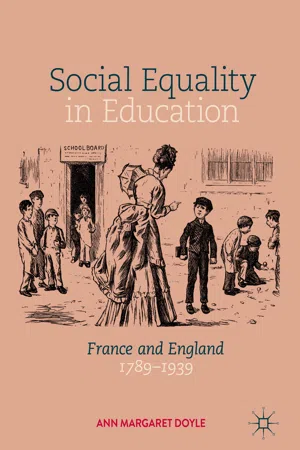
This book explores the development of education in France and England from the French Revolution to the outbreak of World War II. The author uses social equality as a framework to compare and contrast the educational systems of both countries and to emphasise the distinctive ideological legacies at the heart of both systems. The author analyses how the French Revolution prompted the emergence of an egalitarian ideology in education that in turn was crucial for propagating the values of equality, patriotism and unity. In tandem, the volume discusses the equally dramatic consequences of the Industrial Revolution for English society: while England led the world by 1800 in trade, commerce and industry, a strict form of liberalism and minimal state intervention impeded the reduction of educational inequality. This pioneering book will be of interest to students and scholars of educational equality as well as the history of education in France and England.
Information
Topic
EducationSubtopic
Comparative Education© The Author(s) 2018
Ann Margaret DoyleSocial Equality in Educationhttps://doi.org/10.1007/978-3-319-94721-1_11. Introduction
Ann Margaret Doyle1
(1)
UCL Institute of Education, University College London, London, UK
Ann Margaret Doyle
Social equality is an important area of research and, given that the social contexts in which educational systems operate are largely based on inequality, it is particularly relevant to education. The ever-increasing gap between rich and poor in the current period particularly since the financial crisis of 2007–8 makes this topic urgently relevant today. The liberal justification for large disparities of wealth on the basis that they open up material conditions for the improvement of the well-being of all has become increasingly difficult to sustain. Furthermore, in a period when liberal democracy, long promoted as the ideal political system, is being called into question in some quarters, it is beneficial to explore two liberal societies, France and England, where the reduction of social inequality in education has followed different paths and to analyse this process historically.
This book explores the development of education in France and England from the French Revolution to the outbreak of World War II (The selection of this time period will be explained further on in this chapter). It focuses on social equality as a framework to compare and contrast both countries educational systems and to explain their distinctiveness. This study emphasises the ideological legacy at the heart of both systems for understanding this difference i.e. republicanism in France and liberalism in England. In tracing this 150 years of educational evolution, it is striking how many similarities to present-day educational policy and debate may be observed. Take for example, the pronouncements made from time to time by different administrations in England to extend grammar schools – although their extension has been banned since 1998. This fits well with the liberal and utilitarian ethos of the 19th and early 20th century which was that of providing educational resources to those most capable of utilising them. Similarly, in France in January 2015, the government launched plans for a major mobilization in schools in favour of secularism and the values of the Republic which corresponds with republicanism.
France and England1 have many similarities in terms of (i) their polity: liberal democracies with representative and accountable institutions and multiple political parties; (ii) their economy: advanced level of capitalist development; and (iii) their welfare and education: universal health care and education with democratization of secondary education initiated in the 1960s. Nevertheless, there are major differences between them which are manifested in their education systems and this difference is a consequence of the variation in their political and cultural histories. In order to understand this variation, a comparative historical analysis of both countries is most appropriate. The comparative method is most advantageous for understanding this relationship in a systematic and coherent way and comparison is particularly helpful in uncovering the similarities and variations between educational systems.
Much of the research on French and English education systems has focused on their distinctiveness in terms of: exemplars of centralised and decentralised systems respectively (Archer 1979), different modalities of state formation (Green 1990), and different forms of curricular control (Broadfoot 1985). The outcome of interest here is different and has never been researched systematically before. It focuses on the key concept of social equality and sets out to explain the variation in how both countries have gone about reducing social inequality in education. It will explore whether a discourse of egalitarianism has more importance in French than in English education. It will also investigate whether educational policies in both countries have helped reduce social inequality in education or not. While some reference will be made to all levels of education, the focus here will be mainly on primary and secondary levels.
This emphasis on equality in France can be traced back to the French Revolution (1789–1799) which was a critical conjuncture (Mahoney 2000) in French history and extremely consequential for the trajectory followed afterwards. The values of equality and secularism, which came to the fore during the revolutionary period continue to underpin the French education system. It is claimed here that events during this critical period gave rise to a revolutionary ideology which has persisted and has had a major influence on educational policy particularly in relation to social equality in education. In contrast to this, liberalism has had the most enduring influence on English education and allied to this the political and economic doctrine of laisssez-faire, emphasising voluntarism and self-help. This can also be traced back to the end of the 18th century which was a period of great significance for England, marking as it did the beginning of its dominance as a commercial and industrial world power. This was also a critical period in English history and of major consequence for the trajectory followed there both politically and for education. It will be argued that a liberal ideology has persisted to the present although this has alternated, particularly following World War II, with a more universal discourse allied to the welfare state. Liberalism has remained the more dominant discourse which comes to the fore particularly in times of crisis. As a result, equality was not a founding principle of the education system; it has evolved more pragmatically in relation to the more inequitable aspects of the education system.
This book sets out to show how these trajectories have differed over the period from 1789 to 1939 and to explain the reasons for this variation with its consequent impact on the outcome of interest i.e. the reduction of social inequality in education . This is an under-researched area of research, as no other substantial work carries out a systematic study into how France and England differ in relation to the reduction of social inequality in education . It will not only compare and contrast these educational systems in relation to this outcome of interest but will also put forward explanatory factors to explain it. The explanatory factors are identified on the basis of a thorough examination of the literature. As social equality in education is strongly influenced by societal forces external to education, the literature examined here is based on political, sociological and historical as well as educational research. These resources will inform the chapters and sections of this study which relate to these areas. The ideological legacy of republicanism and liberalism is a major factor used here to explain the variation in how both countries go about reducing social inequality in education and represents the originality of my contribution to comparative educational research. Here ideology is treated, not as an abstract concept, but as to how it is manifested within the socio-economic relations of production within the capitalist system and in the political relations within society. For that reason social class alliances are also analysed here as an explanatory factor. The difference between the nature of the state in both countries is also examined and its influence on educational inequality is also tested within the historical period under review here.
The aim of this book is to explain through comparative historical analysis, the variation in how France and England have gone about reducing social inequality in education. It is concerned with the way in which political ideologies in both countries have impacted on social equality in education and why a discourse of egalitarianism is stronger in French than in English education. The next section provides a brief outline of the methods used for carrying out this research and identifies three factors which are used throughout to explain this variation.
The Method Used
The method of enquiry used to answer the major question posed above is drawn from comparative historical sociology. Comparative history has for long been associated with sociological enquiry because of the general usefulness of looking at historical trajectories in order to study social change (Skocpol and Somers 1980; Mahoney and Rueschmeyer 2003). The founders of the social sciences, such as Marx and de Tocqueville, pursued comparative history as a source of investigation, as did the classic scholars of sociology, for example, Durkheim and Weber . All of these were preoccupied with the immense changes brought about by the transitions from traditional social forms to modern industrial capitalism. Mahoney and Rueschmeyer define comparative historical analysis by its concern for causal analysis, its emphasis on processes over time, and by its use of systematic and contextualised comparison. Thus, this mode of analysis is concerned with the ‘explanation and the identification of causal configurations that produce major outcomes of interest’. Furthermore, it deals with events, such as, social revolutions, state formation and dictatorships, which are seen as processes that unfold over time.
Comparative historical analysis is the approach taken here. It is distinct from history in that historians write at a lower level of generalization. The latter use mainly archival an...
Table of contents
- Cover
- Front Matter
- 1. Introduction
- 2. Further Elaboration of the Hypotheses
- 3. Towards a Definition of Social Equality in Education
- 4. The Development of Education in France from 1789 to 1870
- 5. The Development of Education in England from 1789 to 1870
- 6. France: The Third Republic 1870–1939
- 7. England: 1870–1939
- 8. Conclusion
- 9. Reflections on the More Recent Period
- Back Matter
Trusted by 375,005 students
Access to over 1.5 million titles for a fair monthly price.
Study more efficiently using our study tools.
Frequently asked questions
Yes, you can cancel anytime from the Subscription tab in your account settings on the Perlego website. Your subscription will stay active until the end of your current billing period. Learn how to cancel your subscription
No, books cannot be downloaded as external files, such as PDFs, for use outside of Perlego. However, you can download books within the Perlego app for offline reading on mobile or tablet. Learn how to download books offline
Perlego offers two plans: Essential and Complete
- Essential is ideal for learners and professionals who enjoy exploring a wide range of subjects. Access the Essential Library with 800,000+ trusted titles and best-sellers across business, personal growth, and the humanities. Includes unlimited reading time and Standard Read Aloud voice.
- Complete: Perfect for advanced learners and researchers needing full, unrestricted access. Unlock 1.5M+ books across hundreds of subjects, including academic and specialized titles. The Complete Plan also includes advanced features like Premium Read Aloud and Research Assistant.
We are an online textbook subscription service, where you can get access to an entire online library for less than the price of a single book per month. With over 1.5 million books across 990+ topics, we’ve got you covered! Learn about our mission
Look out for the read-aloud symbol on your next book to see if you can listen to it. The read-aloud tool reads text aloud for you, highlighting the text as it is being read. You can pause it, speed it up and slow it down. Learn more about Read Aloud
Yes! You can use the Perlego app on both iOS and Android devices to read anytime, anywhere — even offline. Perfect for commutes or when you’re on the go.
Please note we cannot support devices running on iOS 13 and Android 7 or earlier. Learn more about using the app
Please note we cannot support devices running on iOS 13 and Android 7 or earlier. Learn more about using the app
Yes, you can access Social Equality in Education by Ann Margaret Doyle in PDF and/or ePUB format, as well as other popular books in Education & Comparative Education. We have over 1.5 million books available in our catalogue for you to explore.