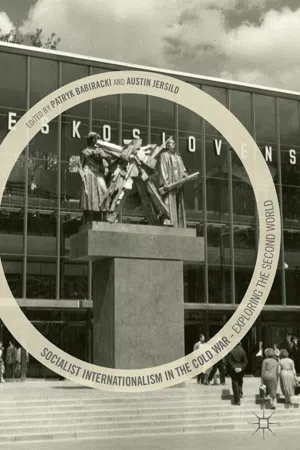
This volume examines how numerous international transfers, circulations, and exchanges shaped the world of socialism during the Cold War. Over the course of half a century, the Soviets shaped politics, values and material culture throughout the vast space of Eurasia, and foreign forces in turn often influenced Soviet policies and society. The result was the distinct and interconnected world of socialism, or the Socialist Second World. Drawing on previously unavailable archival sources and cutting-edge insights from "New Cold War" and transnational histories, the twelve contributors to this volume focus on diverse cultural and social forms of this global socialist exchange: the cults of communist leaders, literature, cinema, television, music, architecture, youth festivals, and cultural diplomacy. The book's contributors seek to understand the forces that enabled and impeded the cultural consolidation of the Socialist Second World. The efforts of those who created this world, and the limitations on what they could do, remain key to understanding both the outcomes of the Cold War and a recent legacy that continues to shape lives, cultures and policies in post-communist states today.
eBook - ePub
Socialist Internationalism in the Cold War
Exploring the Second World
- English
- ePUB (mobile friendly)
- Available on iOS & Android
eBook - ePub
Socialist Internationalism in the Cold War
Exploring the Second World
About this book
Information
© The Author(s) 2016
Patryk Babiracki and Austin Jersild (eds.)Socialist Internationalism in the Cold War 10.1007/978-3-319-32570-5_11. Editors’ Introduction
Patryk Babiracki1 and Austin Jersild2
(1)
University of Texas at Arlington, Arlington, TX, USA
(2)
Old Dominion University, Norfolk, VA, USA
There was “no single practice of communism,” emphasizes Maria Todorova in a discussion of memory and the socialist world, but there were “similar trajectories” and similar blueprints, institutions, and experiences that made what we are calling in this volume the “Second World,” something distinctly different from either the “First” or “Third.” 1 The growth in the study of memory, “socialist consumerism,” and difficult post-socialist “transitions,” as well as the more popular forms of Ostalgie in film, exhibits, and literature, all attest to the existence of the distinct and shared experience of socialism. 2 Even Berlin, famously remaking itself today as the new capital of the new Germany, routinely offers glimpses of historical and social experience more familiar to residents of Warsaw, Budapest, and Moscow than to its many tourists and recently arrived former West Germans. “From here [Berlin] to Vladivostok,” recounted journalist and writer Anna Funder, more than a decade ago, there was “linoleum and grey cement, asbestos and prefabricated concrete,” in her disillusioned view, all part of “Communism’s gift to the built environment.” 3
The “Second World” had distinctive characteristics, evolved over time, featured transnational exchange and was itself a product of transnational exchange, was highly significant to the evolution of the Cold War, and continues to shape this vast “Eurasian” space today. 4 Topics of study are routinely difficult to confine within the boundaries of a particular nation-state. 5 We refer to this world as “the Second World,” both in order to convey its distinctness and interconnectedness and to mark the historiographic shift of which this volume is part. Multiple forms of exchange, shared experiences, perceptions, and dilemmas that crossed boundaries and borders, both transnational or within the socialist world and transsystemic or across the “Iron Curtain,” shaped the history and evolution of the Second World. 6 Travel and exchange and its significance repeatedly emerge as topics for exploration in this volume, including attention to important foreign visitors and foreign influences, and the circulation within the Second World of ideas, practices, and norms. As Wendy Bracewell pointed out, “travels within the fraternal countries of the Socialist bloc were simultaneously travels abroad (new sights and sounds, different ways of doing things, perhaps even a different range of goods on sale) and travels at home (a shared socialist and internationalist ideology).” 7 Travel and transnational influences both affirmed the shared identity of the Second World and led to its fragmentation.
Few observers referred to the Second World during the Cold War; when they did, it was to use it as shorthand for the Soviet-type planned economies. 8 Early works tended to focus on those transnational institutions and practices that were central to policing, stability, and order. 9 The policies of the Soviet Union, at least initially, seemed designed to curtail rather than facilitate exchange and communication, as mystified East Europeans sometimes complained. 10 The primary Soviet interest was initially focused on the creation of a secure buffer zone against a future attack from the West. Over time, however, the Soviet and East European communists also thoroughly transformed their countries’ landscapes, languages, fashions, rhythms of industrial production, identities, and values. By the 1970s, the inhabitants of the Second World came to share a distinct culture, which eventually outlived socialist political systems; it is also a culture that has been rarely acknowledged, much less “theorized.” 11 These social and cultural aspects of the Second World lie at the center of our volume.
The Second World was both a promise and a problem to Moscow, especially in the era of reform and “peaceful coexistence” that emerged after the death of Stalin in 1953. “Let us verify in practice whose system is better,” Nikita Khrushchev proclaimed in India. “We say to the leaders of the capitalist states: ‘Let us compete without war.’” 12 The improved functioning and health of the Bloc was a crucial part of the official Soviet effort to “catch up with and surpass” the United States. Khrushchev and numerous reformers highly valued the skills and experiences of especially countries such as East Germany, Poland, Hungary, and Czechoslovakia, and many East Europeans were pleased that their advanced standing within the Second World was finally recognized. 13 Polish sociologists, for example, were proud that they were in a position to offer their Soviet counterparts exposure to the “sociologists of the West.” 14 The virtues of Eastern Europe were on display at the Czechoslovak pavilion at the World’s Fair in Brussels in 1958. 15 The presentation of consumer culture (restaurants, tourist trips, fashion, hot springs in Karlový Vary, restored churches in Prague), industrial productivity (Kaplan turbines), and high culture (the Czech Philharmonic) displayed by the Czechoslovaks was much approved by the Soviets. 16 When Czechoslovak Party First Secretary, Antonín Novotný, was in Moscow July 2–4, 1958, he listened to Khrushchev praise the “contribution of Czechoslovakia to the development of commerce between the east and the West.” Soviet Minister of Defense, Kliment Voroshilov, visited the Czechoslovak pavilion, and pronounced it “splendid, superb, simply magnificent.” 17
The problem was that the region was also now a source of instability for the Soviet Union itself. 18 Czechoslovakia was quiet in 1956, but the “events” in Poland and Hungary that summer and fall alarmed communist party leaders and many others throughout the Bloc. In internal but frank debate, the distant Chinese, high officials, diplomats, advisers, and others worried about the weaknesses of the Soviet model, the advising program, Socialist Bloc exchange, the planning process, and even posed questions about the role of historic Russian imperialism (although now generally formulated as “great power chauvinism”). Khrushchev’s optimism about the superiority of Soviet socialism seemed especially unconvincing in countries long exposed to alternatives. Exchange and travel also ironically meant greater East European exposure to the Soviet Union, confirming the assumptions of many in the region about traditional Russian backwardness in comparison to lands further West.
These developments even form the background to the Sino-Soviet split, so dramatically expressed in the sudden withdrawal of numerous Soviet advisers, teachers, and industrial specialists from China in the summer of 1960. “Socialist consumerism” and dissent were not what the Chinese Communist Party had in mind when Chairman Mao opted to “lean to one side” and “learn from the Soviet Union.” 19 From the perspective of the evolution of the Bloc, the frustration was mutual: the Chinese were frustrated by forms of economic, industrial, and cultural development that they felt did not address the needs of China’s special “experience,” and Soviet officials were concluding that the future of the Bloc belonged in further engagement with the more industrial and consumer societies of the West rather than the agrarian and undeveloped East. 20 Reform, peaceful coexistence, and further engagement with the West appeared to have dangerous consequences. The Chinese watched these matters closely throughout the 1950s, and along with the Albanians and North Koreans, eventually denounced both the Soviets and their fraternal allies for their “revisionist” betrayal of the October Revolution. 21 The Second World found itself in competition with both the West and the Chinese in the developing conflicts of the Third World, an important new arena of Cold War competition. 22
In part, the Second World was held together by common claims about the virtues and special characteristics of “internationalism.” As is well known, ninet...
Table of contents
- Cover
- Frontmatter
- 1. Editors’ Introduction
- 1. The Second World Under Stalin
- 2. Post-Stalinist Entanglements in the Second World
- 3. Second World Cultures
- 4. Internationalism and the Iron Curtain
- 5. Between the Second and the Third Worlds
- Backmatter
Trusted by 375,005 students
Access to over 1.5 million titles for a fair monthly price.
Study more efficiently using our study tools.
Frequently asked questions
Yes, you can cancel anytime from the Subscription tab in your account settings on the Perlego website. Your subscription will stay active until the end of your current billing period. Learn how to cancel your subscription
No, books cannot be downloaded as external files, such as PDFs, for use outside of Perlego. However, you can download books within the Perlego app for offline reading on mobile or tablet. Learn how to download books offline
Perlego offers two plans: Essential and Complete
- Essential is ideal for learners and professionals who enjoy exploring a wide range of subjects. Access the Essential Library with 800,000+ trusted titles and best-sellers across business, personal growth, and the humanities. Includes unlimited reading time and Standard Read Aloud voice.
- Complete: Perfect for advanced learners and researchers needing full, unrestricted access. Unlock 1.5M+ books across hundreds of subjects, including academic and specialized titles. The Complete Plan also includes advanced features like Premium Read Aloud and Research Assistant.
We are an online textbook subscription service, where you can get access to an entire online library for less than the price of a single book per month. With over 1.5 million books across 990+ topics, we’ve got you covered! Learn about our mission
Look out for the read-aloud symbol on your next book to see if you can listen to it. The read-aloud tool reads text aloud for you, highlighting the text as it is being read. You can pause it, speed it up and slow it down. Learn more about Read Aloud
Yes! You can use the Perlego app on both iOS and Android devices to read anytime, anywhere — even offline. Perfect for commutes or when you’re on the go.
Please note we cannot support devices running on iOS 13 and Android 7 or earlier. Learn more about using the app
Please note we cannot support devices running on iOS 13 and Android 7 or earlier. Learn more about using the app
Yes, you can access Socialist Internationalism in the Cold War by Patryk Babiracki, Austin Jersild, Patryk Babiracki,Austin Jersild in PDF and/or ePUB format, as well as other popular books in History & Eastern European History. We have over 1.5 million books available in our catalogue for you to explore.