eBook - ePub
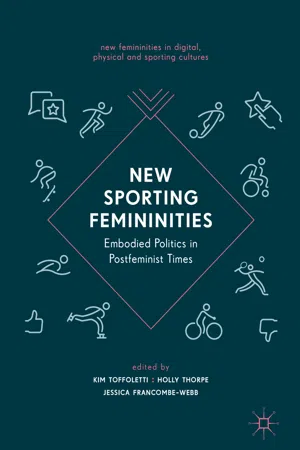
New Sporting Femininities
Embodied Politics in Postfeminist Times
- English
- ePUB (mobile friendly)
- Available on iOS & Android
eBook - ePub
New Sporting Femininities
Embodied Politics in Postfeminist Times
About this book
Information
Print ISBN
9783319724805
Subtopic
Gender Studies© The Author(s) 2018
Kim Toffoletti, Holly Thorpe and Jessica Francombe-Webb (eds.)New Sporting FemininitiesNew Femininities in Digital, Physical and Sporting Cultureshttps://doi.org/10.1007/978-3-319-72481-2_11. Femininities, Sport and Physical Culture in Postfeminist, Neoliberal Times
Kim Toffoletti1 , Jessica Francombe-Webb2 and Holly Thorpe3
(1)
School of Humanities and Social Sciences, Deakin University, VIC, Australia
(2)
Department for Health, University of Bath, Bath, UK
(3)
Faculty of Health, Sport and Human Performance, University of Waikato, Waikato, New Zealand
Keywords
PostfeminismPhysical cultureSporting femininityFeminismIntroduction
This book explores the changing nature of gendered sporting subjectivities, bodies, practices, politics, agency and experiences in a period characterised by postfeminist sentiments and the emergence of new strands of feminism including popular feminism and fourth-wave feminism. The decision to put this collection together came about at a moment of considerable academic and popular debate about the renewed interest in feminism in political, cultural and corporate life (Gill, 2016; McRobbie, 2015; Rottenberg, 2014). This growing visibility of feminism has been tied to wider cultural shifts over the past decade, which have seen women and girls reimagined as agentic, empowered and active subjects in globalised economies (Dobson & Harris, 2015). For a sustained period throughout the ‘90s and into the 2000s, the celebration of “girl power” was largely understood in the Western popular mindset as part of the “postfeminist” view of feminism as redundant in an era of women’s apparent “equality” (Harris, 2004; McRobbie, 2009). This is despite ongoing feminist activism to address issues facing diverse groups of women globally in tandem with rigorous academic engagement with various forms of feminist praxis and critique. In more recent times we have witnessed feminism, as well as a more general interest in women’s issues, brought to the fore of public debate, complicating the idea that feminism is “over.” Online media forms, such as social media, have been instrumental in facilitating the increased visibility granted to women’s and girls’ endeavours, achievements and activities, as well as drawing attention to the ongoing systemic issues and everyday challenges encountered by women. A resurgence of feminist activism online (Keller, 2015) has been a notable feature of recent times, as has a growing awareness of intersectionality, cultural difference and gender and sexual diversity in relation to discussions of women’s issues in more mainstream media forums.
The domains of contemporary sport, fitness and physical activity offer many instances that speak to the complexities of our current post/anti/resurgent/multiple feminist moment. Given the centrality of the body to women’s experiences of active recreation, studies of movement and physical cultures ideally lend themselves to explorations of the cultural practices and everyday processes through which contemporary postfeminist femininities are produced. Not only are women participating in a wider range of sports than in generations past, but women’s athletic endeavours are being given greater prominence and attention, as noted in Simone Fullagar’s insightful foreword to this collection. The heightened focus on women’s sporting achievements can be seen in the naming of 2015 as the “Year of Women in Sports,” with African American tennis player Serena Williams recognised as “Sportsperson of the Year” by Sports Illustrated (SI) magazine (see Cooky, this volume). On its front cover, Williams appears resplendent in a black lace leotard and heels. Seated on a gilt throne, she casually slings her leg over the armrest and looks assertively down the camera lens. Williams’ “crowning moment” on the cover of SI does not elicit a straightforward response. In a postfeminist moment this rendering of “empowered femininity” could be interpreted as both “sexist” and as an act of “freely-chosen,” “self-pleasing,” feminine expression.
Existing alongside the proliferation of glamorous images of celebrity sportswomen are debates in the popular media concerning the sustained injustices experienced by women athletes worldwide, such as gender testing, disparities in pay, quality and amount of media coverage. While this indicates that discussions of gender inequality are back on the agenda, popular discussions around women in sport expose some of the challenges raised by postfeminist rhetoric that emphasises women’s individualism , choice and agency, often at the expense of actions directed towards redressing structural inequalities and advocating social change (Gill, 2016). Indeed, the multiple discourses circulating around women in sport generate complex and often contradictory messages that belie binary understandings of women as “empowered” and “equal” participants in sport, or as “victims” of a patriarchal sports industry. Indeed, it is within this dynamic context that we call for a focus on postfeminist times in the study of women’s sport and physical activity. In locating our consideration of sporting femininities in the context of “postfeminist times,” we do so in order to trouble both the idea that feminism is “over,” as well as accounts that suggest it is “back.”
Conceptualising Postfeminism in Sport and Physical Culture
Our conceptualisation of postfeminism in this collection acknowledges the multiple uses and meanings of the term, as well as its intersections and overlaps with other feminist sensibilities and movements. Determining what constitutes postfeminism is not clear-cut and while it remains a contested term, feminist understandings of postfeminism can be broadly characterised along the following lines: as an epistemological position; a historical shift; a backlash against feminism; or a cultural sensibility (Gill, 2007). In keeping with the approach of feminist analysts of postfeminism such as Angela McRobbie (2009) and Rosalind Gill (2016), we view postfeminism through a critical lens. That is, postfeminism does not simply stand for the rejection of feminism or a period after feminism but constitutes a distinctive cultural condition that invites and produces new articulations of femininity. A number of feminist critics have sought to identify the characteristics of postfeminism, noting its emphasis on women’s empowerment and independence, the expression of femininity as a bodily property, the centrality of consumption to women’s acts of bodily maintenance and transformation, and a preoccupation with expressions of hetero-sexy femininity that “extends beyond the body to constitute a remaking of subjectivity” (Gill, 2016, p. 613). These shifts are understood relative to a proliferating media culture and viewed as inextricably linked to ideologies of neoliberalism and consumerism . Within these frameworks, assertions of women’s personal “choice” become the dominant mode through which gender “equality” is understood, taking precedent over more collectivist forms of politics (Genz & Brabon, 2012; Gill, 2007; Gill & Scharff, 2011; McRobbie, 2009; Tasker & Negra, 2007). Although “the tendency has been to understand post-feminism itself as Western,” more recent intersectional approaches to postfeminism have exposed how postfeminist logics can account for racial and other forms of difference (Doeskun, 2015, p. 961; see also Butler, 2013; Samie & Toffoletti, Chap. 5).
Viewed in this wa...
Table of contents
- Cover
- Front Matter
- 1. Femininities, Sport and Physical Culture in Postfeminist, Neoliberal Times
- Part I. Postfeminism and the Sport-Media-Industrial Complex
- Part II. Everyday Athletic Girls and Women Negotiating Postfeminism
- Part III. Postfeminism in Online Sport and Fitness Spaces
- Erratum to: New Sporting Femininities
- Back Matter
Trusted by 375,005 students
Access to over 1.5 million titles for a fair monthly price.
Study more efficiently using our study tools.
Frequently asked questions
Yes, you can cancel anytime from the Subscription tab in your account settings on the Perlego website. Your subscription will stay active until the end of your current billing period. Learn how to cancel your subscription
No, books cannot be downloaded as external files, such as PDFs, for use outside of Perlego. However, you can download books within the Perlego app for offline reading on mobile or tablet. Learn how to download books offline
Perlego offers two plans: Essential and Complete
- Essential is ideal for learners and professionals who enjoy exploring a wide range of subjects. Access the Essential Library with 800,000+ trusted titles and best-sellers across business, personal growth, and the humanities. Includes unlimited reading time and Standard Read Aloud voice.
- Complete: Perfect for advanced learners and researchers needing full, unrestricted access. Unlock 1.5M+ books across hundreds of subjects, including academic and specialized titles. The Complete Plan also includes advanced features like Premium Read Aloud and Research Assistant.
We are an online textbook subscription service, where you can get access to an entire online library for less than the price of a single book per month. With over 1.5 million books across 990+ topics, we’ve got you covered! Learn about our mission
Look out for the read-aloud symbol on your next book to see if you can listen to it. The read-aloud tool reads text aloud for you, highlighting the text as it is being read. You can pause it, speed it up and slow it down. Learn more about Read Aloud
Yes! You can use the Perlego app on both iOS and Android devices to read anytime, anywhere — even offline. Perfect for commutes or when you’re on the go.
Please note we cannot support devices running on iOS 13 and Android 7 or earlier. Learn more about using the app
Please note we cannot support devices running on iOS 13 and Android 7 or earlier. Learn more about using the app
Yes, you can access New Sporting Femininities by Kim Toffoletti, Holly Thorpe, Jessica Francombe-Webb, Kim Toffoletti,Holly Thorpe,Jessica Francombe-Webb in PDF and/or ePUB format. We have over 1.5 million books available in our catalogue for you to explore.