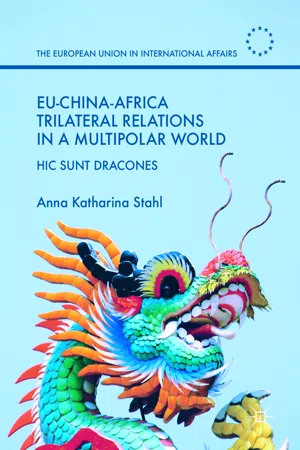
As suggested by the subtitle “Hic Sunt Dracones”, this book studies an original phenomenon that has not yet been fully grasped by scholars or policymakers. The Latin phrase “hic sunt dracones” − literally, “here are dragons”1 – was used on ancient European maps to denote unexplored territories and as a warning of the potential dangers in these parts of the world. By placing a monstrous creature like a dragon on an uncharted territory, the drafters of the maps represented in symbols an artistic, albeit reasonable, justification for fearing and avoiding the territory in question, where in truth the one thing instinctively feared is what is unknown or what is beyond the current level of understanding.
The specific reference to a dragon can be explained by the fact that it was a recurring presence in the mythology and folklore of many European cultures, where it was depicted as a terrifying creature. At the same time, dragons were a recurring figure in ancient Chinese folklore and art. Whereas in the European imagination dragons are malevolent, in China dragons are generally perceived as benevolent animals. Nowadays, the dragon has become a widespread symbol of China throughout the world. Deborah Bräutigam’s book The Dragon’s Gift, which is considered to be one of the standard works related to China’s contemporary Africa policy, is a prominent example (Bräutigam 2009). It is also important to note that the use of the expression “hic sunt dracones” by medieval cartographers followed what is said to be a Roman practice to denote dangerous territories on maps with “hic sunt leones”, literally, “here are lions”. Whereas the dragon has become a symbol for China, the lion is commonly associated with Africa.
While it is generally assumed that Europeans first explored the world, there is new historical evidence2 questioning this assertion of European supremacy. According to several sources, Chinese travellers were the first to travel to unexplored parts of the world, including Africa (Snow 1988; Menzies 2002). In the early fifteenth century, navigator Zheng He – who is considered the “Chinese Columbus” – commanded several maritime expeditions to unexplored regions, ranging as far as the coast of East Africa (Snow 1988). These early voyages under the Ming dynasty went down in history as China’s original encounter with Africa. The first Chinese explorers behaved quite differently from the Europeans, who arrived in Africa seventy years later (Snow 1988, 29). Unlike the European powers, the Chinese explorers did not have any intention to colonise land beyond the Middle Kingdom and, therefore, had no interest in the African continent itself. Instead, Admiral Zheng He came to Africa “to fill his ships with animals (including lions), spices and tokens of allegiance” and therefore “had no reason to stay” (Snow 1988, 32). Thus, the early Chinese explorers were perceived as less aggressive, leaving “little visible mark on Africa” (Snow 1988, 29,32).
After the collapse of the Ming dynasty, China isolated itself from the world and China’s initial presence in Africa would have probably been forgotten if it hadn’t reappeared on the continent in the 1950s and 1970s. During the decolonisation period, China supported several African leaders in liberating themselves from European rule (Larkin 1971).
Already in the 1980s, Philip Snow wrote in his well-known book The Star Raft that China’s reappearance in Africa “must be considered an important chapter in the history of our times” as “it is a reminder that we in the West can no longer always expect to occupy the centre-stage” (Snow 1988, xv). Moreover, he foresaw that “Africa may not always be weak” and “as African countries slowly become more stable and more prosperous, their leaders can be expected to grow increasingly impatient with the continent’s unhappy state of disunity and dependence on Western funds and advice” (Snow 1988, xv).
As predicted by Philip Snow, since the turn of the century we have witnessed a re-emergence of China on the international scene and a more prosperous African continent. From the point of view of the European Union (EU) this is a major challenge as it implies a transition towards a new, unknown international system. Initially, the European response to China’s current engagement in Africa was characterised by the same “exaggerated fears” over China’s interaction with African countries in the 1950s and 1960s (Snow 1988, xiv). This European apprehension can be explained by the fact that China’s interests in Africa and African sympathy with China are generally seen as “an implicit threat to the West’s supremacy” (Snow 1988, xiv). Yet, this assumption is slowly changing and there are growing calls for engaging China as a “partner” or “responsible stakeholder” in Africa’s development and security (Bräutigam 2009; Raine 2009). The development of trilateral relations between the EU, China and Africa provides a prominent example of the new trend of engagement with emerging powers. Although they have remained largely unnoticed, EU-China-Africa trilateral relations are an important illustration of how traditional players like the EU are responding to the changing global world through efforts of building new strategic partnerships with rising powers.
This research project has been motivated by the need to better understand the elements driving the transformation of the current world order. In order to provide a more detailed analysis of the current transformation of the international system, this book examines the uncharted territory of EU-China-Africa trilateral relations as a new trend in international politics of the twenty-first century. Moving beyond the consideration of the direct consequences of China’s presence for Africa’s political and socio-economic development, this book looks at the broader implications of growing Sino-African relations and the rise of emerging powers. In particular, it focuses on the role of the EU in the emerging multipolar world order and its efforts to engage rising powers. Considering the lack of thorough research of the process of engagement with emerging powers, this book provides a detailed examination of the EU’s foreign policy in the context of the emerging multipolar world order. By adopting a European research perspective, it sheds light on the difficulties faced by the EU in engaging China and Africa.
1.1 The EU and the Emerging Multipolar World
The twenty-first century is characterised by an unprecedented shift in global power, which could potentially lead to the formation of a new, so-called multipolar world order. Since the end of the Cold War, and in particular after the turn of the century, a shift in the centre of gravity of the international system can be identified. In International Relations (IR) scholarship this is reflected in the literature on the distribution of power, which relies on the concept of polarity to express the distribution of power (Mansfield 1993). IR literature refers to the current power transition as a shift from a “unipolar” system with the USA as the only superpower (Wohlforth 2009; Wohlforth 1999; Krauthammer 1990/1991; Waltz 1964; Monteiro 2014; Jervis 2009) or a “bipolar” world with the USA and the EU as two global powers (Moravcsik 2010, 172) to a new system of multiple poles. This tectonic shift from the past is described as a system “multipolarity”. The concept of multipolarity describes a world order, which is characterised by multiple centres of power or poles and where no single dominates (Herolf 2011, 6; Haass 2008). In recent years, the expression of a “multipolar world” has become widely used to reflect a global rebalancing of economic and political forces (Geeraerts 2011; De Vasconcelos 2008; Wade 2011). Due to the presence of a set of new international players, American and European economic and political dominance in the world is declining.
A key challenge related to multipolarity concerns the classification of the different “centres of power” or “poles”. In fact, the identification of the different factors determining the “rise and fall of great powers” has been a key concern among IR scholars (Kennedy 1987). Since the turn of the century, academics and policymakers have entered into a lively debate to identify the new “poles” of the current world order (Missiroli and O’Sullivan 2013). In 2001, the chairman of Goldman Sachs Jim O’Neill made an important contribution to the debate by introducing the concept of “BRIC”. BRIC stands as an acronym for Brazil, Russia, India and China, which O’Neil identified as emerging economic global powerhouses that would fundamentally change the nature of the world economy (O’Neill 2001). Over the years, the shorthand BRIC and now BRICS (including South Africa) has become a commonly used analytical category in IR research (Armijo 2007; Gross...