How were social media posts, scripted speeches, traditional news media and political cartoons used and understood during the Brexit campaign? What phrases and metaphors were key during and after the 2016 Brexit referendum? How far did the Remain and Leave campaigns rely on metaphor to engage with supporters in communicating their political positions? These questions, and many others, can be answered only through a systematic analysis of the actual language used in relation to Brexit by the different parties involved. By drawing on a range of data sources and types of communication, and presenting them as 'frames' through which individuals can attempt to understand the world, the author provides the first book-length examination of the metaphors of Brexit. This book takes a detailed look at the rhetorical language behind one of the major political events of the era, and it will be of interest to students and scholars of linguistics and political science, as well as anyone witha special interest in metaphor, rhetoric, Brexit, or political communication more broadly.
- English
- ePUB (mobile friendly)
- Available on iOS & Android
eBook - ePub
About this book
Information
© The Author(s) 2019
J. Charteris-BlackMetaphors of Brexithttps://doi.org/10.1007/978-3-030-28768-9_11. Cherries on the Cake?
Jonathan Charteris-Black1
(1)
Faculty of Arts, Creative Industries and Education, University of the West of England, Bristol, UK
Introduction: Metaphor and Brexit
In some pubs the word ‘Brexit’ is treated as a swear word and you have to buy a round of drinks every time the word is mentioned because of its potential to initiate conflict. The topic invites positions to be taken, makes people angry and turns them away from reason. Some are annoyed by the very word ‘Brexit’ itself: the media driven blend of ‘Britain’ and ‘exit’ to produce the simple, croaked, bi-syllabic sound conceals a reality that leaving the European Union is the most complex international negotiation on which the United Kingdom has ever embarked. The word ‘exit’ is found in public building such as a cinema or a hotel and implies there is a simple choice between being ‘in’ or ‘out’ of something but the reality is different. Metaphors have dominated thought about ‘Brexit’ in the deliberations of politicians and media discussions and they have influenced the private reflections of individuals. Supporters of Leave found evidence of ‘collaborators’, ‘saboteurs’ or ‘traitors’ who were committing ‘treason’ while the Remain ‘side’ referred to their opponents as ‘wolves in sheeps clothing’. But in their urge to persuade, advocates of both sides commonly forgot that these were metaphors at all, so that political positions ended up in a linguistic maze—few even understood the meaning of the endlessly repeated ‘Backstop’—a maze without an ‘exit’. Is it any wonder that ‘Brexit’ became a taboo word?
In this book I illustrate how metaphor was ‘weaponised’ in discussions surrounding Britain’s decision to leave the European Union and how it contributed to the tone of the Brexit debate. Sometimes this tone has been savage with medieval words such as ‘betrayal’ and ‘traitor’ becoming everyday vocabulary. But once we look under the surface we find that understanding the metaphors of the Brexit debate provides rich insight into the profoundly moral outlooks that influenced both those who sought to leave the European Union and those who wished to remain in it. Members of the public, opinion formers and politicians relied on metaphor as a way of framing political issues and creating persuasive stories and allegories. Understanding these better helps us to understand not only what divided the two sides but also what both sides held in common: a belief and desire that they could improve their country.
In this opening chapter I illustrate how metaphors influenced the Brexit debate in various ways. When Boris Johnson claimed “My policy on cake is pro having it and pro eating it” he was combining moral reasoning with humour. When political cartoonists represented Britain or the European Union as the ‘titanic’ they were contesting allegories in which the same symbols expressed opposing perspectives. When Theresa May insisted on her ‘red lines’ she was using a familiar idiom to mean: ‘I am not prepared to negotiate on these issues’—strong language that was not reflected in the strength of her political position. In the second half of the chapter I introduce various linguistic and psychological concepts that contribute to an understanding of the pervasive and persuasive role of metaphor in the discourse of Brexit.
Reasoning Through Humour: “Having Your Cake and Eating It”
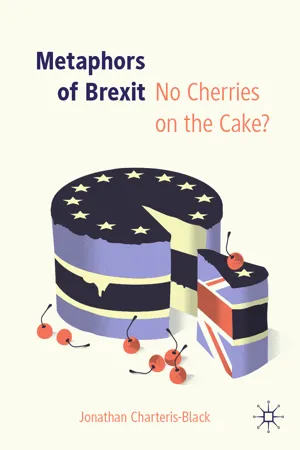
When asked in an interview in April 2019 about being accused of wanting ‘to have his cake and eat it’ Boris Johnson said: “Well, I still am. Let’s not beat about the bush here. My policy on cake is still pro having it and pro eating it.” 1 This metaphor expressed an argument that on withdrawing from the European Union Britain would still be able to retain many of the benefits that it had enjoyed as a member. But its morality was contested through different interpretations of the metaphor. Belgian MEP Philippe Lamberts told Theresa May: “I think it will be interesting to see how things develop but you cannot have your cake and eat it”. 2 In the following month an eagle-eyed reporter photographed a handwritten note, carried by Julia Dockerill, an aide to the Tory vice-chair Mark Field stating: “What’s the model? Have your cake and eat it”. To pro-Europeans this implied that the UK wanted to retain all the main benefits that came from being a member of the European Union (henceforth the EU). It sought to restrict EU immigration and leave the Single Market, while ensuring that frictionless trade with the EU would continue after Brexit: but this appeared to the EU negotiators as wanting to ‘have it both ways’. 3 The idiomatic proverb therefore pointed to a moral dilemma that was familiar to other Europeans; in French the proverb took the form: “Wanting to have the butter and the money from the butter, and the milkmaid’s ass”, suggesting that the moral dilemma was not an especially British one.
The moral contest was reasoned through other ‘food’ metaphors, such as when a German political thinker, Ulrike Guérot, wrote on Politico:
Yes, we indulged you while you were part of the European Union. We gave you your rebate. We allowed you to sit on the sidelines of Schengen and the euro. But those days are over, now that you’ve decided to go. It’s time for you to stop acting like a spoiled child and accept that you can’t have everything both ways - departure from the EU but membership in programmes like Galileo and Erasmus; an Irish border that’s both closed but somehow open; access to the single market without its most important conditions; the freedom of movement and no oversight by the European Court of Justice; your pick of the European cherry tree, without bothering to water the soil or tend to its branches. 4
Here after likening Britain to a ‘spoilt child’, she introduced the idea that Britain was ‘cherry picking’ by wanting to select only beneficial aspects of EU membership. She extends the cherry tree metaphor to take into account the necessary preconditions for growing the ‘European cherry tree’. In this regard she was framing the EU as an essentially productive enterprise nurtured with love and care. These two different metaphors—‘having cake’ and ‘cherry picking’—offer the similar moral argument that choosing only pleasurable actions while avoiding the painful ones is morally naive. The metaphors allude to each other and create an intertextual relationship precisely because they share the same moral reasoning: they accuse the person who is ‘cherry picking’ or trying to ‘have their cake and eat it’ of being selfish by putting their own interests before those of others. They are both usually indicative of an EU perspective on the British position on Brexit, as shown in the ‘Metaphor Brexicon’ at the end of this book.
Like many fixed expressions taken from popular culture it is often their traditional sense that may be played with for rhetorical effect. The meaning of the proverb is not clear because it would seem quite logical to ‘have your cake and eat it’—until we realise that the phrase was originally in reverse order: “Wolde ye bothe eate your cake, and haue your cake?” 5 This meant that you could no longer have your cake after you have eaten it because there would no longer be any cake left to eat. Normally speakers accuse others of ‘cherry picking’ or ‘wanting to have their cake and eat it’ but sometimes if they were being self-ironic they could represent their own actions and positions in this way. Boris Johnson is the most notable political exponent of the art of metaphor and his image is constructed partly through humour and embodied forms of persuasion. He reversed the moral judgement implied in the idiom with his version: “My policy on cake is pro having it and pro eating it” and this worked well because food is a topic that he has a reputation for exploiting humourously. He rejected the bias implied by the original proverb by expressing it in terms of rational self interest: it is quite logical to want to possess cake and to eat it. His version of the proverb came to symbolise a defiant and unyielding position associated with supporters of a so-called ‘hard’ Brexit.
The ‘cake’ metaphor was taken further by the British Chancellor of the Exchequer Philip Hammond, who, while speaking at the annual conference of the Christian Democrats Economic Council, quoted the economist and finance minister Ludwig Erhard, that:
…a compromise is the art of dividing a cake in such a way that everyone believes he has the biggest piece. 6
Hammond went on to argue that there is “some applicability to the Brexit negotiations, although I try to discourage talk of ‘cake’ amongst my colleagues” and went on ...
Table of contents
- Cover
- Front Matter
- 1. Cherries on the Cake?
- 2. The Lexicon of the Referendum
- 3. I Love My Country
- 4. ‘Take Back Control’: Invaded Nation or Sovereign Nation?
- 5. Conceptual Metaphors: ‘Eurocrats Living in the Brussels Bubble’
- 6. The Metaphors of Boris Johnson
- 7. Happy Families and Special Relationships
- 8. Are Marriages Made in Heaven?
- 9. Animals: Moral Intuition and Moral Reasoning
- 10. Metaphors for Brexit
- Back Matter
Trusted by 375,005 students
Access to over 1.5 million titles for a fair monthly price.
Study more efficiently using our study tools.
Frequently asked questions
Yes, you can cancel anytime from the Subscription tab in your account settings on the Perlego website. Your subscription will stay active until the end of your current billing period. Learn how to cancel your subscription
No, books cannot be downloaded as external files, such as PDFs, for use outside of Perlego. However, you can download books within the Perlego app for offline reading on mobile or tablet. Learn how to download books offline
Perlego offers two plans: Essential and Complete
- Essential is ideal for learners and professionals who enjoy exploring a wide range of subjects. Access the Essential Library with 800,000+ trusted titles and best-sellers across business, personal growth, and the humanities. Includes unlimited reading time and Standard Read Aloud voice.
- Complete: Perfect for advanced learners and researchers needing full, unrestricted access. Unlock 1.5M+ books across hundreds of subjects, including academic and specialized titles. The Complete Plan also includes advanced features like Premium Read Aloud and Research Assistant.
We are an online textbook subscription service, where you can get access to an entire online library for less than the price of a single book per month. With over 1.5 million books across 990+ topics, we’ve got you covered! Learn about our mission
Look out for the read-aloud symbol on your next book to see if you can listen to it. The read-aloud tool reads text aloud for you, highlighting the text as it is being read. You can pause it, speed it up and slow it down. Learn more about Read Aloud
Yes! You can use the Perlego app on both iOS and Android devices to read anytime, anywhere — even offline. Perfect for commutes or when you’re on the go.
Please note we cannot support devices running on iOS 13 and Android 7 or earlier. Learn more about using the app
Please note we cannot support devices running on iOS 13 and Android 7 or earlier. Learn more about using the app
Yes, you can access Metaphors of Brexit by Jonathan Charteris-Black in PDF and/or ePUB format, as well as other popular books in Social Sciences & Linguistics. We have over 1.5 million books available in our catalogue for you to explore.