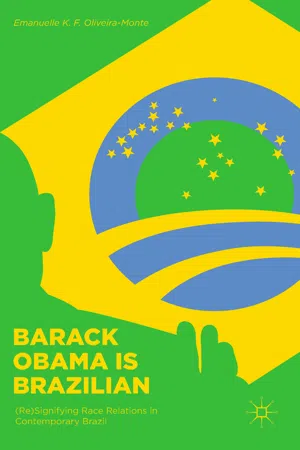
This book examines US President Barack Obama's characterizations in the Brazilian media, with a specific focus on political cartoons and internet memes. Brazilians celebrate their country as a racial democracy; thus the US works as its nemesis. The rise of a black president to the office of the most prominent country in the global, political, and economic landscape led some analysts to postulate that the US was living in a post-racial era. President Obama's election also had a tremendous impact on the imaginary of the African Diaspora, and this volume investigates how the election of the first black US president complicates Brazilians' own racial discourses. By focusing on three events—Barack Obama's election in 2008, his visit to Brazil in March 2011, and the aftermath of the US espionage on the Brazilian government in 2013—Emanuelle K. F. Oliveira-Monte analyzes Barack Obama's shifting portrayals that confirm and challenge Brazilian racial conceptions projected upon his figure.
eBook - ePub
Barack Obama is Brazilian
(Re)Signifying Race Relations in Contemporary Brazil
- English
- ePUB (mobile friendly)
- Available on iOS & Android
eBook - ePub
Barack Obama is Brazilian
(Re)Signifying Race Relations in Contemporary Brazil
About this book
Information
Print ISBN
9781137594808
Subtopic
American Government© The Author(s) 2018
Emanuelle K. F. Oliveira-MonteBarack Obama is Brazilianhttps://doi.org/10.1057/978-1-137-58353-6_11. Introduction
Emanuelle K. F. Oliveira-Monte1
(1)
Department of Spanish and Portuguese, Vanderbilt University, Nashville, TN, USA
Keywords
Post-racial“Black lives matter”African diaspora“Yes, We can”Barack Obama’s election to the American presidency in 2008 sparked a renewed interest in the theme of race, not only in the Americas, but also worldwide. In the United States, the election of a black man to the office of the most prominent country in the global, political, and economic landscape led some analysts to postulate that North America was living in a post-racial era; that is, theoretically the nation had forged an environment that surpassed racial preference, discrimination, and prejudice (Ifill; Kinder and Dale-Riddler; Tesler and Sears).
Obama’s road to the presidency goes beyond the personal story of a middle-class mixed-race boy who through education ascended socially and landed in the White House. Obama is an open sign, in which people’s expectations, anxieties, and hopes are placed and displaced in order to respond to society’s needs and perspectives. In “The Tale of Two Obamas,” David Theo Golberg analyzes the “two Obamas in the body of Barack” (201): Obama the Person and Obama the Phenomenon. In a so-called post-racial era, Golberg underscores that Obama emerges as a new face of America: self-describing as a “mutt” and a “mongrel,” he becomes the “quintessential American … unabashed and unashamed about his resonant mestizaje ” (202). The “new Negro” is thus refashioned into the post-racial politician, as an African–American who goes beyond black, in whom the American trumps the African, pushing the latter category to the background. In his article, Goldberg reminds of the dangers of post-raciality; in other words, post-raciality is about new markets and new identities, a multiplication and proliferation of racial inputs, which turn multiplicity into denial: a denial of historical racial conditions and contemporary constraints, or a denial of “the legacy of racially driven inequalities” (203). In the neoliberal landscape, the intersection of race and class renders the once black subject whiter by virtue of his class standing (203), but offers no respite from society’s real oppressive conditions. In this new post-racial era, the African–American is never American enough, continuing to be the “other.” Goldberg concludes by affirming that post-racialism creates a pernicious society in which racism does not emerge in formalized state policy, but appears more diffused in the social body (and is, in this sense, not less damaging): “racisms are manufactured and manifested more silently, informally, [seen as] expressions of private preference schemes … reproducing the given and seemingly gone” (211).
Obama’s rise to the presidency led American scholars and the general public to reflect on the new meaning(s) of race in America, which was revealed to be “a new” that had more of the same. In poor communities, black people remained oppressed, and, outside their perimeters, they were quickly reminded that, no matter their privileged class status, they were still confined to stereotyped representational schemes. Racial tensions continued to be visible during Obama’s presidency; in fact, they acutely escalated in the last years of his mandate. Racial profiling and killings of black citizens at the hands of police have brought tensions to a boiling point, leading to riots (such as the one in Ferguson, Missouri, following the death of eighteen-year-old Michael Brown on August 9, 2014) and the formation of the movement “Black Lives Matter” (after George Zimmerman was acquitted of the murder of seventeen-year-old Trayvon Martin). The movement is a call to black people to
actively resist our dehumanization, … a call to action and a response to the virulent anti-Black racism that permeates our society. Black Lives Matter is a unique contribution that goes beyond extrajudicial killings of Black people by police and vigilantes.When we say Black Lives Matter , we are broadening the conversation around state violence to include all of the ways in which Black people are intentionally left powerless at the hands of the state. We are talking about the ways in which Black lives are deprived of our basic human rights and dignity. (“About the Black Lives Matter Network”)
“Black Lives Matter” placed racial tensions once more at the core of U.S. human rights debates. In the Obama era, racism outmaneuvered post-raciality, demonstrating that the election of a black president did not bring a less bigoted social reality. Still, Obama’s symbolic appeal persists, even after he has left power. Going beyond American national politics, his election also had a tremendous impact on the imaginary of the African Diaspora. What did Obama’s victory mean to Africa, a continent plagued by authoritarianism and profound economic inequalities? Even prior to the Afro-American candidate’s victory, Cameroonian writer Alain Patrice Nganang 1 announced that he was campaigning for Obama and celebrated the candidate as “his brother”: “je me sois dit qu’il m’était important d’aller battre champagne pour mon frère, car après tout, Obama est mon frère.” [I told myself that it was important to go and campaign for my brother, because after all, Obama is my brother.]
Brotherhood is, therefore, expressed not only by the color of the skin or African ancestry, but—and most importantly—by the hope for change, locally and globally. Nevertheless, a shadow of doubt is cast when the Cameroonian writer poses the intriguing question “Et si Obama était camerounais?” In this article, “And What If Obama Were Cameroonian?” published in June 2008, Nganang notes that despotism in Cameroonian politics renders this proposition impossible. The established ruler would quickly crush an opposing Cameroonian Obama, as happened with economist Celestine Monga, who was imprisoned for criticizing President Paul Biya in an open letter in 1991. Biya ascended to power in 1983, after the resignation of President Ahmadou Ahidjo, and remains in the Cameroonian presidency today. Nganang, therefore, concludes that in Cameroonian politics, the racially and democratically charged credo “Yes, We Can” would be displaced by the oligarchical, repressive word “power,” thereby indicating the impossibility of forging a true Diasporic democracy in the African nation.
Also in the post-election setting, Mozambican writer Mia Couto 2 published in November 2009 “E Se Obama Fosse Africano?” [What If Obama Was African?], an article that saluted Obama’s victory. Like Nganang, Couto perceives Obama’s victory as a symbol of hope and change :
Os africanos rejubilaram com a vitória de Obama. Eu fui um deles. Depois de uma noite em claro, na irrealidade da penumbra da madrugada, as lágrimas corriam quando ele pronunciou o discurso de vencedor. … Na noite de 5 de Novembro, o novo presidente norte-americano não era apenas um homem que falava. Era a sufocada voz da esperança que se reerguia, liberta dentro de nós. Meu coração tinha votado, mesmo sem permissão: habituado a pedir pouco, eu festejava uma vitória sem dimensões. Ao sair à rua, minha cidade havia se deslocado para Chicago, negros e brancos comungando de uma mesma surpresa feliz. (209)[Africans rejoiced with Obama’s victory. I was one of them. After staying up all night, in the unreality of the penumbra of the dawn, tears ran (down my face) when he gave his victorious speech. … On the night of November 5, the new North American president was not only a man who spoke. He was the suffocated voice of hope that reemerged, freed inside of us. My heart had voted, even without permission: I used to ask for little, I celebrated a victory without dimensions. When I went to the streets, my city had moved to Chicago, blacks and whites sharing the same happy surprise].
Despite rejoicing this “happy surprise,” the Mozambican writer, much like his Cameroonian colleague, asserts the impossibility of an African Obama ever reaching power. This imaginary candidate would face insurmountable challenges on the road to the presidency of any African country. For example, the established ruler would employ any type of non-democratic strategy to keep his power, such as changing the constitution to extend his mandate or limiting the opposition candidate’s access to the media (Mia Couto 211). Most interesting, nevertheless, is that Obama’s biracial status would be a political handicap: “Sejamos claros: Obama é negro nos Estados Unidos. Em África ele é mulato. … [O] novo presidente americano seria vilipendiado em casa como representante dos ‘outros’, dos de outra raça.” [Let’s be clear: Obama is black in the United States. In Africa, he is a mulatto. … The new American president would be scorned at home as the representative of the “others,” of the ones of the other race.] (212) His mixed heritage, therefore, makes him an “unauthentic African,” whitening him in the eyes of the general public.
The question of whether Obama is a black or mulatto man is central to his mutable identity. Obama would refer to himself mostly as black, but at times also hint that he is a mulatto , playing with this dual racial register and bringing more malleability to his racial status. In this sense, when considering Obama, black and mulatto (or biracial) will be used interchangeably in this study, as this represents the flexibility of Obama’s own racial register. This investigation analyzes an ever-changing Obama, who oscillates between being a “cosmopolitan mulatto” and a “black icon,” categories that play extremely well within Brazil’s flexible racial system and that country’s notion of social harmony.
Undoubtedly, the 2008 American election captured the hearts and imagination of the entire globe; hence, Alain Patrice Nganang and Mia Couto expressed the feelings that populations experienced on the African continent. But what about Brazil, a country that has traditionally promoted its image of “racial paradise”? This current study proposes that Obama’s victory complicated the supposed harmonious balance of Brazilian racial discourse. International scholars have long investigated race relations in the United States and Brazil, frequently comparing and contrasting these two racial systems (see Gilberto Freyre ; Carl Degler ; Thomas Skidmore ; Florestan Fernandes ; Carlos Hasenbalg 1985, 1992, 1999; Nelson do Valle Silva ; and more recently Edward Telles , just to name a few). Since the redemocratization period, Brazilian academics, the black movement, and certain segments of civil society have been challenging the notion of racial democracy . In the midst of these new racial debates, Obama poses Brazilians with a new dilemma. To Brazilians he is “uma verdadeira batata quente,” a hot potato, leading them to face the realities of their own racial system.
Would it be possible for this country to elect a black president committed to Afro-Brazilians and marginalized segments of the population? Or is racial democracy forever destined to be a myth, an appeasing discourse that, in reality, relegates blacks to society’s lower strata? In the market of racial relations, Brazilians have always considered the United States as the undesirable model, a society marked by profound racial violence and segregation, whereas Brazil emerges as a nation that has embraced all races and ethnicities, and that has always been known for its racial tolerance and absence of racism . However, the election of a black candidate to the highest office of the most powerful nation in the world has been revealed to be a conundrum for Brazil, as this nation is faced with the possibility of considering the candidacy and election of a black president. In the land of presumed racial harmony, would it be possible to have an Afro-Brazilian president, identified with black discourse and demands? In this sense, what did Obama’s victory mean to Brazil, a country in which over 50% of the population is black?
This manuscript seeks to delve into the abovementioned questions, while examining Obama’s depictions in the Brazilian media, especially vehicles of political humor, the charges políticas [political cartoons]. In the visual representations analyzed, another set of questions arises. How is Obama portrayed? What elements of Brazil’s racial conceptions are projected upon Obama’s figure? Does Obama confirm or challenge the Brazilian racial representations’ imaginary? In a country where the myth of racial democracy has been systematically challenged by the black movement, and yet has demonstrated a tremendous enduring power, what does the election of a black American president represent? How do Brazilians (re)signify their own racial discourses in light of Obama’s victory? Barack Obama Is Brazilian delves into these intriguing questions, revealing a continuous dialogue between the United States and Brazil, a dialogue in which racial categories are continuously rearticulated and reformulated.
This investigation seeks to demonstrate that Obama’s depictions either confirm or challenge Brazil’s racial relations imaginary. In this sense, if Brazil could not elect a black president, Brazilians had to show how Obama was not really American, but in reality a “true” Brazilian, if not by his nationality, then by his “essence.” To that end, Barack Obama Is Brazilian examines how Brazilians rearticulated Obama’s rise to power in light of their own racial perceptions, anxieties, and aspirations, using various types of cultural products, from the Brazilian Portuguese translation of Obama’s Dreams from My Father to political cartoons and Internet memes. Ultimately, this study intends to dialogue with the rich tradition that compares racial systems in Brazil and the United States, examining how their dynamics affect both nations. In this sense, the constant process of contrasting/comparing produces an intense dialogue on racial perceptions and representations between these two countries.
Chapter 2, “Obama Dreams of Brazil: A Mulatto in the Land of Racial Democracy ,” is subdivided into three sections. The first sectio...
Table of contents
- Cover
- Frontmatter
- 1. Introduction
- 2. Obama Dreams of Brazil: A Mulatto in the Land of Racial Democracy
- 3. Barack Obama Is Brazilian
- 4. Obama and Dilma in Love: Race and Gender in the Realm of Political Humor
- 5. “Our” Candidate Obama: Barack Obama in the Brazilian Elections
- 6. Conclusion
- Backmatter
Trusted by 375,005 students
Access to over 1.5 million titles for a fair monthly price.
Study more efficiently using our study tools.
Frequently asked questions
Yes, you can cancel anytime from the Subscription tab in your account settings on the Perlego website. Your subscription will stay active until the end of your current billing period. Learn how to cancel your subscription
No, books cannot be downloaded as external files, such as PDFs, for use outside of Perlego. However, you can download books within the Perlego app for offline reading on mobile or tablet. Learn how to download books offline
Perlego offers two plans: Essential and Complete
- Essential is ideal for learners and professionals who enjoy exploring a wide range of subjects. Access the Essential Library with 800,000+ trusted titles and best-sellers across business, personal growth, and the humanities. Includes unlimited reading time and Standard Read Aloud voice.
- Complete: Perfect for advanced learners and researchers needing full, unrestricted access. Unlock 1.5M+ books across hundreds of subjects, including academic and specialized titles. The Complete Plan also includes advanced features like Premium Read Aloud and Research Assistant.
We are an online textbook subscription service, where you can get access to an entire online library for less than the price of a single book per month. With over 1.5 million books across 990+ topics, we’ve got you covered! Learn about our mission
Look out for the read-aloud symbol on your next book to see if you can listen to it. The read-aloud tool reads text aloud for you, highlighting the text as it is being read. You can pause it, speed it up and slow it down. Learn more about Read Aloud
Yes! You can use the Perlego app on both iOS and Android devices to read anytime, anywhere — even offline. Perfect for commutes or when you’re on the go.
Please note we cannot support devices running on iOS 13 and Android 7 or earlier. Learn more about using the app
Please note we cannot support devices running on iOS 13 and Android 7 or earlier. Learn more about using the app
Yes, you can access Barack Obama is Brazilian by Emanuelle K. F. Oliveira-Monte in PDF and/or ePUB format. We have over 1.5 million books available in our catalogue for you to explore.